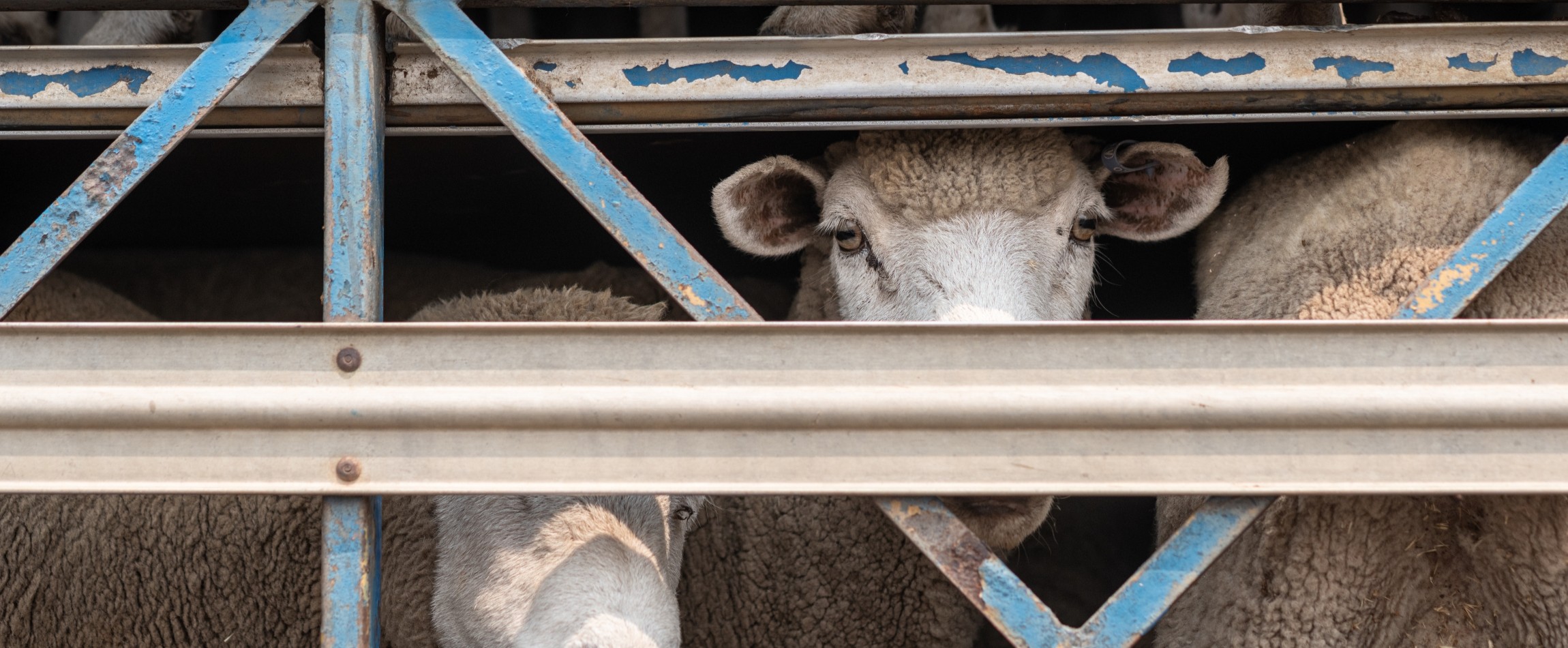
The Hidden Costs Of Live Animal Export


While advocates have long raised welfare concerns about the long-distance live export of farmed animals, some industry groups argue that the trade is an economic necessity. This innovative report from Human Behaviour Change for Life, commissioned by Eurogroup for Animals, challenges this narrative by building a comprehensive business case for transitioning to a carcass-only trade. The researchers sought to provide an evidence-based comparison of the economic, environmental, and social impacts of exporting live animals versus meat.
To conduct their analysis, the researchers used a multi-pronged approach that included a review of existing literature, interviews with stakeholders, and data modeling. The core of the study is a detailed economic and environmental model that compares two scenarios for the well-established trade route of farmed sheep from Portugal to Israel:
- Scenario 1 (live export): Young sheep, weighing around 40 kilograms, are transported live by sea from Portugal to Israel. Upon arrival, they’re brought to a feedlot to be fattened to a slaughter weight of 65 kilograms before being killed.
- Scenario 2 (carcass trade): Sheep are raised until they reach a weight of 65 kilograms and slaughtered in Portugal. Their frozen carcasses are then shipped to Israel for processing.
A Clear Winner: The Carcass Trade
The modeling revealed that the carcass trade is more efficient on every major metric.
Economically, transporting live animals was found to be almost 2.5 times more expensive than transporting carcasses. The total cost to deliver one kilogram of meat to a processing facility in Israel was €3.94 in the live export scenario versus just €1.65 in the carcass trade scenario. This represents a potential savings of €2.29 per kilogram. The cost difference is largely driven by the inefficiencies of maritime transport for live animals. A cargo ship can carry almost 60 times more meat in the form of frozen carcasses than a specialized livestock vessel can carry live animals.
Environmentally, the live trade has a significantly larger footprint. The model calculated that per kilogram of meat, the live export scenario generates nearly six times more carbon dioxide-equivalent emissions and uses almost seven times more diesel fuel than the carcass trade scenario.
From an animal welfare perspective, the carcass trade is also the better option. By avoiding the immense stress of a long-distance sea journey, animals experience lower mortality rates (1.02% versus 1.29%). They also reach their slaughter weight about nine days faster because they don’t have to recover from weight loss caused by transport stress.
Social And Economic Opportunities
The report also found that a transition to a carcass trade would create social and economic benefits in both Portugal and Israel. In Portugal, the live export industry is a recent development (since 2015) that’s primarily benefited large, international corporations, sometimes at the expense of small, traditional farmers. Since the country’s slaughterhouses are currently working at just one-third of their capacity, a shift to processing animals domestically would boost the local economy and create jobs.
In Israel, the reliance on live imports contributes to extremely high retail prices for meat, which in turn encourages an unregulated and potentially unsafe “black market” for slaughter. Importing cheaper carcasses could make professionally inspected, safer meat more accessible to consumers. A potential hurdle is the need for Kosher slaughter, but the report notes this is a logistical challenge, not an insurmountable barrier. While Portugal currently lacks Kosher-certified slaughterhouses, other E.U. countries like Spain already have them and successfully export Kosher meat to Israel.
Time To End The Live Trade?
This report provides powerful, evidence-based arguments against the live trade of farmed animals. Animal advocates can use these findings to challenge the claim that live export is economically necessary. The data shows the opposite is true: it’s a financially inefficient system that costs nearly 2.5 times more than a carcass trade.
Advocates can build a broader coalition for change by emphasizing not just animal welfare, but also the significant economic and environmental benefits of switching to a carcass-only trade. The report shows that a transition could also support local farmers and economies in both exporting and importing countries, with benefits for animals, people, and the planet.
This summary was drafted by a large language model (LLM) and closely edited by our Research Library Manager for clarity and accuracy. As per our AI policy, Faunalytics only uses LLMs to summarize very long reports (50+ pages) that are not appropriate to assign to volunteers, as well as studies that contain graphic descriptions of animal cruelty or animal industries. We remain committed to bringing you reliable data, which is why any AI-generated work will always be thoroughly reviewed by a human.