
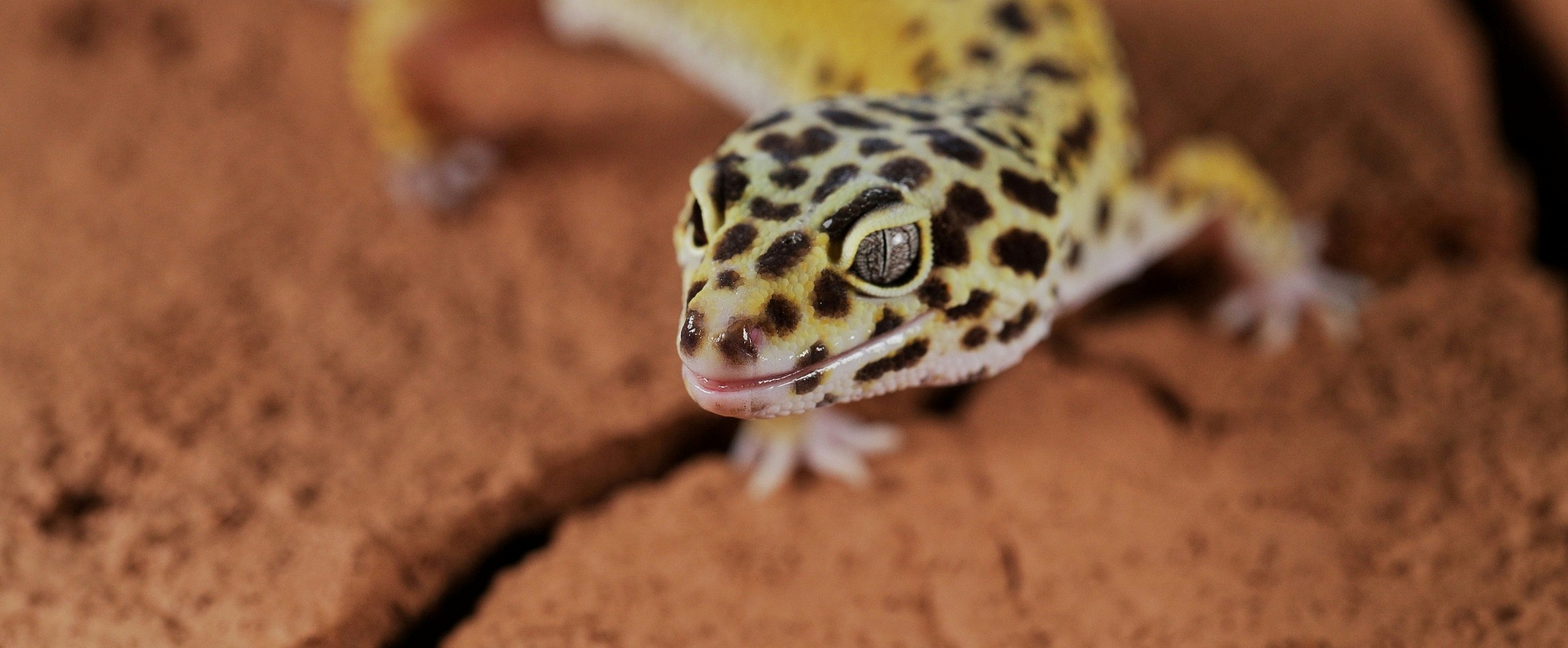
Improving Leopard Gecko Welfare Through Environmental Enrichment


Leopard geckos may have a reputation for being chill critters, but they deserve higher quality care than their “starter pet” label suggests. Because they might be many people’s first reptile companion, it’s even more important to spread awareness on how to keep them happy and healthy.
How an animal behaves is often a reflection of how they feel. We know from existing research on mammals and birds that providing interesting and dynamic environments for animals in captivity allows them to engage in more natural behaviors and ultimately experience better welfare.
Less is known about the needs of reptiles and how introducing complexity in their environments may improve well-being. Research suggests that not all environmental changes improve welfare. In this study, the authors wanted to see how different levels and types of long-term environmental enrichment affected the behavior and welfare of leopard geckos.
The researchers rotated six leopard geckos (one male and five females) between three housing environments, with the geckos experiencing each environment for four weeks.
The Three Environments
All three enclosures were the same size and set up as follows:
- The standard environment contained just “the basics,” including a small rock hide, a small water bowl, and newspaper ground cover.
- The enriched non-naturalistic environment included four different hiding spaces, a water bowl large enough for the gecko to lie in, fake plants, and a ground mixture made of topsoil and sand.
- The enriched naturalistic environment was the same as the enriched non-naturalistic environment, except it had real plants and live invertebrates (springtails, woodlice, mealworms, and earthworms) to break down the organic matter.
All environments included heat, lighting, and bowls containing calcium, a common dietary supplement for leopard geckos.
The Three Tests
Gecko welfare was assessed using three measures:
- Behavioral observations: The researchers observed the geckos’ behavior in each environment by reviewing 30-minute video recordings captured three times a day.
- Behavioral anxiety tests: When a gecko had finished their four weeks in each environment, the researchers placed them in a new environment and presented a novel object. Previous research suggests that leopard geckos’ and other reptiles’ behavior in new situations can indicate their anxiety levels.
- Preference test: Once a gecko had rotated through all three environments, the researchers placed them in a box connected to three terrariums, each replicating the three previous conditions, for 24 hours.
For the behavioral observations and anxiety tests, the researchers measured how long or how often each gecko performed certain behaviors. They compared gecko behaviors between the standard and enriched housing conditions and then, if they found a difference, between the naturalistic and non-naturalistic housing conditions. For the preference test, they measured how much time each gecko spent in each terrarium.
For Leopard Geckos, Enrichment = Enjoyment
Overall, the researchers found that:
- The enriched environment beat the standard one: The behavioral observations revealed that in the enriched environments, geckos used all available enrichment items and showed improved welfare as a result.
- Both the naturalistic and non-naturalistic conditions improved welfare: In the behavioral observations, the geckos didn’t act much differently between the naturalistic and non-naturalistic environments.
- The anxiety tests didn’t reveal as much: The researchers were surprised to find that the geckos didn’t react differently to the novel environments or objects after being in the standard compared to the enriched environment.
- In the end, geckos preferred naturalistic conditions: When given the choice between all three conditions, geckos spent much more time in the naturalistic set-up. There was no significant difference in how long geckos spent in the standard versus the enriched non-naturalistic environment.
The authors weren’t sure exactly why the results of the anxiety tests didn’t align with findings from the behavioral observations and preference test. It’s possible that measuring responses to a new environment and object isn’t a reliable way of assessing leopard gecko welfare, so the authors acknowledge the need for more research on that front. For the preference test, they also note that testing each two-way housing choice separately rather than offering the geckos all three at once could’ve revealed more about their preferences. Still, the biggest takeaway remains clear: environmental enrichment supports leopard gecko welfare.
How To Make Leopard Geckos A Home Away From Home
For these small, spotty critters, the more natural the environment, the better. With that being said, advocates should expect that not everyone who takes in one of these animals as a companion will provide the most naturalistic conditions. This study also helps show how leopard geckos adapt in more accessible set-ups.
Still, advocates should emphasize the importance of key enrichment features and share the authors’ recommendations to make leopard geckos feel most comfortable:
- Make sure the enclosure is at least 46 centimeters (over 18 inches) high;
- Include a variety of hiding spots, climbing opportunities, and a water bowl large enough for the gecko to submerge themselves in; and
- When possible, incorporate live plants and invertebrates.
Many reptile lovers start their reptile care journey with a leopard gecko. This study reminds us that “beginner” companions deserve enriching living spaces that feel like a home away from home.
https://doi.org/10.1016/j.applanim.2024.106487

Citations:
Rickman, E. L., Wilkinson, A., Pike, T. W., & Burman, O. H. P. (2025). The impact of enriched housing on the behaviour and welfare of captive leopard geckos (Eublepharis macularius). Applied Animal Behaviour Science, 283, 106487. https://doi.org/10.1016/j.applanim.2024.106487
