The Industrial Chokehold On Chicken Production


Chicken is the most consumed meat on the planet, with these birds vastly outnumbering every other farmed land animal slaughtered for food. However, we have limited knowledge of the corporations responsible for the massive expansion of industrial chicken production, particularly in the Global South.
This report examines corporate control of the chicken industry in Brazil, Mexico, India, and China, where fewer than a hundred companies account for over a third of global production. The authors outline the strategic levers animal advocates can use to push back against the industry’s power, given that these four nations already number among the top six chicken producers in the world.
The analysis identifies the sector’s key actors in each country by determining the number of chickens slaughtered annually from 2018 to 2024, contextualized with national production statistics to calculate market share. It then investigates the ownership and shareholder structure of these major players by gathering information from publicly available sources.
The study reveals that the chicken industry in the Global South is dominated by a few powerful corporations. In Brazil, for example, JBS, the world’s largest meat producer, controls about two-thirds of the country’s chicken production. This publicly traded company is partially financed by U.S.-based asset managers Blackrock and Vanguard, which also own significant stakes in a rival Brazilian firm, BRF. BRF is the country’s second largest chicken producer. A similar picture emerges in India, where just two firms, Suguna and LDC India, have captured most of the market.
The relationships between these corporations are complex and dynamic. In Mexico, for instance, Pilgrim’s de Mexico, the country’s second largest chicken producer, is a subsidiary of Pilgrim’s Pride, a U.S. firm. Pilgrim’s Pride, in turn, is majority-owned by Brazil’s JBS. Meanwhile, China’s chicken industry has seen significant growth from just nine firms in 2018 to 19 in 2024. These range from family-owned businesses to multinational companies with ties to agribusiness giants like Cargill.
So what are the consequences of this corporate control? To attract and retain investment, firms are driven to maximize profitability and boost efficiency at all costs — costs that are born by the animals, workers, and environment.
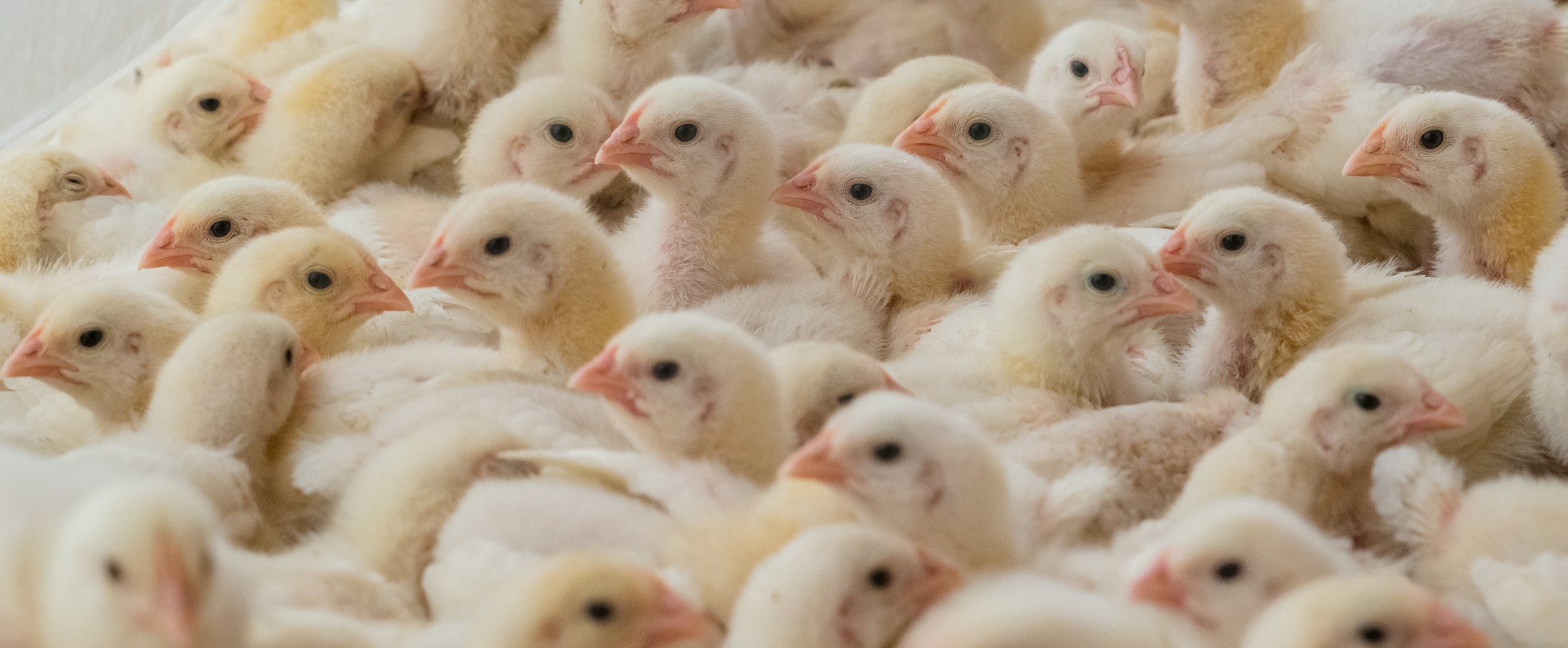
This relentless pursuit of efficiency has resulted in the engineering of a bird who converts feed into meat faster than any other land animal. This creates extreme animal suffering as chickens are bred to grow so fast that their skeletons often can’t support the weight of their bodies. Workers are also exploited by the system, with low wages and dangerous conditions leading to high rates of injury. Finally, the chicken industry’s vast demand for feed crops is a major driver of land-use change, with soy in particular causing deforestation in the Brazilian Amazon.
Producers across Brazil, Mexico, India, and China have now adopted the same ‘factory’ model under intense market pressure. Essentially, firms control the most profitable parts of the supply chain (e.g., genetics, feed, pharmaceuticals) and outsource the riskiest and least profitable activity — raising the birds — to contract farmers. These farmers are locked into contracts that demand strict production targets for a low fixed price, with harsh penalties for failure. This system, known as the ‘Southern Model’ for its origins in the U.S., ensures a steady supply of cheap chicken for the corporation while transferring risk onto the farmer.
The authors note a few limitations to the study:
- The data only covers a six-year period, preventing historical analysis.
- Production is measured in terms of the number of chickens slaughtered rather than weight, as most other sources report.
- The production numbers for each firm come from a single source and are difficult to verify with company reports, which tend to focus on financials.
Despite these limitations, the report makes a compelling case for why the chicken industry’s consolidation and control matters, with the authors suggesting a number of actions that advocates can take:
- Financial activism targeting public companies can act as a powerful lever for change, with the goal of pressuring investors to divest from companies driving destructive industrial practices or to use their shareholder power to demand reform.
- Investigative and legal action targeting private companies can be used to expose animal welfare abuses, poor working conditions, and anti-competitive practices.
- Corporate campaigning in support of higher welfare standards can bring public pressure to bear on companies to adopt initiatives such as the Better Chicken Commitment, with attention paid to tracking progress and ensuring follow-through.
- Government advocacy supporting resilient, local alternatives can be used to address the lack of genetic diversity and thus the vulnerability to disease outbreaks in the global chicken population.
The consequences of the industrial model of chicken production range from market power inequalities and widespread corporate corruption to extreme animal suffering and labor exploitation, as well as the displacement of localized food systems. This makes it necessary to hold accountable the corporate actors and financial institutions that profit from the system, so that it becomes possible to create a food system built on equity, justice, and sustainability rather than an industrial model that sacrifices so much for production and profit.
https://www.issuelab.org/resources/45034/45034.pdf

Citations:
Karamchedu, A., & Coles, B. (2025). Who owns chickens? Corporate control and industrial broiler production in the Global South. Tiny Beam Fund. https://www.issuelab.org/resources/45034/45034.pdf