
Is ‘Sustainable Intensification’ Of Chicken Production Possible?


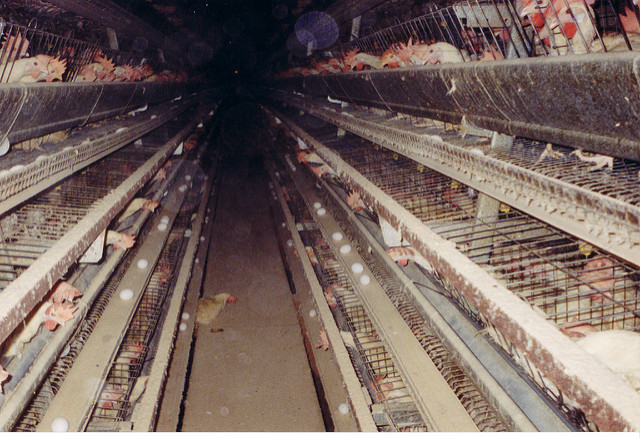
The challenge of how to feed more people with fewer resources is becoming an increasingly pressing and persistent problem. In relation to meat production and consumption, Faunalytics describes this issue as “the protein gap”— that is, the difference between the amount of animal protein we can produce and how much a growing population wants to consume. The idea that we can continue to produce more and more meat, and that this intensification can be done “sustainably,” is a harmful and dangerous way of thinking.
In this study, authors describe this aforementioned approach as the “wicked problem.” Academics have identified 10 traits of the wicked problem, but the main aspect of it is its persistency. A problem may consist of a group of related sub-problems. And any solution may show further connections to other problems. These webs of issues reveal “intractable patterns of cause-and-effect relationships.” And they make the overall problem especially hard to address.
To study the application of this concept to animal agriculture, the researchers of this study honed in on the “broiler” chicken industry in The Netherlands. The researchers note that there is a “persistent consumer demand” in The Netherlands for low prices of chicken meat. And this has lead “to a strong lock-in and institutional inertia in this specialized, fragmented and highly intensified supply chain.” Despite this, sustainability is “high on the agenda” of many aspects of the industry. And this is especially true for consumers themselves. This contradictory positioning creates a virtually unsolvable paradox.
The researchers note that this paradox has been made worse by the fact that food production is disconnected from its ecological and social context. And it is only by reconnecting producers and consumers with the realities of their roles in food production that we will be able to make real strides toward sustainability. Otherwise, there are quite simply too many trade-offs between production and sustainability that the broiler chicken industry “hardly addresses.”
This study does not present a necessarily new position for animal advocates. But, the way that the study describes the problem may be new and of interest. Many of us deal with advocacy situations where people may describe the kind of “sustainable intensification” promoted in this article. And knowing how to respond to this is vital for moving forward in animal welfare.

Citations:
van Bueren, E.M., van Bueren, E.T.M., & van der Zijpp, A. J. (2014). Understanding Wicked Problems And Organized Irresponsibility: Challenges For Governing The Sustainable Intensification Of Chicken Meat Production. Current Opinion in Environmental Sustainability, 8. 1-14.
