
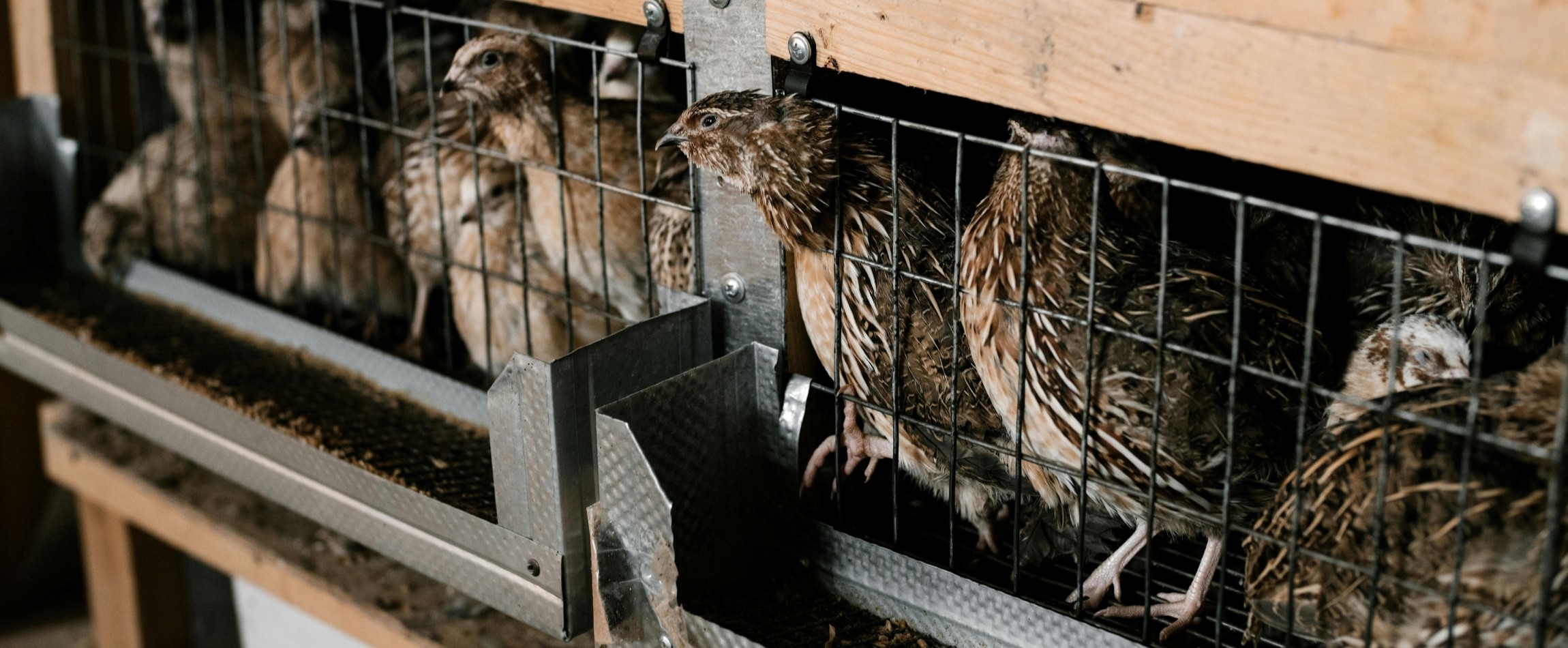
Cage-Free Housing For Japanese Quails


Japanese quails are raised for both meat and eggs. Despite being less commonly farmed than chickens, they’re becoming more popular, making up an estimated 10% of table eggs and 0.2% of poultry meat produced worldwide. As the public becomes more aware of Japanese quail farming, there’s greater focus on the welfare concerns of these birds. Between 2018 and 2020, 1.4 million European Union citizens signed a petition to “End the cage age,” prompting the European Commission to commit to putting forward legislation to phase out and ultimately prohibit the use of cages for many farmed animals, including Japanese quails.
Given this push to transition to cage-free production, researchers reviewed what’s currently known about cage-free housing for quails in order to make evidence-based recommendations. Due to the limited availability of peer-reviewed research specific to Japanese quails, similar studies on cage-free chickens and other farmed birds were also consulted.
The researchers report their findings on three main topics:
- Social environment (e.g., stocking density, space allocation, group composition)
- Physical environment (e.g., cover, elevation, flooring material, nest box availability and construction)
- General welfare concerns (e.g., biosecurity, injuries and movement problems)
They also highlight gaps in the current body of knowledge, and provide suggestions for how to close those gaps.
Social Environment
Similar to chickens, Japanese quails are a social species with a pecking order, and therefore the social environment is very important to their welfare.
What little research was available on stocking density for quails mostly focused on cage housing. Studies tended to measure qualities of economic interest like growth rate and egg production and overlooked behavioral impacts. But, generally, the researchers found that increasing stocking density leads to less “productive” and less healthy quails.
For instance, research in bobwhite quails suggests a minimum stocking density of 372 square centimeters per bird as a compromise between mortality rate and economic productivity — far less crowded than the 180 to 200 square centimeters per bird currently recommended by the United Nations’ Food and Agriculture Organization. However, these figures are based on cages. How they would apply to cage-free systems is unknown.
Aggression between quails has been observed in cages as well as more spacious aviaries, and is mainly associated with mixed-sex groups used for breeding. When reviewing papers on group composition, the researchers found that reducing the male-to-female ratio has the potential to reduce aggression between males without significantly impacting egg fertility.
Physical Environment
As mainly ground-dwelling birds, Japanese quails seek out cover at ground level rather than using perches or other elevated structures to feel safe. They also have a natural need to dust-bathe. These are important features to consider for any cage-free system, though specific parameters on cover are lacking.
Litter type matters too, as studies indicated that quail chicks grew better, picked at their feathers less, and performed more maintenance activities like eating and preening when reared on sawdust.
The researchers point out that hygiene and maintenance matter a lot, as cage-free housing is likely to be dustier. In these systems, quails would have greater exposure to waste and parasites like mites — even more so than chickens who naturally roost off the ground.
Like chickens, quails prefer laying their eggs in nest boxes rather than out in the open. Studies revealed that enclosed nest boxes placed close to walls and in corners are best. There’s some evidence that quails also prefer nest boxes that are somewhat camouflaged, though more research is needed to verify this. Conclusions can’t yet be drawn for other aspects of nest box design such as flooring, or for optimal ratios of females to nest boxes.
General Welfare Concerns
The researchers note that it can be harder to prevent the spread of disease in cage-free systems. However, the risk for quails can be controlled in much the same way as it is for chickens: restricting contact with wild birds and rodents, using dedicated equipment, footwear, and clothing with each flock, restricting visitors, using hygiene barriers, and avoiding mixing birds from different sources and age groups.
Injuries are also a concern in cage-free systems. In particular, quails are prone to serious, even fatal, head and neck injuries because they tend to fly straight up when something frightens them. Higher ceilings and ground cover should minimize this risk. Other recommendations to prevent injuries in cage-free housing include keeping breeding groups small to prevent male-male aggression and having good quality litter to prevent damage to foot pads.
The researchers suggest that lameness and keel bone damage might be as much of a concern in cage-free quails as they are in cage-free chickens, but can’t offer mitigation strategies at this time due to a lack of information.
Future Research Priorities
The researchers identify genomic selection and precision farming as two key methods that could improve the welfare of farmed quails.
- Genomic selection could be used to reduce aggression in male quails. Aggressive behavior varies a lot between quails, so being able to select against this trait would help farmers reduce injuries from male-male aggression. Researchers have recently identified candidate genes associated with social behavior in quails, which may make genomic selection for aggression possible in the future.
- Precision farming uses various technologies to monitor and manage farmed animal environments. These technologies can help farmers track how animals use their housing, control disease, and detect injuries. Recent advances in artificial intelligence are making precision farming even more effective. This would also be helpful for researchers looking to do more studies on quails.
Overall, the researchers highlight a need for more focused research on Japanese quails, but point out that the body of research on chickens and other farmed birds will aid farmers in transitioning quails into cage-free housing.
While progress has been made on improving the welfare of farmed birds, this review shows that there are still blind spots in the literature for certain species. If we want to accelerate the movement toward cage-free systems, we need more information about quails and how to help them thrive in these settings. Public demand for cage-free housing is increasing. This demand can drive further research into how best to handle the transition — and encourage quail farmers to implement the information we already have. If we wish to improve conditions for farmed quails, it’s important to vocally support these crucial reforms.
https://doi.org/10.1016/j.psj.2025.105263

Citations:
Jansson, D. S., Lundmark Hedman, F., Yngvesson, J., Keeling, L., & Henriksen, R. (2025). A critical review on the welfare of Japanese quail in cage-free housing: Current knowledge and future perspectives. Poultry Science, 104(8), 105263. https://doi.org/10.1016/j.psj.2025.105263
