
Why The U.K. Should Apply Its Animal Protection Standards To Imports


Animal welfare is a public issue that concerns citizens, farmers, and governments alike. Polling has found that 90% of British people value animal welfare, and 84% support restrictions on low-welfare imports. Battery cages, sow stalls, force-feeding for foie gras production, fur farming, and live lamb cutting have all been banned in the U.K., yet the country still participates in trade with countries where such practices are legal.
Beyond welfare concerns, this also creates a challenging market for British farmers: even if they do practice higher welfare standards, they’re forced to compete with low-welfare imports, which often happen to be cheaper. To close the welfare gap between national and international standards while ensuring fair competition for domestic producers, this report argues that the U.K. government must revise its import policy.
The Problem With Trade Deals
Out of the 88 countries that have or are negotiating tariff-free access to U.K. markets for animal products, 84 have lower welfare standards. This will inevitably threaten welfare standards within the U.K., particularly when new trade agreements take effect. The report notes that ongoing negotiations with countries like India, Turkey, and South Korea, as well as existing agreements with countries like Mexico and the U.S., are cause for concern.
Farmed Animals Impacted By Imports
The report outlines the major welfare issues that different farmed animal species experience in countries that export products to the United Kingdom.
Pigs
While sow stalls were banned in the U.K. in 1999, they’re at least partially permitted by most current and possible future trading partners. These cages confine female pigs for the duration of their pregnancy to a space that’s almost exactly their body size, making it impossible for them to express natural behavior — or even turn around.
Egg-Laying Hens
Battery cages are small wire enclosures where hens spend most of their lives crowded together with other hens. The confined space stops them from performing natural behaviors like foraging, dust bathing, and nesting. These cages were banned in the U.K. in 2012, but are permitted in possible future sources of imports, such as India and Mexico.
Broiler Chickens
These birds are selected for rapid growth and slaughtered for their meat at an early age. Normally, they’re kept in single-level, littered floor systems. However, cage systems similar to battery cages are permitted by some trading partners. These allow for a higher density of chickens per square meter, restricting their movement and resulting in more injuries. The U.K. has effectively banned cages for broiler chickens by requiring littered floors and enforcing maximum stocking density limits.
Sheep
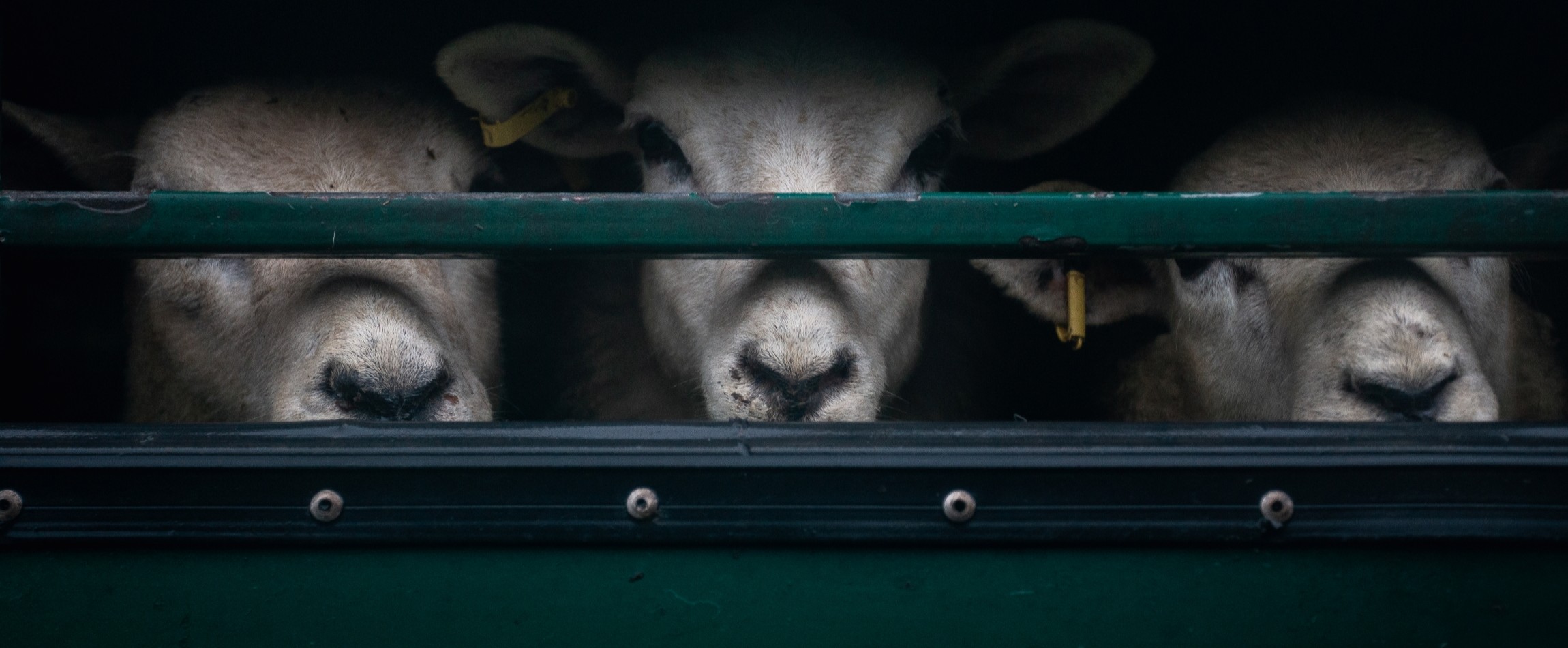
Wool from sheep comes mostly from countries like New Zealand, Turkey, and Australia. Unfortunately, the latter permits live lamb cutting (“mulesing”), a procedure where pieces of skin are removed from a lamb’s rear and tail. The procedure, which is illegal in the U.K., causes severe pain but is performed without anesthesia and often without pain relief.
Ducks And Geese
Used to produce foie gras, these birds are force-fed with a tube pushed down their throat several times a day in the weeks leading up to slaughter. This helps their liver grow up to 10 times bigger than normal, causing them severe stress in the process. Foie gras production by force-feeding was banned in the U.K. in 2007, but imports continue, mainly from Hungary and France.
Minks, Foxes, Chinchillas, And Others
Even though fur farming has been banned in the U.K. since 2003, hundreds of tonnes of fur products are still being imported each year, mostly from China, Germany, and Turkey. Globally, the fur industry is responsible for the death of 20 million animals a year, each of them subject to immense suffering on fur farms.
Time For Policy Reform
Holding imports to domestic standards has been a recurring topic in U.K. parliament, and precedent has already been set by the banning of certain imports such as shark fins and ivory on animal welfare grounds. Further, World Trade Organization rules would seem to permit some sort of restriction on imports based on “public morals” — the prevailing standard of what’s considered right or wrong in a given country.
The report argues that piecemeal negotiation of free trade agreements isn’t enough of a guarantee and that legislative action is necessary. It brings forward two policy enforcement options:
- Import ban: Imports would have to meet U.K. animal welfare standards. This could be modeled on current regulations that require imports to meet domestic animal health standards, where countries have to apply and be approved to export their animals and animal products.
- Sales ban: Imports would have to meet accurate and reliable U.K. animal welfare labeling requirements. Countries would have to submit evidence that their animal products meet these requirements in order to be added to a registry of approved welfare assurance schemes.
Both of these options would most likely require a transition period to allow for knowledge exchange with affected trade partners.
Poor welfare impacts billions of farmed animals worldwide. Even though loopholes in the law make it possible for the U.K. to import lower-welfare products, ensuring high import standards is gaining urgency. As public opinion and farmer concerns put pressure on the U.K. government to close the welfare gap, the government must ensure that the country’s commitment to animal welfare is upheld and reflects British values.
Citations:
Animal Policy International, Compassion in World Farming, & RSPCA. (2025). Closing the welfare gap: Why the UK must apply its animal protection standards to imports. https://71ce2505-19f2-44c7-85ca-128537362493.usrfiles.com/ugd/71ce25_25ddf8f019eb45f796119d2eda1a3b3c.pdf
