Revered Or Reviled? Conflicted Relationships With Animals


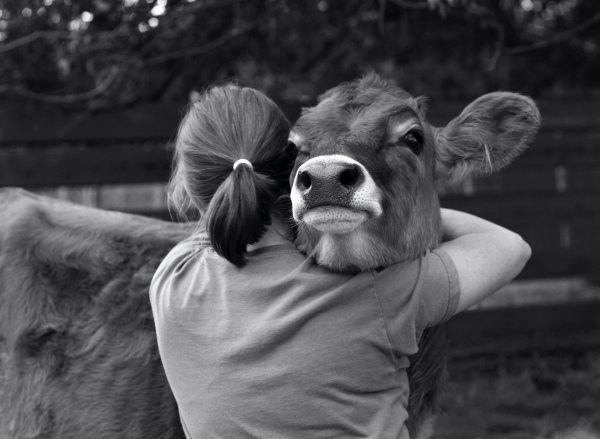
Some readers may remember an image that once appeared on billboards and buses; it showed a cat and a piglet in profile, almost touching nose to snout. The caption above read, “Who do you pet and who do you eat?” It is no surprise to animal advocates that there is a vast and arbitrary gulf between our treatment of some nonhuman animals, such as companion dogs and cats, and other animals, such as those we eat for dinner.
——————————

Study Summary
A recent analysis of the legal history of Australia’s kangaroo population reminds us that such a dichotomy can exist for attitudes toward a single species as well. The study by Keely Boom (et al) of the University of Technology in Sydney describes how views of kangaroos have evolved over time, from historically being perceived as “pests” to currently being considered a commercial resource. While this means the growing kangaroo industry (and its government supporters) gives more lip service to kangaroo welfare, the reality shows less improvement.
Indeed, Boom concludes that the commercial kangaroo industry in Australia “does not have any clearly defined policy benefit and should be reassessed to take greater account of the impact it has on ecosystems and kangaroo welfare.” The value of a kangaroo, like wildlife in many parts of the world, is examined primarily through the lens of how the species – and its exploitation – benefits humans. It’s an attitude that animal advocates need to change.
A recent incident near my home in the state of Washington offers another example. After specious complaints from farmers and ranchers about predation of “livestock,” the state Department of Fish Wildlife used helicopters to shoot and kill two members of a grey wolf pack. Wolves are some of the most revered animals in North America, yet somehow their survival is worth less than the cost to control predators in humane ways. Of course, the irony is tragic: humans are killing wolves to protect their ability to kill cows and sheep and other farmed animals.
Policy Implications
In the U.S., commercial interests make it very difficult to enact policies that would protect nonhuman animals from the arbitrary attitudes and actions of humans. At a minimum, however, policymakers and government agencies must first stop using the outcry of a handful of farmers as their primary basis for making decisions. The interests of wolves (for example), as expressed by animal advocates and conservationists, should be considered with equal or greater weight than the profits of the farmers who would have them killed.
Longer term, the conflicted attitude that humans have toward some other animal species must be re-examined. Attitudes will never be the same across national and cultural boundaries, but how we balance those attitudes with the interests of animals has major implications for the future of all species. Although a “true cost” economic system that correctly values nonhuman animals (and the wild in general) may take decades or even centuries to realize (if it ever does), it is essential for a just and humane world.
Learn more at https://faunalytics.org/pest-and-resource-a-legal-history-of-australias-kangaroos/
This research nutshell comes from Che Green at Faunalytics in collaboration with the Animals and Society Institute (ASI), an organization dedicated to policy-oriented research and human-animal studies. Faunlytics and ASI already collaborate on multiple projects and we will work together to identify important studies for future research nutshells.