It’s Time To Talk Turkey Welfare


Turkeys are widely farmed for meat, but the European Union (E.U.) currently lacks specific animal welfare laws to protect them. While general rules for farmed animals apply, the European Commission asked the European Food Safety Authority (EFSA) to review the scientific evidence to provide a foundation for future turkey-specific legislation. EFSA’s report focuses on welfare consequences — negative states like pain, fear, frustration, or boredom — that turkeys may experience due to their housing and management.
To assess these welfare consequences, a panel of experts reviewed scientific and gray literature, consulted with industry and advocacy groups, and visited turkey facilities as part of a fact-finding mission in several E.U. countries. They also looked at the scientific evidence available on other poultry species — chickens in particular — as there are far fewer studies on turkeys.
Similar to previous assessments, the expert panel used a behavioral space model to calculate the minimum area a turkey needs to perform basic activities like walking, preening, wing-flapping, and dust-bathing. This model also accounts for inter-individual distance, which is the space birds naturally maintain between each other to avoid social conflict.
The assessment identified several critical areas where current farming practices harm turkey welfare.
Space Allowance
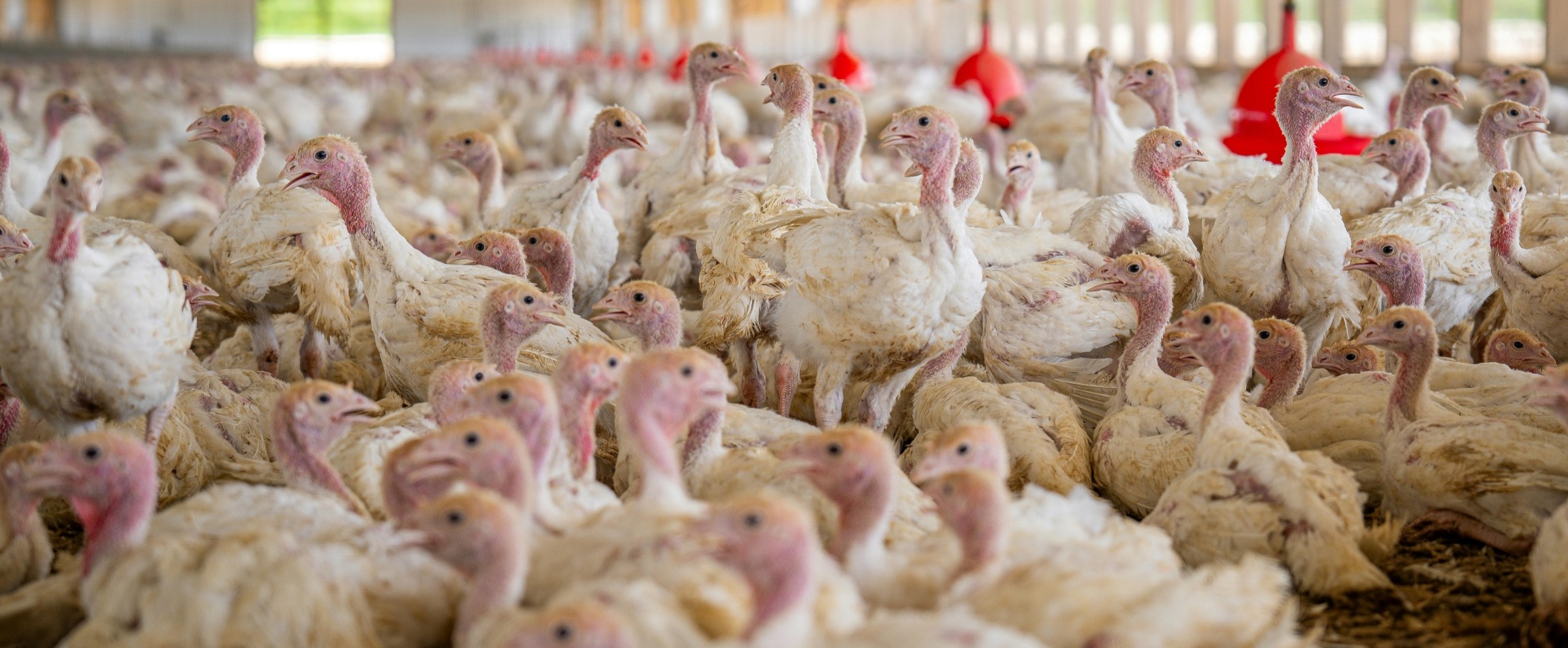
Current stocking densities in many commercial systems are too high, leading to restricted movement, resting problems, and group stress. The report recommends much lower densities. For example, a male turkey (tom) weighing 20 kilograms needs about 0.78 square meters of space to move comfortably. Current national guidelines often allow for much more crowded conditions — just 0.34 square meters for a 20-kilogram tom in the Netherlands, for example.
Flock Thinning
Also referred to as “partial depopulation,” this practice involves removing some birds early for slaughter to manage space for the remaining turkeys. It causes significant welfare issues for the birds left behind, including stress from the actions of the catchers and social disruption. The process of catching and removing some birds often results in temporary deprivation of food and water for the whole flock, leading to hunger and thirst. Multiple thinning cycles may be needed to empty the barn, which means some turkeys will experience these welfare consequences multiple times.
Mutilations
Procedures like beak trimming, toe trimming, and “desnooding” (removing the fleshy appendage on a tom’s head) are common. These cause both acute and chronic pain. While used to prevent injuries from pecking or scratching, the report concludes that these behaviors can be managed through better housing and lower stocking densities instead.
Enrichment
Turkeys are highly motivated to use elevated structures for roosting. The report recommends providing platforms, which are easier for heavy birds to use than narrow perches. Other essential additions include edible materials like straw or pecking blocks, which encourage foraging and reduce injurious pecking.
Hatchery Conditions
Newly hatched turkeys (poults) often face significant sensory and physical challenges. Constant noise from incubator heat and ventilation systems can reach 90 dB. Excessive noise causes sensory overstimulation, and studies in chickens have shown it can negatively impact a chick’s brain size and body weight by the time of hatching.
Poults go without food and water from the time they hatch to when they arrive on farm, which in some cases may be at least 48 hours. This leads to prolonged hunger, thirst, and weight loss, as their yolk sac alone is not enough to meet their nutritional needs beyond this timeframe.
Automated machinery and conveyor belts used to “process” poults in preparation for transport (e.g., sort them by sex, vaccinate them) can cause disorientation, handling stress, and physical injury if the baby turkeys fall or become trapped.
Genetics And Breeding
Breeding strategies for turkeys have long prioritized fast growth and heavy breast meat. Similar to chickens, this has caused widespread leg disorders, walking difficulties, and heart problems. The report suggests that breeding goals must shift to prioritize health and walking ability.
Breeder turkeys face specific welfare challenges related to their reproductive cycle and the long duration they spend on farm, which can reach around 59 weeks. Because modern breeder toms are too heavy to mate naturally, they are subjected to weekly manual semen collection, while hens (female turkeys) undergo repeated artificial insemination, both beginning at about 28 weeks of age. These invasive procedures, which involve repeated catching and physical restraint, are associated with significant welfare consequences like handling stress, cloacal hemorrhages, and bone fractures.
Additionally, toms are often feed-restricted to manage their weight for better fertility, which can lead to prolonged hunger and group stress, though this has been little studied. For breeder hens, inadequate nest conditions — such as a lack of loose material like wood shavings or peat — can prevent them from expressing natural nesting behaviors, causing frustration and secondary issues like pecking injuries.
Study Limitations
A major challenge for the researchers was the relative scarcity of scientific studies specifically focused on turkey welfare compared to other farmed birds like chickens. Some findings were extrapolated from other species or relied on expert consensus where data was missing.
Turkeys Need Stronger Protections
This report marks the first time EFSA has provided a comprehensive scientific opinion on the welfare of turkeys on farm. It demonstrates that many current industrial practices — such as extreme crowding and routine mutilations — conflict with the biological needs of the birds. By providing specific, evidence-based recommendations for housing and management, the report gives lawmakers the technical tools needed to draft robust new protections.
The report also provides advocates with a clear roadmap to demand these stronger protections for turkeys. As a start, advocates may want to focus on:
- Lowering stocking densities: Push for regulations that align with the report’s behavioral space model, ensuring birds have enough room to flap their wings and move without bumping into others.
- Ending routine mutilations: Call for a total phase-out of beak and toe trimming and desnooding, accompanied by improved environmental enrichment to manage bird behavior naturally.
- Improving breeding goals: Support policies that require breeding companies to value leg health and liveability as much as meat production.
Ultimately, improving turkey welfare requires moving away from a narrow focus on productivity and toward housing systems that allow these birds to live without constant pain or frustration.
This summary was drafted by a large language model (LLM) and closely edited by our Research Library Manager for clarity and accuracy. As per our AI policy, Faunalytics only uses LLMs to summarize very long reports (50+ pages) that are not appropriate to assign to volunteers, as well as studies that contain graphic descriptions of animal cruelty or animal industries. We remain committed to bringing you reliable data, which is why any AI-generated work will always be reviewed by a human.
https://doi.org/10.2903/j.efsa.2026.9851

Citations:
EFSA Panel on Animal Health and Welfare. (2026). Welfare assessment of turkeys (Meleagris gallopavo gallopavo) on farm. EFSA Journal, 24(2), e9851. https://doi.org/10.2903/j.efsa.2026.9851