Improving The Welfare Of Indonesia’s Laying Ducks


Indonesia is a global leader in duck egg production. In 2024, the nation housed approximately 43 million of these birds, the fourth highest farmed duck population in the world. Ducks play a vital role in food security and rural livelihoods, yet they’re often overlooked in research and advocacy compared to other animals used for food.
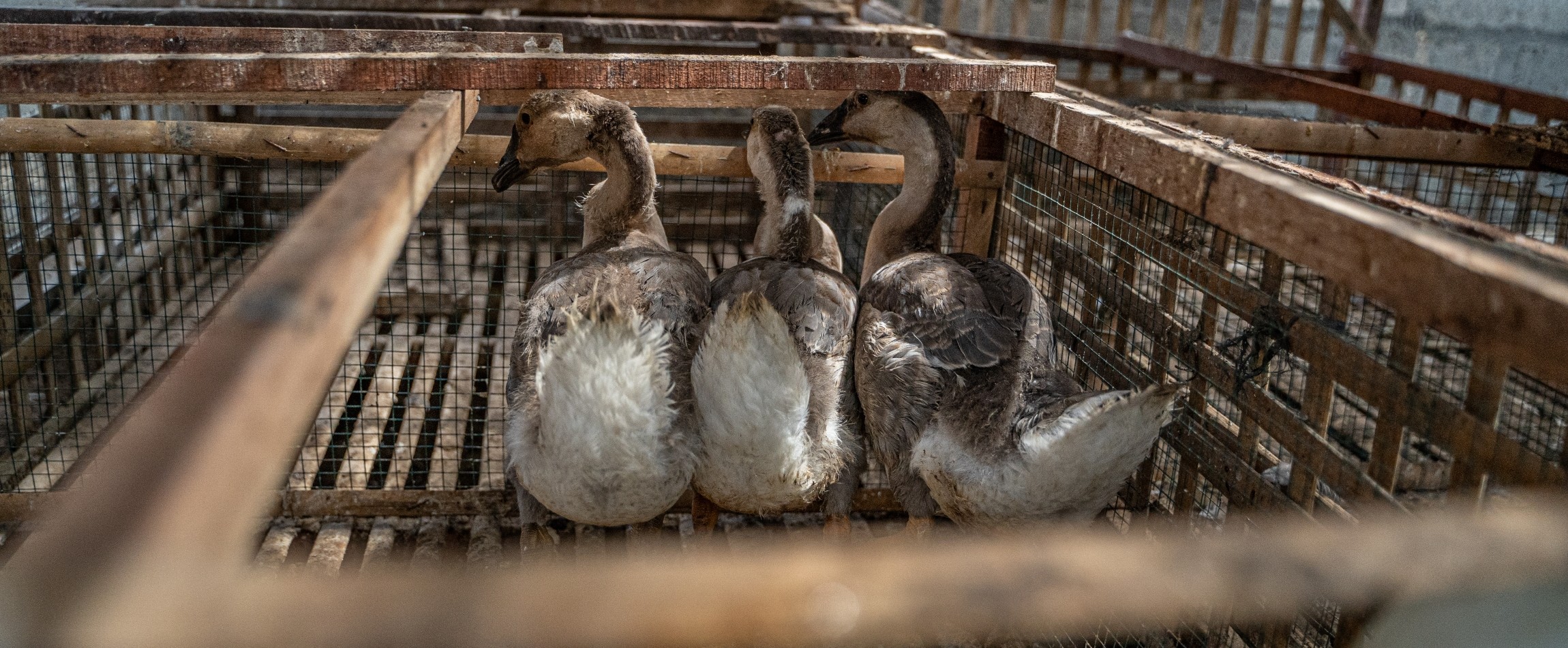
Many Indonesian farmers still use traditional cage-free methods. However, as the domestic market for duck eggs grows — with a projected annual increase of almost 7% — some are shifting to intensive battery-cage systems to try to increase productivity. This report from Across Species Project Indonesia (ASPI) looks at how these different systems affect the welfare of these birds with the aim of providing evidence-based recommendations for housing that supports their biological needs.
Between February and March 2025, ASPI researchers visited 36 farms across East Java and Yogyakarta. These areas were chosen to represent both established and emerging centers of the industry. The sample included 12 battery-cage operations and 24 cage-free systems, ranging in size from 200 to 40,000 ducks. Battery cages confine ducks individually or in small groups, while cage-free housing includes traditional extensive, semi-intensive, and intensive floor-based systems.
- Extensive: Allows ducks to forage naturally in open environments like rice fields and riversides while being moved by farmers using mobile carts or temporary shelters
- Semi-intensive: Provides ducks with floor-based housing and access to outdoor areas, sometimes with ponds
- Intensive floor-based: Keeps ducks in shared indoor enclosures with soil or litter floors but no outdoor or swimming water access
The team used the Five Domains model to assess duck welfare, which considers their nutrition, environment, health, behavior, and mental state.
The researchers conducted interviews with farmers, made direct observations, and used digital tools to measure air and water quality. They also tested egg weight, shell thickness, and egg freshness to see whether welfare affected the final product. They then used statistical tests to compare results between the two types of systems.
Physical Health And Mortality
Physical condition scores were consistently worse for caged ducks across every category measured.
- Plumage: Caged ducks were much dirtier and experienced severe feather loss, particularly on their bellies.
- Injuries: Abrasions and open lesions were more common in battery cages, often caused by the birds rubbing against the bamboo cage structure.
- Eye and nose health: Higher levels of eye irritation and blocked nostrils were found in caged birds, likely due to ammonia exposure and a lack of open water for cleaning.
- Foot health: Caged ducks had foot problems like open lesions and thickened pads because they were forced to stand on hard, slatted floors. Their claws often became overgrown and sharp because they didn’t have abrasive surfaces like soil to wear them down.
- Body condition: Cage-free ducks had an average body condition score of 3.0 (on a five-point scale), while caged ducks averaged only 2.5. This was possibly due to the impact of restricted movement on their appetite and metabolism.
While both systems maintained mortality rates that are considered very low by industry standards, there was a slight difference between the two. Cage-free systems had an average estimated mortality of close to 2%, while in battery cages, it was roughly 1%. The report attributes this to larger group sizes, more direct contact among ducks, and variable biosecurity practices, which can all increase pathogen exposure within cage-free systems.
However, battery cages present a unique structural hazard: some ducks died after becoming trapped in the bamboo slats of the cages. This risk is inherent to the system and nearly impossible to eliminate.
Behavior And Stress
Ducks in battery cages were unable to express natural behaviors like wing-flapping, walking, or foraging. They were much more likely to show abnormal repetitive (“stereotypic”) behaviors compared to those in cage-free systems. For example, 78% of caged ducks showed behaviors like pacing, circling, or hitting their bodies against the cage roof or sides. In contrast, only 3% of cage-free ducks showed these signs. Excessive vocalization — a common sign of anxiety — was also much higher in cages (61%) than in cage-free settings (9%). With more space and opportunities for exploration, cage-free ducks were generally calmer.
Air And Water Quality
While air quality was generally within recommended limits for both systems, battery cages had significantly higher carbon dioxide levels. They create concentrated waste that can be hard to manage. Feces often pile up for a year or more, leading to intense odors and maggot outbreaks. One farmer attempted to address this by putting fishes in a pond beneath the ducks to eat the waste, but this raises separate concerns about water quality and the welfare of those fishes.
Water quality was often better in cages because of flowing water lines that kept the water cleaner. However, cage-free systems could be improved with better water storage and more frequent water replacement.
Egg Quality And Human Health
The researchers found that better welfare led to better eggs. Cage-free eggs were heavier, averaging 66 grams compared to 62 grams for caged eggs. Their shells were also thicker (0.42 millimeters versus 0.30 millimeters). Thinner shells in cage systems make the eggs more fragile and increase the risk of bacterial contamination like Salmonella from the environment.
However, antibiotic use is a major concern in both systems. Farmers often give broad-spectrum antibiotics to entire flocks as a preventive measure. In battery cages, these drugs may be used as part of an “anti-stress regimen” to help the birds cope with the cramped conditions. Regardless of housing type, the widespread use of antibiotics raises big concerns about antimicrobial resistance in the food chain.
Economics
Battery-cage farms currently earn more monthly income: about IDR 2,345,667 per 100 ducks compared to IDR 1,448,857 for cage-free. This is because cages allow for higher stocking densities and greater egg production (80 to 81 eggs per 100 ducks per day versus 76 to 77 eggs in cage-free). However, these income figures don’t include operational costs. The report notes that cage-free systems hold potential for a higher market price that has yet to be fully leveraged by local farmers.
Advocacy Takeaways
The study has a few limitations. It only covered two regions of Indonesia, so it doesn’t represent the whole country. Also, much of the data on egg production, income, and mortality were based on what farmers remembered or estimated rather than official written records.
Despite these gaps, animal advocates can use this evidence to push for a gradual phase-out of battery cages in Indonesia’s duck industry. Key actions include:
- Promote cage-free benefits: Many farmers currently want to switch to cages because they seem more convenient. Use the data on shell thickness and egg weight to convince producers and consumers that cage-free systems produce safer and higher-quality products.
- Market access: Helping cage-free farmers find markets that value higher-welfare products will make the transition more financially viable.
- Protect traditional systems: Traditional extensive systems showed the best physical outcomes for ducks. Safeguarding the open lands used for these systems supports both animal welfare and environmental health.
- Simple improvements: As cage-free systems aren’t without issues, advocates can help farmers adopt low-cost welfare fixes. These include adding litter, installing nest boxes, and building small bathing areas. This can be accompanied by peer-to-peer training and support.
This summary was drafted by a large language model (LLM) and closely edited by our Research Library Manager for clarity and accuracy. As per our AI policy, Faunalytics only uses LLMs to summarize very long reports (50+ pages) that are not appropriate to assign to volunteers, as well as studies that contain graphic descriptions of animal cruelty or animal industries. We remain committed to bringing you reliable data, which is why any AI-generated work will always be reviewed by a human.

Citations:
Across Species Project Indonesia. (2026). Exploring the welfare of laying ducks in Indonesia: A comparison between cage-free and battery cage systems. https://drive.google.com/file/d/1SRr-8TdRYnfCpq6lrAh1rH4uAcNy-tlv/view