
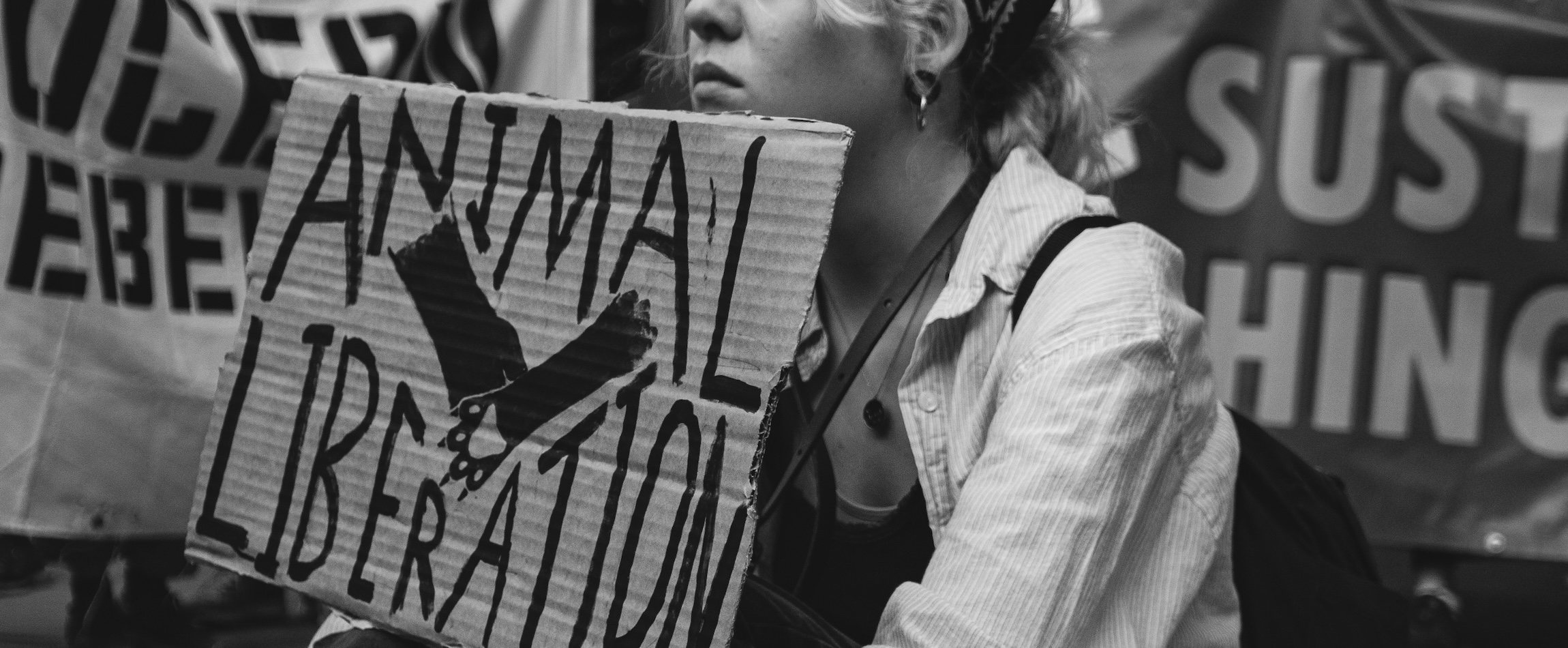
Tactics In Practice: The Science Of Protests And Demonstrations


Welcome to the third installment of Tactics In Practice (TM), a series where we analyze the science behind popular advocacy interventions. Today, grab your signs and ready those chants because we are about to hit the streets to examine the impact of protest, demonstration, and street activism.
How Is Protest Used By Animal Advocates?
There are various terms for protest and demonstration that can sometimes (but not always) be used interchangeably: non-violent grassroots pressure tactics, direct action, protest, or civil disobedience — but we will be using “protest” as an umbrella term in this resource. It’s important to note that protest involves far more than writing slogans on cardboard: public demonstration tactics can include sit-ins, marches, blockades, milk pours, vigils, days of remembrance, video outreach, and many more diverse actions. Still, these tactics are sometimes categorized into two buckets: disruptive, often defined as actions that disrupt individuals, institutions, or ways of making money (think milk pours, road blockages, or physical disruption of events), and non-disruptive, which are usually accepted by authorities (think posters, sanctioned protests, or marches with permits).
Protests are used by advocates for many reasons, which can be grouped into three categories:
- Pressuring key decision-makers — this can include establishing a legal precedent, encouraging allies to more actively support the cause (e.g., environmental groups), or getting businesses to drop harmful practices.
- Spreading awareness — this can involve gaining media attention, demonstrating a shift in social norms, or increasing awareness and support (or hostility towards the opposition).
- Cultivating new activists — this can involve training, leadership opportunities, recruitment, fostering solidarity, and building confidence.
While the word “protest” likely conjures up images of streets filled to the brim with activists, these events are likely more common and less well-attended than you might think. According to research from Animal Charity Evaluators, between 40 and 80 animal protection protests occur every week in the U.S. alone, with a median size of seven participants. In our conversations with protest advocates, they told us that many of their demonstrations never receive media attention, so this estimate is likely still an undercount.
Unfortunately, protests for animal rights tend to be unpopular with the general public. From 2008 to 2017, our Animal Tracker found that demonstrating and protesting were the least supported form of animal activism from a list of eight. Another study found that disruptive protests made participants view vegans and the vegan movement in a more negative light, an effect that was stronger for women, and people viewed vegan protests more negatively than similar fast-fashion protests. To paraphrase Hamlet, the movement doth protest too much (according to the public, at least).
Does Protesting Work?
Yes, we know protesting works — depending on the cause, at least. In a report on overall protest outcomes, the Social Change Lab found that protests (not just animal protests) are likely to influence public discourse, have small positive changes on policy, and result in small positive changes in public opinion. Research on political protests in the U.S. also showed big results on both sides of the aisle. The 2020 Black Lives Matter protests showed that for each 0.1% of people who attended a BLM protest, Democrats received a 0.35% voting-day boost in that county, while the 2009 Tea Party protests showed that every 0.1% increase of protestors corresponded to a 1.9% increase in Republican votes.
One analysis of an animal protest revealed that people’s initial reactions to the protest depended on their previous beliefs regarding animals — that is, pro-animal people had more positive reactions and people with more anti-animal beliefs had more negative attitudes. Therefore, it’s likely that the outcome of a protest campaign is linked to the overall support for the activists’ position. This means that since farmed animal protection is relatively unpopular, protests may not be as effective in achieving our aims as it might be for other movements. But this also indicates that pro-animal protest may become more effective as public support for farmed animal rights increases, or that more popular cause areas, such as anti–animal-testing campaigns, are likely to see more success, or that certain countries benefit more from protest than others. In other words, while a protest in Brazil may be popular due to relatively high levels of pro-animal sentiment in the public, a protest in China may not be.
Let’s turn our attention to animal-specific protests: our study on the effectiveness of different advocacy methods found that both disruptive and non-disruptive protests are unlikely to shift individual diet change.
In that study, we estimated how many U.S. Americans reduced meat consumption after exposure to different types of advocacy methods. We estimated that only 4% and 10% of U.S. Americans have reduced their animal product consumption, at least a little bit, due to disruptive or non-disruptive protest, respectively. What’s worse, nearly half of people who recalled seeing a disruptive protest in the past felt angry towards activists and were less likely to take a pro-animal action — protest’s backfire effect was by far the highest of any advocacy method. The backfire effect is important to be aware of because negative opinions or stereotypes about activists can harm support for their cause, regardless of how peaceful the protest actually is. But let’s put a pin in the idea of the backfire effect for now.
Our data is clear that protest probably isn’t a good way to make new vegans, but, before you grab your pitchforks, remember that this doesn’t mean it isn’t useful. In our conversations with animal advocates who work in street demonstrations, they shared a variety of aims for their protests, including getting meat companies to install higher-welfare practices, helping the public think more about animals, bearing witness to animal cruelty, forcing companies to cut ties with organizations that promote animal suffering, and more. In that sense, it’s possible that protest is more effective when the goal of the protest is specific, or perhaps not focused on dietary change. For example, the Stop Huntingdon Animal Cruelty (SHAC) protests were likely more successful because they targeted a specific organization instead of the general institution of animal experimentation, and their aims were largely focused around economic disruption rather than creating new vegans.
Now let’s examine the backfire effect. The Social Change Lab has a series of excellent studies that explore the impact of protest by both the climate and animal movements that helps explain the potential of street activism. One study polled people who watched the 2023 Animal Rising disruptive protests against the Grand National U.K. horse race, both directly after and six months after the action took place. Right after the disruptive protest, exposure was generally linked to worsened attitudes towards animals, a finding that they also found in a follow-up experiment. In other words, the protest probably harmed the many members of the public’s opinion of animal rights. However, the negative connection between the protest and poor attitudes towards animal rights disappeared after six months, and the protest was correlated with greater donations for Animal Rising, more media attention, and mailing list sign-ups. In other words, the protest’s backfire effect seemed to disappear over time and the protest was able to increase Animal Rising’s presence through media, donations, and volunteers.
It’s important to note that this series of studies examined protests against animals used for entertainment, not animals used for food. When participants were polled on their support for banning various acts of animal cruelty during the Animal Rising study, a ban on animal agriculture was the only one not to increase over six months.
Common Theories Of Change For Protest
Protest may also serve to normalize other, more moderate arms of the movement. This is known by a few different names: shifting the Overton Window, the inside-outside strategy, or, most commonly in the literature, the radical flank effect. Think of it this way: a non-vegan passes by a disruptive protest — say, a bunch of activists pouring out milk in the front of a packed supermarket. They shake their heads, frustrated at the inconvenience as they step around the puddles. Then, a few weeks later, an animal activist asks them politely to vote for a local ban on gestation crates. Finally, the non-vegan thinks, a reasonable activist! Then, they may be more open to the message that the “moderate” advocate is communicating.
The evidence for a radical flank effect is strong. In one study, participants in the U.K. read fake newspaper articles about three scenarios: two non-violent protests; one non-violent and one violent protest; and two violent protests. When the protest was about meat reduction at a university, the presence of a more radical group’s protest increased support for the moderate group more than the decrease of its own support. In other words, radical protest boosted the moderate position more than it harmed the credibility of the radical group. We see a similar result in another study on animal rights activists, which found that radical tactics (like aggressive or protests), not radical agendas (like ending animal agriculture), are the reason we see the radical flank effect. One note: both of these studies involved violence in their definition of “radical,” meaning we weren’t able to find results that tested the effects of a disruptive, non-violent protest, like milk pouring, public nudity, or displays of gore.
Real-world examples of the radical flank effect can also be found in other social movements — like this climate-oriented study which found that, after disruptive protests from Just Stop Oil, individuals were more likely to support the more moderate group Friends of the Earth. An analysis of the efforts of Stop Huntingdon Animal Cruelty (SHAC) to shut down a large animal-testing facility, Huntingdon Life Sciences (HLS), found mixed results. The existence of a radical wing was largely responsible for the government taking interest in and taking action against SHAC and also likely led to decreased public support. However, the radical wing was impressive in the corporate sphere, where it was likely able to intimidate companies into cutting ties with HLS.
Some animal activists we spoke to pointed out another popular theory of change: the 3.5% rule. This idea posits that if 3.5% of a population are actively engaged in non-violent campaigns, the movement will achieve serious political change. Some people interpret this to mean that once 3.5% of a population are vegan, or are animal activists, political change for animals is an inevitability.
Unfortunately, the 3.5% rule likely doesn’t apply to the vegan movement. A 2020 paper argues that the 3.5% rule can’t be applied to Extinction Rebellion (a climate change grassroots group) because they are targeting liberal democracies, not authoritarian regimes. It’s also important to point out that mobilizing 3.5% of people would require far more than 3.5% support because most people who support an issue aren’t going to be mobilized to fight for it in the streets. As DXE points out, that base of support doesn’t yet exist for most animal issues.
Other Forms Of Street Activism
Protests aren’t the only forms of advocacy on the streets. Many organizations, from Anonymous for the Voiceless to We The Free, have their own spin on public demonstrations.
Video outreach — like I-Animal, Diamonds, or Cubes of Truth — may be quite effective. In our study on Animal Equality’s I-Animal tactic, in which people on the street are asked to watch a video showing animal cruelty via either an iPad or a VR headset, we found that people who watched the pig cruelty video were more likely to want to reduce pork consumption compared to people who didn’t watch. Most importantly, one month later, 33% of people who watched the 2D video actually did reduce their pork consumption, as compared to just 25% in the control. Although it’s only one study, it shows promise for public video intervention.
But not all forms of street activism are demonstrated to be effective, at least for individual diet change. Case in point: leafleting or pamphleting has mixed evidence for its impact. In one study, reading a meat-reduction pamphlet as part of university orientation prompted students to reduce meat consumption by just 1.6–2.4%, depending on the participant’s gender and the type of animal product consumed, and that effect disappeared after two months. In particular, men reduced chicken and fish consumption but women swapped beef for chicken, an instance of the small body problem. Two other studies found that pamphlets resulted in no statistically significant change in diet, while our relative effectiveness study (with a larger sample size) found that leaflets were able to affect pro-animal motivations, but not behavior.
However, a low-touch intervention like pamphleting, which can convey a short message to a relatively wide audience, may function similar to a social media post: it’s possible these short interactions could function as one step along a longer journey to veganism, an idea we discuss in an earlier edition of TIPs. Still, this hasn’t been formally tested yet.
In recent years, many animal groups have been shifting their strategies to other goals — like Our Planet, Theirs Too’s National Animal Rights Day, which uses public demonstration as a form of memorial: to honor animals who passed away in factory farms and give advocates a chance to publicly grieve. The use of animal bodies in their demonstration is used to start conversations while also honoring their lives.
We The Free also uses a specific form of public demonstration: a “3-Minute Movie Challenge” in which passersby are shown, with consent, a three-minute movie on factory farming that contains graphic footage. After the movie, advocates engage with the participants in a constructive, non-argumentative conversation, helping them identify paths to positive behavioral change for animals. According to data from We The Free, this method resulted in 44% of passersby later checking out pro-vegan materials for more information. While we don’t know exactly what percentage of them changed their diet, nearly half sought out more info, which is a positive sign.
Tips For Conducting A Successful Protest
Never, Ever Engage In Violence
Hopefully this one is obvious but it bears repeating. Using violence against people in a protest is not only morally wrong, but a tactical mistake. Evidence from other social movements — such as the 20th century U.S. civil rights movement and modern anti-racist movements to name a few — shows that violence against humans is not an effective strategy because it causes onlookers to reduce their support for the cause. In disruptive protests, it is likely that you will need to train your protestors in anti-violent behavior, as situations can escalate quickly, regardless of your initial intentions.
On the flipside, be aware of potential violence against your protestors. While we didn’t find evidence of large-scale violence against animal activists in the research, it certainly exists in other social movements. Minoritized animal protection protestors may also be in more danger. The advocates we spoke with recommended researching the laws of your local county, region, or city to ensure you are safe. We also recommend reviewing APEX Advocacy’s Safety Resources.
Pick Your Protest Goals Carefully
The research shows that people aren’t likely to change their diets after a protest — but maybe they’ll be more likely to vote for a pro-animal politician, abstain from a particularly cruel factory farm, or support a public referendum or moratorium on factory farming. Make sure the goals of the protest are specific and clearly articulated to both onlookers and the media, like “Support [bill]! Ban factory farming in [region]” or “Divest from animal testing at [university].”
In particular, try to choose a cause that is already supported by the community. This requires advocates to review polling data — for example, our study on U.S. adults’ openness to pro-animal actions, or this poll data on U.S. adults’ support for specific farming practices.
Have A Media And Messaging Plan
Since research from other social movements shows that protest can affect media coverage, and the impact of a protest can be mitigated through the media, protest groups need to have a media plan. Research from the Social Change Lab shows that hearing about a protest from a media source that strongly praised the protest is correlated with a person being supportive of the protestors’ actions. The research also found that the specific outlet correlates with support for the protest group (see Figure 7 here for the full list of U.K.-based outlets).
When making a narrative or public message, try to identify commonalities between the protestors and the public. This may help avoid backfire effects. For example, what public values overlap with animal advocacy?
Further, a study on protests’ messaging found that focusing on the problem was more effective than focusing on norms or solutions in making participants support the goals of the animal rights organization. In other words, focusing on the negative harms of factory farming was more effective overall than focusing on the values of our society or the desire for a plant-based future. However, the “solution” condition only focused on long-term change (a fully plant-based food system), so we don’t know if focusing on short-term change would have the same effect. The takeaway: focus on the problems of animal agriculture or use.
To help gain media attention, you can review Animal Ask’s assessments of 98 tactics, (adapted from Gene Sharp’s famous list of 198 non-violent actions), especially the results in Column D “Attention,” or review the Activists Resource Hub for more ideas. We also recommend this resource about different climate protests that were successful in gaining media attention. Reviewing these lessons can certainly help inform animal protestors as well.
In our conversations with protest activists, we discovered that gaining media attention isn’t as easy as it appears, and many forms of street protest will never see the pages of a newspaper or get airtime on local news. This is backed up by the study into SHAC, which found the media only covered the group’s most controversial acts. Still, be aware of what portrayal you are looking for, which brings us to…
Be Aware Of Your Role In The Larger Movement
It can be helpful to further separate the moderate and radical wings of the movement. In one study, participants were shown articles of a radical group and a moderate group — in one condition they were either told the two groups had previously split off from one unified group, or weren’t told any information about their backstory. While this difference wasn’t the only variable between conditions (meaning we can’t draw strong conclusions from it), it is interesting to know that public connections between moderate and radical groups are detrimental to their strategy.
We’d want to see more research to be sure, but it’s worth thinking about it if one group should be playing both the moderate and radical wing at the same time. To borrow a phrase, the “good cops” should be good and the “bad cops” should be bad — with little gray area or interconnectedness between the two. There isn’t an easy way to do this, but it involves talking with other groups in your region or cause area and coordinating a larger plan.
Choose Your Location Carefully
In a study on non-violent grassroots protest, researchers point out that the location of the protest can be divided into five categories:
- Point of assumption (streets and public areas)
- Point of decision (congress buildings, mayors’ offices, or meat industry headquarters)
- Point of consumption (restaurants or cafeterias)
- Point of production (factory farms or feedlots)
- Point of destruction (slaughterhouses or processing plants)
While this is still a theoretical framework, it can be helpful for organizers to strategize — how can you tie the protest goal to the location? If you are protesting the use of animal experimentation on-campus, it may be best, as advocates we spoke to argued, to target the decision-makers’ offices as opposed to a public quad.
Time Your Protests Well
Protest can serve to increase the salience of an issue, so consider instituting protest to correspond with public sentiments, hot-button issues, or timely events. For example, if your state or province is considering a moratorium on factory farms, it might be time to protest in support of the bill. Or if a climate conference is coming to town, try to protest the unsustainable practices of factory farms. Some evidence suggests that a sustained campaign may be best for raising the relevance of a given issue, as compared to a single protest. You have to get into it for the long haul.
Make Sure Attendance Is High
Pump up those numbers! Research into the media’s response to animal rights protestors in the 80s and 90s found that media coverage increases with the number of protest participants — in other words, the more protestors and events, the more articles. Other research on protest more generally found the same: successful protests tend to have many people in attendance and be well organized.
While these findings aren’t new, the implication still holds true: more people means more eyeballs. As we mentioned above, the median protest in the U.S. is just seven people, so organizations should think about increasing recruitment. Easier said than done, but important nonetheless.
Track Your Effectiveness
This won’t come as a surprise, but as a research organization, we are pro-testing your campaigns — we strongly believe that organizations should be actively tracking their own impact with a research mindset, including protest and demonstration.
Before your protest, identify the primary aims of the intervention: Increased public support? Divestment? Recruitment? To make another group look better by comparison? Then, after the protest, try to pick an ideal result (dependent variable) that most closely matches with your aims. A list of variables could include:
- Number of news articles written about the protest
- Headline sentiments (essentially, how positively or negatively it paints the protests)
- Number of social media shares
- Direct outcomes (like the targeted group cutting ties with an unethical farm)
- Opinions of people who watched the protest
- Sign-ups to your cause
- Visits to your website
- Donations to your cause
Many organizations, like Direct Action Everywhere, Our Planet, Theirs Too, and We The Free use QR codes and link tracking to monitor how many onlookers actively seek out more information after seeing a protest (a stand-in for pro-animal motivations). By tracking the number of visitors who use the QR codes associated with a single event, protest groups can start evaluating the effectiveness of certain protest types, locations, slogans, time of year, and more! As always, Faunalytics is here to help: simply come to our Office Hours with questions and we can give advice for tracking your impact.
Collaborate!
Many researchers who examine protest — such as a Faunalyst, the Animal Charity Evaluators team, and more — believe that protest has a big, untapped advantage: collaboration with other social movements. We also know that protests in general are more effective when they have high public support and powerful allies.
So, consider doing more intersectional protest: form an alliance with a climate group to demand more plant-based options at an institution to lower the carbon footprint; team up with human rights organizations to protest factory farms that pollute local waterways; or work with civil rights activists to call for an end to ag-gag laws.
As always, if you still have questions about implementing protest in an evidence-based way, come to our office hours or contact our team.
Faunalytics is deeply appreciative of the thoughtful contributions from Jen Deighan-Schenk (We The Free), Chris Eubanks (APEX Advocacy), Almira Tanner (Direct Action Everywhere), Aylam Orian (Our Planet, Theirs Too), and Michelle Del Cuoto (Direct Action Everywhere).
Sources:
Effects Of Animal Protest
- Effective Advocacy For Animals Through Protest – Faunalytics
- Practices, Opportunity, and Protest Effectiveness: Illustrations from Four Animal Rights Campaigns*
- Do Disruptive Protests Help Vegan Advocacy?
- go.mercyforanimals.org/measuring-non-violent-activism
- The Challenges Of Changing Public Opinion
- Effective Advocacy For Animals Through Protest
- Protest Intervention Report
- The Challenges Of Researching Animal Advocacy Protests
- The ironic impact of activists: Negative stereotypes reduce social change influence
- The vegan dilemma: Do peaceful protests worsen attitudes to veganism?
- Planting Seeds: The Impact Of Diet & Different Animal Advocacy Tactics
- Tactics from Social Movements: Analysis for animal advocacy
Social Change Lab Reports
- Protest Movements: How Effective Are They?
- How did Animal Rising’s protest impact public attitudes towards animals?
- The Effects of Protest Tactics & Messaging Strategies On Attitudes Towards Animals
- Animal Rising’s Grand National protest: Public opinion impacts and beyond
- The Short & Long Term Impacts of Disruptive Animal Rights Protest
- A case study of UK anti-animal testing activism: SHAC
Media Response
Popularity Of Protest
Protest Theory And Non-Animal Related Protest
- Disruptive protest, civil disobedience & direct action
- The Influence of Social Protests on Issue Salience among Latinos
- Do Political Protests Matter? Evidence from the Tea Party Movement
- 198 Methods of Nonviolent Action
- Disruptive protest, civil disobedience & direct action
- Does Violent Protest Backfire? Testing a Theory of Public Reactions to Activist Violence
- Weather to Protest: The Effect of Black Lives Matter Protests on the 2020 Presidential Election
- Protest Group Success: The Impact of Group Characteristics, Social Control, and Context
- When Will Collective Action Be Effective? Violent and Non-Violent Protests Differentially Influence Perceptions of Legitimacy and Efficacy Among Sympathizers
- Justifying Nonviolent Disobedience
- Does Violent Protest Backfire? Testing a Theory of Public Reactions to Activist Violence – Brent Simpson, Robb Willer, Matthew Feinberg, 2018 (sagepub.com)
- Amplifying Public Opinion: The Policy Impact of the U.S. Environmental Movement | Social Forces | Oxford Academic (oup.com)
- Climate summits and protests have a strong impact on climate change media coverage in Germany
- The power of protest in the media: examining portrayals of climate activism in UK news | Humanities and Social Sciences Communications (nature.com)
- Protest movements involving limited violence can sometimes be effective: Evidence from the 2020 BlackLivesMatter protests
- When Are Social Protests Effective?: Trends in Cognitive Sciences
- What is the right way to protest? On the process of justification of protest, and its relationship to the propensity to participate in different types of protest
- The Policy Impact of Social Movements: a Replication Through Qualitative Comparative Analysis
- How exposure to media about the 2019 London April Rebellion affected the UK general public
- Just Stop Oil’s strategy in their own words (socialchangelab.org)
- Increase in concerns about climate change following climate strikes and civil disobedience in Germany
- Tactics from Social Movements: Analysis for animal advocacy
Protest As Collective Action
- Animal rights protest and the challenge to deliberative democracy
- Demonstrating Veganism
- Sustained Efforts And Collective Claims: The Social Influence Of The Vegan Movement From 1944 To Present
- Dietary behaviour as a form of collective action: A social identity model of vegan activism
- From Angry Militants to Happy Vegans: Animal Rights Activists’ Recasting for Vegan Recruitment
- Agenda Seeding: How 1960s Black Protests Moved Elites, Public Opinion and Voting
3.5% Rule
- The ‘3.5% rule’: How a small minority can change the world (bbc.com)
- Why Civil Resistance Works: The Strategic Logic of Nonviolent Conflict
- The rule of 3.5% has been broken. What does this mean for DxE? **
- Social movements and the (mis)use of research: Extinction Rebellion and the 3.5% rule
Radical Flank Effect
- Exploring Animal Advocacy And The ‘Radical Flank Effect’
- The Influence Of Radical Flanks On Social Movement Support
- A Quantitative Reevaluation of Radical Flank Effects within Nonviolent Campaigns
- Deepening the Explanation of Radical Flank Effects: Tracing Contingent Outcomes of Destructive Capacity
- Radical climate protests linked to increases in public support for moderate organizations
- Radical flanks of social movements can increase support for moderate factions
- Embracing an Inside-Outside Strategy for Animal Freedom
Practical Resources
Other Forms Of Street Activism
Video
Pamphlets

