India’s Northeast Reveals A Path Beyond Factory Farming


As countries become richer, people eat more animal products. To keep up with demand, farms intensify, raising huge numbers of animals indoors in crowded conditions. This is especially true for the chicken industry. Whether used for meat or eggs, chickens experience massive suffering in intensive farming systems, like heat stress, skin lesions, and bones too weak to support them. The birds are unable to fully express their natural behaviors in these restrictive settings, and farmers often resort to painfully trimming their beaks so they don’t hurt each other.
Besides animal welfare issues, these intensive systems also affect humans. Factory farming can spread diseases, make antibiotics less effective, and push small farmers out of business. That’s why animal welfare is increasingly seen as an integral part of building a sustainable food system.
Using India as a case study, this paper explores the possibility of a country growing economically without automatically ending up with intensive animal farming. The authors compared different states within India to find “outliers” defying the factory farming trend and examined their policies to see whether other countries could learn from them.
India is a good example because it has states with human populations as big as some countries, and many of these have transitioned away from small-scale, extensive chicken production. While about 35% of chickens in India are still raised in small backyard flocks, most are now kept in indoor commercial systems. Large-scale free-range broiler farms and cage-free egg farms are very rare.
For their analysis, the authors looked at factors linked to intensive chicken farming, including the state’s wealth, human population density, level of urbanization, and local feed production like maize and soy. To spot the outliers, they checked for states whose actual intensification levels were far below predictions. Then they explored whether state policies could help explain this discrepancy.
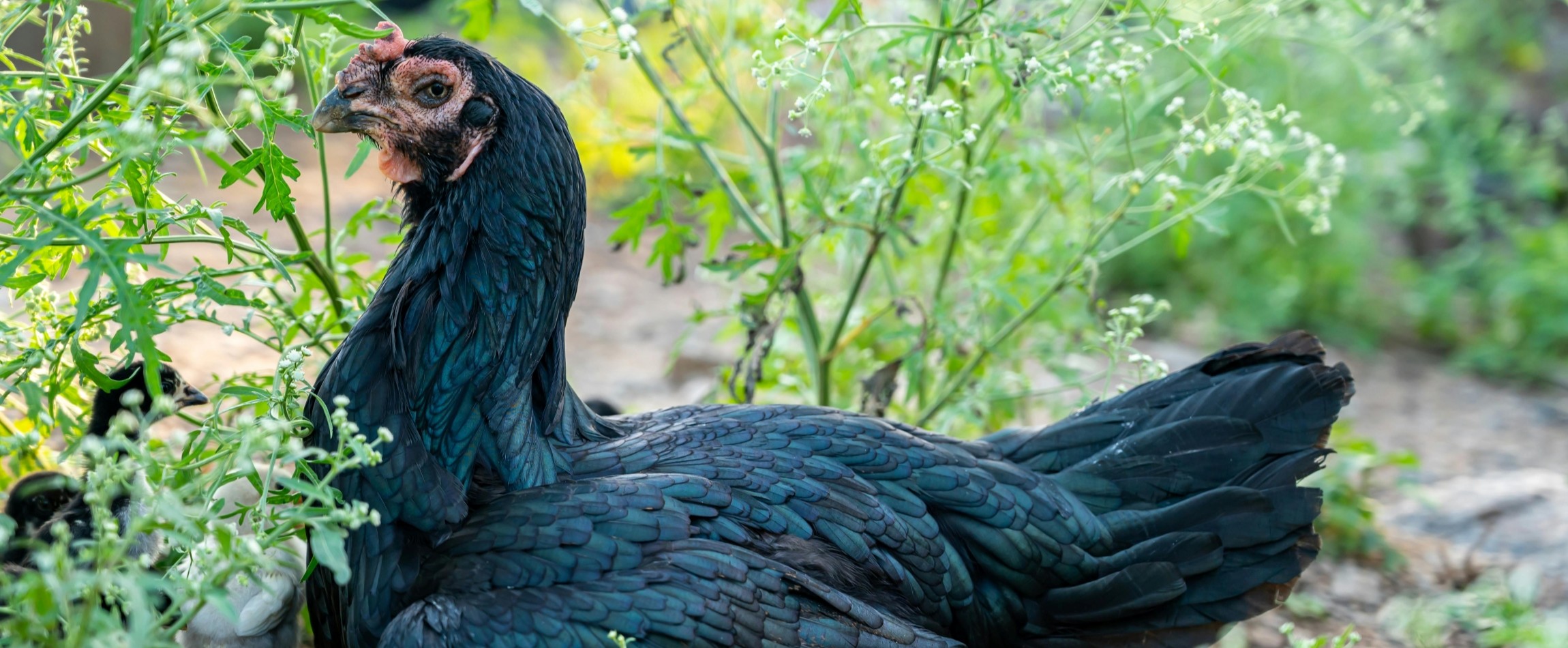
The authors found that several states in Northeast India, especially Manipur, Assam, Arunachal Pradesh, and Sikkim, have much lower levels of chicken intensification than expected, given their income levels. For example, Sikkim has the second-highest income per person in India but less than 1% of its chickens are raised on commercial farms. In these states, chicken production remains reliant on smallholders, unlike most of India where commercial farming dominates.
One possible reason for these outliers is geography, as the mountainous, forested terrain of the Northeast makes large-scale farming difficult. Another reason could be the region’s lower human population densities, meaning that the market might not be large enough to encourage commercialization.
However, in the authors’ view, the most compelling reason is strong policy choices. Sikkim became the world’s first 100% organic state, banning hormones, growth regulators, feed additives, and antibiotics. Similar organic farming regulations exist in Mizoram, Arunachal Pradesh, and Meghalaya, with support from an organic agriculture program launched by the national government. These states also promote self-sufficiency in egg and chicken meat production through organic farming, and Sikkim has even invested in high-yield indigenous chicken breeds to improve productivity while keeping backyard systems.
The role of these organic policies is highlighted when considering Uttarakhand, a state with similar geography and population density to the Northeastern states but with high levels of chicken intensification. This suggests that the difference is less about physical conditions and more about policies shaping farming practices.
However, there are limitations to note. Some states, like Sikkim and Assam, still import large amounts of chicken meat and eggs, meaning their low intensification is partly offset by production happening elsewhere. Also, backyard systems in the Northeast are sustained by the fact that over half of households (57%) keep farmed animals, which may not be realistic in more urbanized settings.
Another possible limitation is religion, which the study didn’t address. Dietary preferences shaped by religious practices could also influence both consumption patterns and farming systems, and may partly explain differences between states.
Overall, the results suggest that policy can play a key role in limiting the intensification of animal farming, even as economies grow. India’s Northeastern states provide useful models, though not every approach can be directly applied elsewhere. Still, these policies show that step-by-step transitions, like promoting backyard production, organic farming, and indigenous breeds, could help other regions reduce reliance on intensive farming.
The authors argue that as countries develop, animal welfare often gets worse before it improves again. Laws and policies, such as the Better Chicken Commitment and corporate pledges to raise welfare standards, along with mechanisms for accountability, could play a crucial role in protecting animals while supporting sustainable growth.
https://doi.org/10.3389/fanim.2025.1488863

Citations:
Khire, I., & Ryba, R. (2025). Breaking free from the trend: Outlier policies promote sustainable poultry practices. Frontiers in Animal Science, 6, 1488863. https://doi.org/10.3389/fanim.2025.1488863