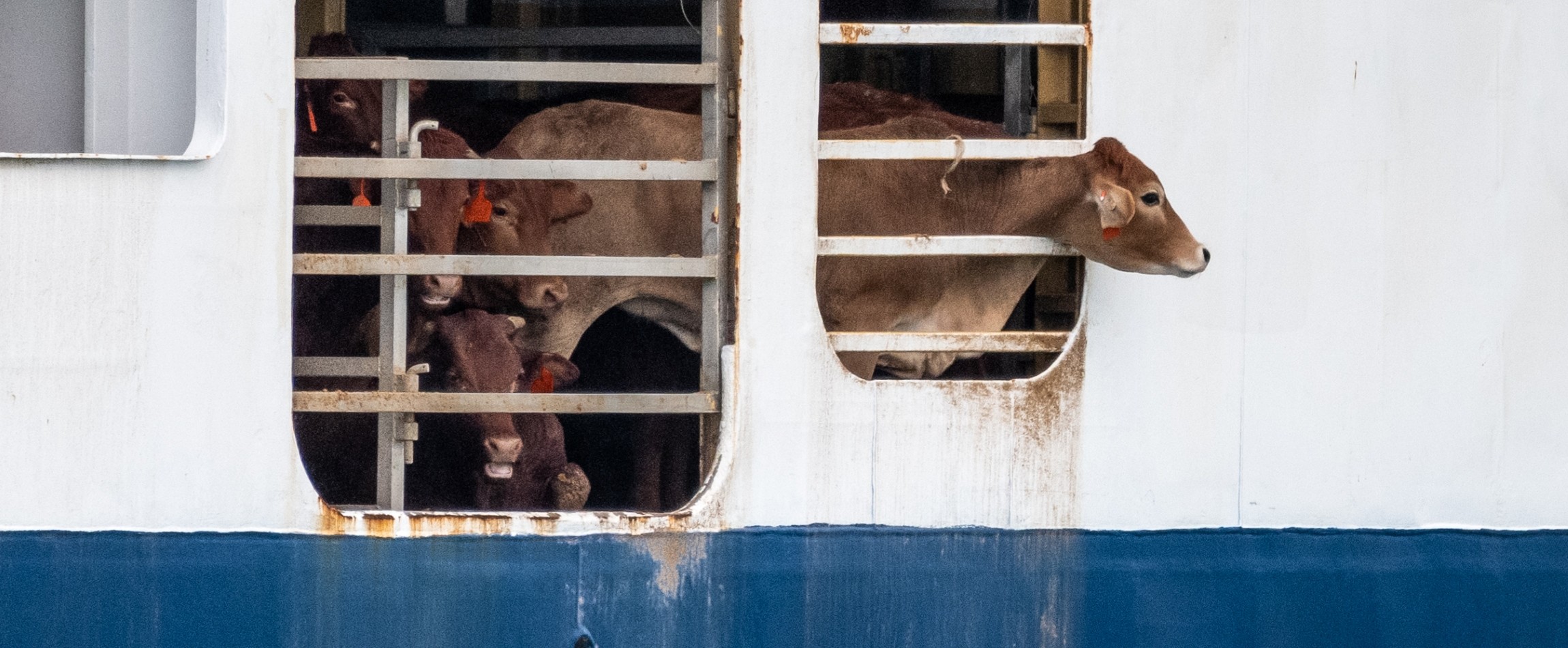
Global Livestock Fleet Plagued By Safety Failures


For years, animal advocates have raised concerns about transporting farmed animals over long distances, including the world’s oceans. This global investigation traces major shipping routes linking exporting regions such as Australia, New Zealand, Europe, and South America with importing countries across regions like the Middle East, North Africa, and Asia. Although no official global count exists, the authors estimate that tens of millions of farmed animals are shipped by sea each year.
The report’s purpose is to document, in detail, the condition and track record of every ship known to be involved in this trade, and to expose the safety, environmental, and animal welfare risks built into the sector’s ownership and oversight structures.
To do this, the authors compiled data on 159 ships from public maritime sources, including the ship information database Equasis, port inspection records, ship tracking data, and records from the independent agencies that certify whether ships meet technical standards. This was a moving target: the report notes that ship names, flags, and owners changed frequently while the research was underway. To track vessels accurately despite these changes, the authors relied on each ship’s permanent International Maritime Organization registration number, which stays fixed for the life of the vessel.
Most Ships Are Old, Converted, And Hard To Trace
Most of the fleet, 134 of the 159 ships (84%), are other types of vessels like cargo or container ships that were converted to carry animals rather than purpose-built for it. These converted ships are 45 years old on average and have a troubling record. On average, they have been cited for 242 safety and equipment problems and detained by port authorities four times over their lifetimes. By contrast, the 25 ships built specifically for the trade are newer (17 years old on average) with far fewer deficiencies (57 on average) and detentions (once on average).
Despite the documented risks of converted ships, the practice is accelerating. Ten ships were converted between January 2024 and March 2026, compared with just three during all of 2022 and 2023 combined. Meanwhile, the last purpose-built ship for international transport was launched in 2017.
Ownership is difficult to trace. More than half the fleet (55%) is officially owned by shell companies based in tax-optimized jurisdictions such as Panama, while the people actually managing the ships are typically based in the same countries that export or import the animals.
A Pattern Of Safety Failures
An international coalition of maritime authorities has ranked livestock carriers the worst-performing type of vessel afloat for at least six years running. In the most recent annual assessment, 88% of inspections turned up at least one deficiency, and 15% ended in detention — nearly four times the average detention rate across all ship inspections. Across their lifetimes, the 159 ships have been detained a combined 565 times.
According to inspection results from 2024 and 2025, the most common deficiencies include issues with certificates and documents (52%), safety of navigation (49%), life-saving appliances (46%), and fire safety (45%).
The authors also describe a loophole in the system used to flag high-risk ships. Owners whose vessels approach a “high-risk” threshold can effectively reset the count by switching to a new ship safety certifier or safety management company, or by re-flagging the vessel to a country whose record hasn’t yet been ranked.
When Voyages Go Wrong
The report documents the toll when incidents occur at sea. Since 1975, at least ten shipwrecks have been recorded due to collisions, fires, storms, or unstable cargo distribution, killing 88 crew members and at least 193,000 animals combined. Recent examples include the 2020 sinking of the Gulf Livestock 1 off the coast of Japan, which killed 41 crew members and 5,867 cows, and the 2019 sinking of the Queen Hind in Romania, which killed 14,420 sheep.
While major shipwrecks have slowed over the past four years, the report highlights an emerging risk from regional conflict. In May 2026, the Haji Ali, an Indian dhow carrying hundreds of sheep and goats from Somaliland to the United Arab Emirates, was struck by an unidentified explosive device in the Gulf of Oman and sank with its cargo.
Even on voyages that go as planned, international shipping rules classify live animals as cargo, and veterinary care isn’t required on every route. Reliable information on animals’ condition once a ship is at sea is also scarce, and the report finds that their welfare isn’t systematically addressed once a voyage is underway. The animals aboard, mostly sheep and cows, can spend weeks or months at sea exposed to movement, noise, vibration, artificial light, humidity, heat, ammonia buildup, crowding, and inadequate feed and water. The report describes animals giving birth in these conditions with little support available.
Crew Conditions And Environmental Pollution
The report finds parallel problems for the crews who operate these ships, and for the environment. In 2024 and 2025, deficiencies related to seafarers’ working and living conditions were recorded on 60 ships, and 16 cases of crew or vessel abandonment occurred, up from 14 across the previous three years combined.
Aging engines and outdated pollution-filtration systems on many of these ships also put them in violation of international environmental rules. In 2024 and 2025, inspectors recorded 80 pollution-related deficiencies on 50 ships, or 31% of the fleet, most often involving oil pollution or garbage disposal. International rules currently classify dead animals as “garbage,” which allows carcasses to be disposed of at sea under certain conditions rather than brought ashore for proper handling.
Limitations
The authors had to piece their findings together from multiple maritime data sources, which can go out of date or leave gaps. They caution that ownership and operational details can change quickly, and that some figures, like the number of animals aboard the dhow that sank in the Gulf of Oman, couldn’t be independently verified.
Time To End Live Transport By Sea?
This report adds to a growing body of evidence that transporting farmed animals by sea carries risks no amount of regulation has fully resolved. Safety and welfare problems are concentrated in aging, converted ships. Yet the industry keeps converting more of them despite the risks, which suggests that stronger inspection rules alone may not fix a sector built around deteriorating, hard-to-trace vessels.
Advocates working to end live export in favor of shipping boxed meat or carcasses instead may find this report useful. It shows that many of the trade’s core problems — aging fleets, ownership structures that obscure accountability, and welfare gaps once a ship reaches open water — are structural features of the industry rather than the result of a few bad operators.
This summary was drafted by a large language model (LLM) and closely edited by our Research Library Manager for clarity and accuracy. As per our AI policy, Faunalytics only uses LLMs to summarize very long reports (~50+ pages) that are not appropriate to assign to volunteers, studies that contain graphic descriptions of animal cruelty or animal industries, and research on niche topics. We remain committed to bringing you reliable data, which is why any AI-generated work will always be reviewed by a human.