
Fish Farming’s False Promise Of Saving The Oceans


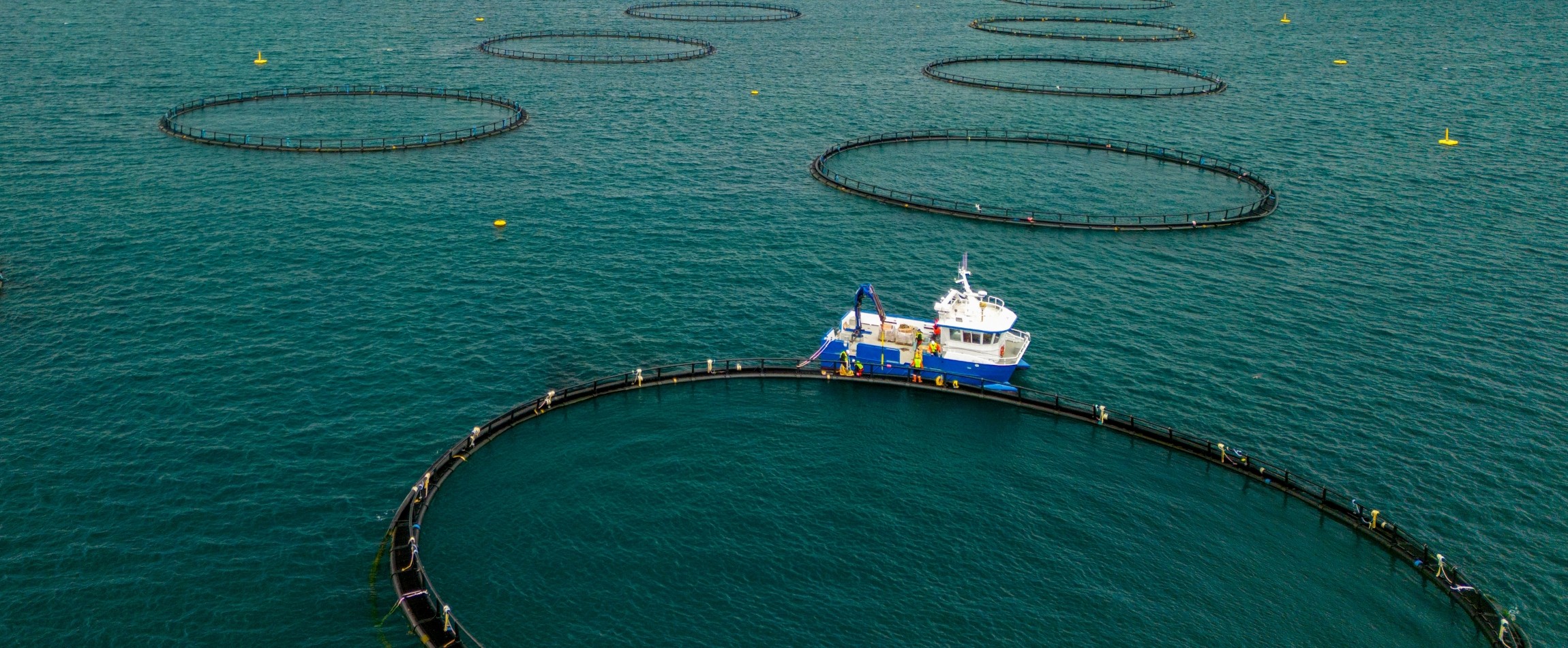
Beginning in the late 20th century, Norway’s salmon farming industry led what it called a “Blue Revolution,” claiming that farming fishes could protect wild fish populations while delivering healthy, sustainable protein to a growing global population. The campaign worked. In 2022, industrial aquaculture production reached 94 million tonnes, surpassing wild-capture fisheries for the first time in history. Today, the sector is worth over $300 billion and supplies 51% of aquatic animal products for human consumption.
However, the reality behind this growth is far from sustainable. This report analyzes five influential myths that the industry uses to justify its growth and maintain a veneer of social and ecological responsibility. Behind the promise of “sustainable seafood,” industrial aquaculture replicates the problems of land-based factory farming, perpetuating ecological collapse and public health risks.
The author draws on scientific literature, government documents, industry data, and investigative reporting to argue that each claim obscures serious harms to oceans, animals, and people. The report focuses primarily on carnivorous species like salmons, which are the most consumed in the Global North and the most ecologically costly to produce. The author also scrutinizes specific industry metrics, such as the Fish In:Fish Out (FIFO) ratio, to determine whether these accurately reflect the sector’s impact on wild fish populations.
Myth #1: Reducing Pressure On Wild Fisheries
The report provides evidence that industrial aquaculture actually exacerbates overfishing. Carnivorous species like salmons are fed diets made from millions of tonnes of small wild-caught fishes, such as anchovies and sardines. These forage fishes are largely sourced from vulnerable Global South fisheries in regions like West Africa and South America. They’re foundational to marine food webs, and their extraction for feed disrupts nutrient flow and reduces prey availability for seabirds and marine mammals. Furthermore, a 2024 study found that true FIFO ratios (a measure of how much wild fish it takes to produce farmed fish) are 27% to 307% higher than industry estimates, meaning aquaculture is a net drain on marine protein.
Myth #2: Meeting A Growing Demand For Seafood
According to the report, the industry doesn’t passively respond to demand; it engineers it. Through supply-driven demand, producers flood markets with cheap products, transforming occasional luxuries like salmon into routine staples. Rather than displacing wild-caught consumption, aquaculture is additive, driving overall fish intake higher and compounding pressure on ecosystems. In fact, per-capita sea animal consumption has more than doubled since the 1980s.
Myth #3: Providing A Healthy Protein Source
The report likens industrial aquaculture operations to water-based factory farms. Crowded, waste-laden pens create ideal conditions for parasites like sea lice and diseases such as infectious salmon anemia, which cause massive die-offs and infect wild populations. To keep animals alive, the industry depends on antibiotics classified as medically important for humans. This has contributed to the global antimicrobial resistance crisis, with testing finding drug-resistant bacteria on retail shelves. By 2030, aquaculture is projected to use more antibiotics per kilogram of production than any other farmed animal sector.
Myth #4: A Climate-Smart Food Solution
The report points to industrial aquaculture’s heavy carbon burden. Life-cycle analyses show that farmed fish produce an average of about 14 kilograms of carbon dioxide-equivalent per kilogram of food product — more than poultry or pork, and 13 times higher than peas. Feed production alone accounts for up to 94% of emissions from salmon farming, even as it shifts away from fish meal and fish oil towards more plant-based ingredients. Shrimp aquaculture has also been a major driver of mangrove destruction since the 1980s, accounting for 38% of mangrove deforestation worldwide. Because mangroves store up to five times more carbon per hectare than most tropical forests, their destruction turns these critical carbon sinks into emissions sources.
Myth #5: Reliable Certifications And Labels
The report asserts that sustainability labels like those from the Aquaculture Stewardship Council (ASC) are primarily marketing tools. These programs are often funded by the companies they certify, creating significant conflicts of interest. Standards are frequently weak or poorly enforced. For example, a 2022 investigation found that five out of six ASC-certified Scottish salmon farms exceeded the program’s own sea lice limits — and all kept their certification. Widely trusted consumer guides like Seafood Watch rate fish by species and region rather than auditing individual farms, meaning that serious problems like high mortality can be hidden behind broad averages.
Because the harms of industrial aquaculture are systemic rather than incidental, the report argues that reform through stricter standards and stronger oversight is likely insufficient. In the author’s view, true ocean protection requires confronting the scale of sea animal consumption.
To this end, advocates can:
- Question greenwashing. Educate the public that certification labels aren’t reliable stand-ins for sustainability.
- Promote plant-forward choices. Encourage consumers to replace animal-based seafood with plant proteins like beans, soy, and grains, which carry a fraction of the carbon, land, and water burdens.
- Target institutional policy. Foodservice leaders like Sodexo and Compass Group have already pledged to significantly increase plant-based menu offerings to meet climate goals, signaling that high-impact, institutional-level change is both possible and underway.
This summary was drafted by a large language model (LLM) and closely edited by our Research Library Manager for clarity and accuracy. As per our AI policy, Faunalytics only uses LLMs to summarize very long reports (50+ pages) that are not appropriate to assign to volunteers, as well as studies that contain graphic descriptions of animal cruelty or animal industries. We remain committed to bringing you reliable data, which is why any AI-generated work will always be reviewed by a human.

Citations:
Cascada, L. L. (2026). The myth of “sustainable” aquaculture: How the fish farming industry sold a false promise of saving the oceans. Aquaculture Accountability Project, Farm Forward. https://aquacultureaccountability.org/wp-content/uploads/2026/01/The-Myth-of-Sustainable-Aquaculture.pdf
