Evidence That Routine Tail Docking In Pigs Is Unnecessary


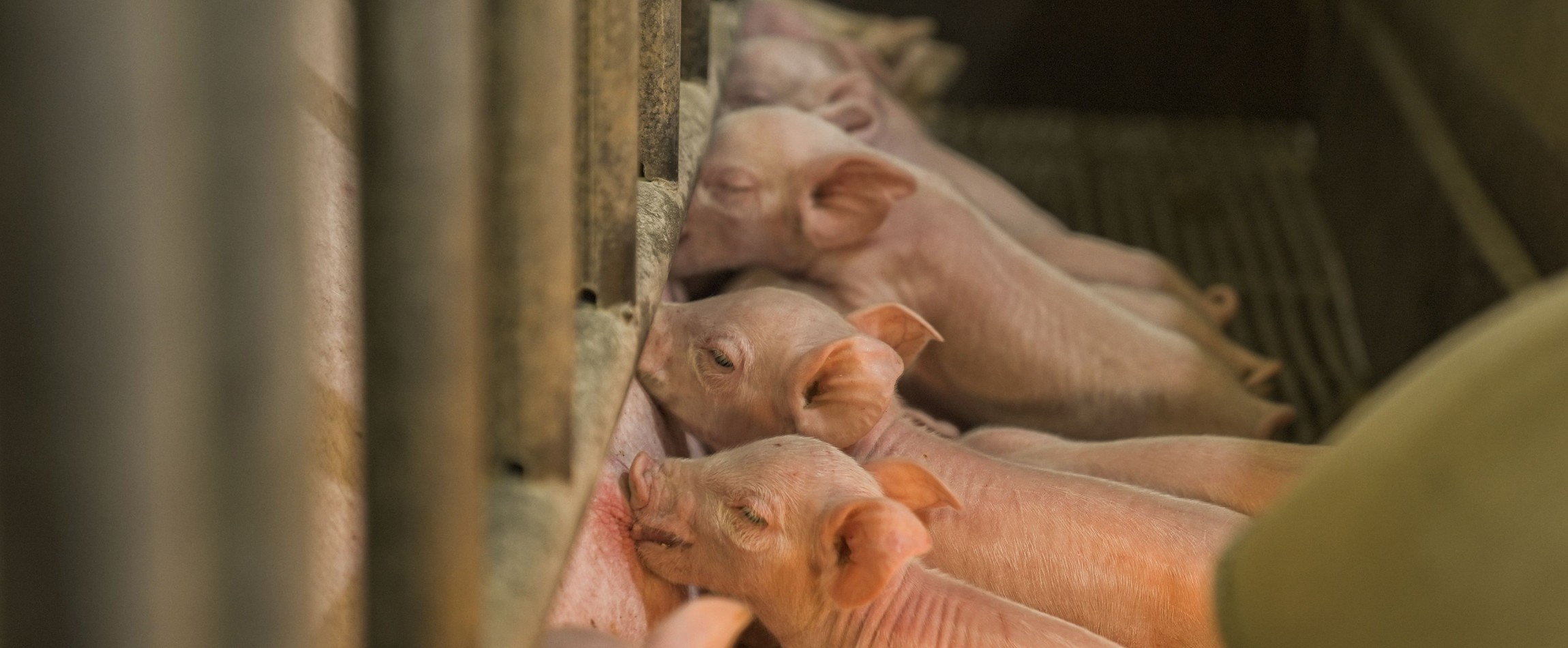
More than 10 million farmed pigs are slaughtered in the U.K. every year. The majority of these are raised in intensive indoor systems. A common practice in these systems is tail docking — the amputation of part of a pig’s tail to reduce injury from other pigs biting it. Tail biting is an abnormal behavior that doesn’t occur in wild pigs, who naturally spend their time rooting, foraging, and exploring. It emerges in farmed pigs when living conditions prevent them from meeting their complex behavioral needs. Factors associated with higher rates of tail biting include the absence of straw, barren environments, overcrowded pens, competition for food, slatted floors, poor nutrition, and temperature stress.
Tail docking is typically performed on piglets in their first week of life, without pain relief, and causes both immediate and long-term harm, including tail stump sensitivity and chronic pain. Critically, it doesn’t even solve the problem it’s meant to address. Because the underlying environmental conditions remain unchanged, tail biting continues to occur even in docked populations, with studies showing prevalence rates ranging from 58% to 72.5%.
This report, published by The Animal Law Foundation, investigates why routine tail docking continues to be widely used in the U.K. despite being prohibited in law, and what can be learned from jurisdictions that have successfully moved beyond it. The authors conducted a comparative legal and policy analysis across five jurisdictions: the U.K., Finland, Sweden, Norway, and Switzerland. For each country, the report reviews relevant legislation, enforcement practices, housing requirements, and available data on tail biting and lesion rates. It draws on secondary sources including legislation, inspection records, farmer surveys, and expert testimony rather than primary data collection.
Under U.K. law, tail docking is classified as a mutilation and is prohibited except as a last resort, after attempts to improve environmental conditions or management systems have failed to stop biting. Veterinary authorization is required before docking proceeds in England and Scotland.
Yet data from multiple sources suggest the law is being systematically disregarded. A welfare monitoring program covering 95% of commercially raised pigs found that 72% had been tail docked between 2018 and 2020. Undercover investigations at farms between 2016 and 2021 found the practice on 85% of premises visited. An expert survey across 24 European countries estimated 84% of pigs in the U.K. were docked on average. These figures reflect a long-standing trend: abattoir surveys show docking rates rose from 25% in 1972 to 81% by 1999. With only 2.2% of farms inspected in 2024, enforcement is far too infrequent to change behavior.
The veterinary profession’s role is also a concern. Because vets are required to authorize docking, high rates of the procedure suggest that authorization is routinely granted without adequate evidence that welfare improvements were tried first. In that same expert survey across 24 European countries, researchers found that economic constraints and market pressures for farmers (18%) and farmers’ management, knowledge, and resistance to change (20%) were among the most commonly cited barriers preventing vets from advising against the procedure, suggesting that commercial relationships are compromising professional obligations to animal welfare.
Finland, Sweden, Norway, and Switzerland demonstrate that commercial pig farming without routine tail docking is viable. Each country goes beyond the European Union minimum on housing standards in many cases — for instance, by providing larger space allowances, restrictions or outright bans on fully slatted floors, or more robust enrichment requirements.
Finland
Finland has banned all tail docking. The government supports producers who improve conditions for pigs with subsidies, including an ‘intact tail subsidy’ when fewer than 5% of pigs arrive at slaughter with tail wounds. Severe tail lesions from biting occur in just 0.9% to 1% of Finnish pigs. Finnish producers also show a cultural difference from their U.K. counterparts: surveys have found that the majority wouldn’t dock pigs even if it were legal, often viewing the practice as cruel.
Sweden
In Sweden, tail docking has been banned since 1988. Tail biting is considered a minor issue, occurring at a rate of 1% to 3% according to official slaughterhouse records. Virtually all Swedish farmers provide straw. Notably, the Swedish government collaborated with producers, retailers, and banks to promote Swedish pork and strengthen the economic situation for farmers, demonstrating that higher welfare standards and commercial viability don’t have to be in conflict when regulators and industry work together to support the market.
Norway
Norway’s strict procedural requirements — mandating veterinary involvement, anesthesia, and prolonged pain management for any docking — have effectively ended the practice altogether. A 2018 expert survey found that 0% of Norwegian pigs were docked. Although government records of tail-biting prevalence at slaughter somewhat conflict with independent on-farm studies (2% versus 7% to 10% of pigs), Norwegian farmers widely report that tail biting is not much of a problem and that high animal welfare standards provide a competitive advantage and support public trust in their industry.
Switzerland
Switzerland has prohibited tail docking since 2008, framing it legally as a violation of an animal’s inherent dignity. An expert survey found approximately 2.5% of Swiss pigs were still docked despite the ban, and acute tail lesions occur in just 1.3% of pigs, consistent with findings in Finland. The Swiss government supports high-welfare farming through two types of subsidies: payments for farmers who provide animals with regular outdoor access, and payments for those who use higher-welfare housing. According to the report, most Swiss farmers raising farmed pigs, chickens, and cows benefit from these welfare-conditional subsidies — a model that ties economic support directly to animal welfare outcomes.
Comparative welfare data across countries should be interpreted with caution, as recording and scoring systems for tail injuries vary across jurisdictions and may not be directly comparable. Additionally, some country-level survey data include small sample sizes. However, these considerations don’t undermine the report’s core argument — that commercial pig farming without routine tail docking is both possible and feasible.
The evidence assembled here suggests that the U.K.’s reliance on routine tail docking reflects systemic failures of enforcement and farm management, not a genuine welfare necessity. Pigs in Finland, Sweden, Norway, and Switzerland live without routine tail mutilation, and tail biting is generally a manageable, low-prevalence issue in those systems. The difference lies not in the pigs but in their conditions.
For advocates, this report points to an important opportunity: ending routine tail docking in the U.K. may not require new legislation at all. The existing prohibition is clear, and because basic housing standards are already legally mandatory for all farms, the requirement to improve conditions before docking can proceed must mean going above and beyond those minimums — not simply meeting them. What’s needed is enforcement: more frequent farm inspections, consistent action when violations are found rather than repeated warnings, and accountability for veterinarians who authorize docking without evidence that genuine welfare improvements were attempted first. Advocates working to end this practice don’t need to argue for a change in the law; they can demand that the existing law is applied.
This summary was drafted by a large language model (LLM) and closely edited by our Research Library Manager for clarity and accuracy. As per our AI policy, Faunalytics only uses LLMs to summarize very long reports (~50+ pages) that are not appropriate to assign to volunteers, studies that contain graphic descriptions of animal cruelty or animal industries, and research on niche topics. We remain committed to bringing you reliable data, which is why any AI-generated work will always be reviewed by a human.

Citations:
The Animal Law Foundation. (2026). A pig’s tail: How Europe is moving beyond routine tail docking. https://animallawfoundation.org/s/A-pigs-tail-Report-mgn5.pdf