
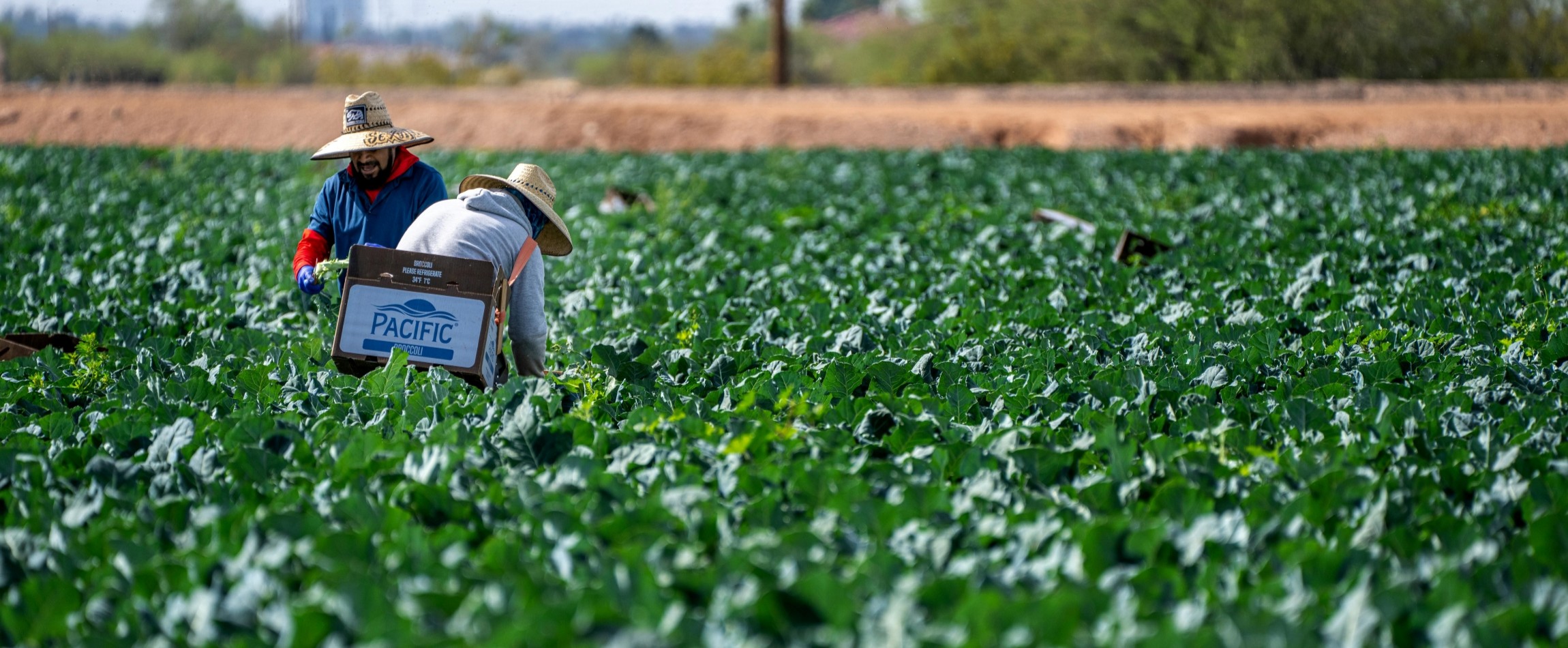
A More Plant-Based World Would Reshape Agricultural Work


In 2019, the EAT-Lancet Commission proposed a global dietary transition that allows both humans and the planet to thrive. It’s a highly influential work that continues to inform policy development and cross-disciplinary research. It recommends plant-based diets rich in fruits, vegetables, legumes, nuts, and whole grains, and reduced overall animal product intake.
This economic modeling study serves as supporting evidence for the EAT-Lancet Commission’s recommendations. Here, the main focus is the agricultural labor transition associated with the global adoption of healthy and sustainable diets. More than a quarter of the world’s employed workers — roughly 860 million people — work in agriculture, making the labor implications of any large-scale dietary shift a critical policy concern.
First, the researchers developed an inventory of labor requirements for the production of 13 plant-based foods and seven animal products across representative production systems and farm sizes from 197 countries. Farm size was used to infer farm labor for any country where specific labor data was lacking. This approach was tested and found to produce reliable estimates. Fisheries data was sourced from an international database spanning 37 countries. Figures for countries not represented in the database were derived from broader regional estimates.
These labor requirements were then linked to projections of how much food would need to be produced under each EAT-Lancet dietary pattern. Scenarios were run by country for flexitarian, pescatarian, vegetarian, and vegan diets. The year 2020 was used as a baseline, and model projections were run for 2030 and 2050. These projections accounted for a range of population and income growth pathways, which influence food demand and agricultural efficiency.
The researchers found that, on average, producing animal products requires roughly four times more labor per unit of food weight than producing plant-based foods. Thus, adoption of plant-rich diets would lead to global reductions in total agricultural labor requirements when compared with a business-as-usual future scenario. The amount of labor reduction depends on the extent that animal products are reduced, ranging from 5% for flexitarian and pescatarian diets to 22% to 28% for vegetarian and vegan diets in the 2030 projection.
Global reductions in labor requirements are also associated with substantially lower economic costs — an estimated US$290 to US$310 billion annually for flexitarian and pescatarian diets, and US$790 to US$995 billion annually for vegetarian and vegan diets in the 2030 projection.
The regional differences underlying this global change are substantial. For example, labor reductions are greatest in countries where animal farming currently dominates, but 26% to 46% of countries in the 2030 projection show increased labor requirements to meet the higher demand for fruits and vegetables. The researchers also note that there would be regional changes to food affordability, farm sizes, and rural livelihoods, all of which are important to consider from a policy perspective.
For those interested in a deeper dive, the article’s appendix presents detailed cross-tabulated results by region and dietary scenario. It also contains a scoping study estimating that 10% to 40% of displaced agricultural workers (depending on the dietary scenario) could be reabsorbed into nature conservation jobs on land no longer needed for animal farming — at a cost roughly equivalent to 0.1% of global gross domestic product.
The researchers highlight that changes in agricultural labor demand will bring both opportunities and challenges, without making a value judgment about these shifts. The study’s modeling has the capacity to inform policy development in support of the labor market transition. However, there are several models and assumptions underlying the work. Perhaps the most significant of these are the assumed future development pathways for each country.
For animal advocates, this study provides important data for a concern that often comes up when arguing for dietary change: what happens to the people whose livelihoods depend on animal farming? The findings suggest that a global shift toward plant-rich diets would reduce agricultural labor demand in some parts of the world and increase it in others. This transition therefore requires proactive policy, including worker retraining programs, investment in horticulture, and rural livelihood support. Advocates pushing for food system change can use this research to argue that a global dietary shift is manageable but demands careful planning.
https://doi.org/10.1016/j.lanplh.2025.101342

Citations:
Vittis, Y., Obersteiner, M., Godfray, H. C. J., & Springmann, M. (2025). Labour requirements for healthy and sustainable diets at global, regional, and national levels: A modelling study. The Lancet Planetary Health, 9(10), 101342. https://doi.org/10.1016/j.lanplh.2025.101342
