
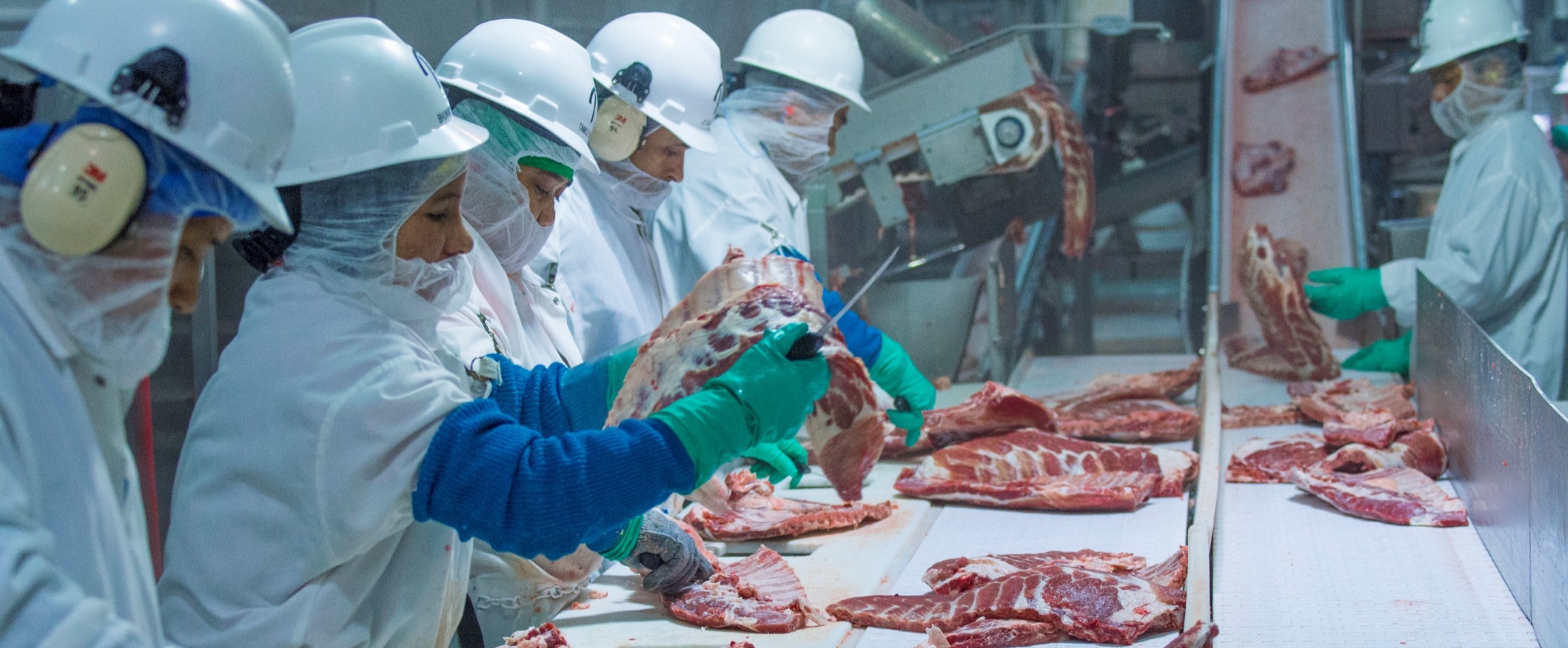
Pig Slaughterhouses Put U.S. Workers At Risk


In 2019, the United States Department of Agriculture (USDA) established a new system that eliminated the maximum line speed limits for slaughterhouses processing farmed pigs. After a court challenge set a limit of 1,106 head per hour, the USDA allowed six establishments to participate in a “time-limited trial” to operate at even faster speeds.
Researchers from the University of California, San Francisco were commissioned to investigate the impact of these increased evisceration line speeds on worker health and safety. The study involved 574 workers across the six participating slaughterhouses. The researchers collected data during two periods: once when the plants operated at the standard speed of 1,106 head per hour, and again when they operated at a faster time-limited trial speed — up to 350 more head per hour in some cases. Using surveys, interviews, video recordings, and wearable devices that measured forearm muscle activity and wrist movements, the study aimed to provide a clear picture of how slaughter speed affects workers.
The workforce studied was about 40 years of age on average. Most employees were male (75%), born outside of the U.S. (81%), identified as Hispanic (69%), and had a primary language other than English (92%).
The study’s primary measure for injury risk was the Peak Force Index Threshold Limit Value score, where a score greater than 1.0 is considered an unacceptably high risk for musculoskeletal disorders. Musculoskeletal disorders are painful and debilitating injuries to muscles, nerves, tendons, and joints caused by highly repetitive and forceful movements. The findings revealed that worker risk is alarmingly high across the board, regardless of line speed.
Nearly half (46%) of all workers were found to be at high risk for musculoskeletal disorders when their establishments operated at the faster time-limited trial line speeds. This risk varied significantly between plants, with the proportion of high-risk workers ranging from 22% at one facility to 65% at another. Yet, slowing things down made little difference: a similar proportion of workers — 45% — were also at high risk for musculoskeletal disorders at the standard line speed. This ranged from 35% to 58% depending on the facility.
Across all establishments, 43% of workers reported experiencing moderate to severe upper-body pain within the last 12 months. For every 100-head-per-hour increase in line speed, the odds of a worker reporting this pain increased by 31%.
Surprisingly, a faster overall line speed didn’t always lead to a higher risk of injury. While one establishment saw a statistically significant increase in musculoskeletal disorder risk at faster speeds, another saw a significant decrease, and the remaining four saw no significant change. The establishment that reduced risk had a comprehensive ergonomics program and lower individual workloads.
This suggests that the overall line speed is a poor indicator of individual worker risk. A more accurate predictor was the “piece rate” — the number of pig parts a single worker handles per minute. The study found that for every additional unit a worker processed per minute, their odds of being at high risk for a musculoskeletal disorder increased by 7%. This shows that individual workload, a combination of speed and staffing levels, is a key driver of injury in pig slaughterhouses. Notably, related research in chicken slaughterhouses came to a similar conclusion.
The study also shed light on the personal toll of this work and a culture that may discourage workers from seeking help. Among workers who had experienced pain, about one-third (32%) didn’t report it to their supervisor. Some feared punishment or job loss for speaking up, while others didn’t think the company would help them.
Pain had a significant impact on workers’ lives outside the slaughterhouse. Around 36% of those with pain said it prevented them from doing important personal activities, and almost one-quarter (24%) had considered changing lines or quitting because of it.
The study notes that its findings are likely an underestimate. The six pig processing plants had an extremely high average annual turnover rate of 49%. This “healthy worker survivor effect” means that employees who are injured or unable to cope with the physical demands of the job often leave, resulting in a current workforce that appears healthier than it is.
For advocates, this data bridges the gap between animal welfare and human rights, illustrating that industrial animal agriculture is a system built on the exploitation of both human and non-human lives. By framing the issue through a One Health lens — where the well-being of humans and animals is interconnected — advocates can more effectively challenge industry narratives of “efficiency” and “sustainability,” as a system causing chronic pain for nearly half its workers is fundamentally broken. Furthermore, the evidence of widespread underreporting of injuries and fear of retaliation among workers can be used in public awareness campaigns to highlight the hidden human cost of cheap meat, encouraging a shift toward more compassionate and equitable food systems.
This summary was drafted by a large language model (LLM) and closely edited by our Research Library Manager for clarity and accuracy. As per our AI policy, Faunalytics only uses LLMs to summarize very long reports (50+ pages) that are not appropriate to assign to volunteers, as well as studies that contain graphic descriptions of animal cruelty or animal industries. We remain committed to bringing you reliable data, which is why any AI-generated work will always be reviewed by a human.

Citations:
Harris-Adamson, C., Harrison, R., Afterman, M., Barr, A., Gandhi, S., Gribble, M. O., Houghton, F., Houlroyd, J., & Rempel, D. (2025). Swine processing line speed evaluation study (PULSE). USDA Food Safety and Inspection Service. https://www.fsis.usda.gov/sites/default/files/media_file/documents/PULSE_SwineStudy_250109_Final.pdf
