
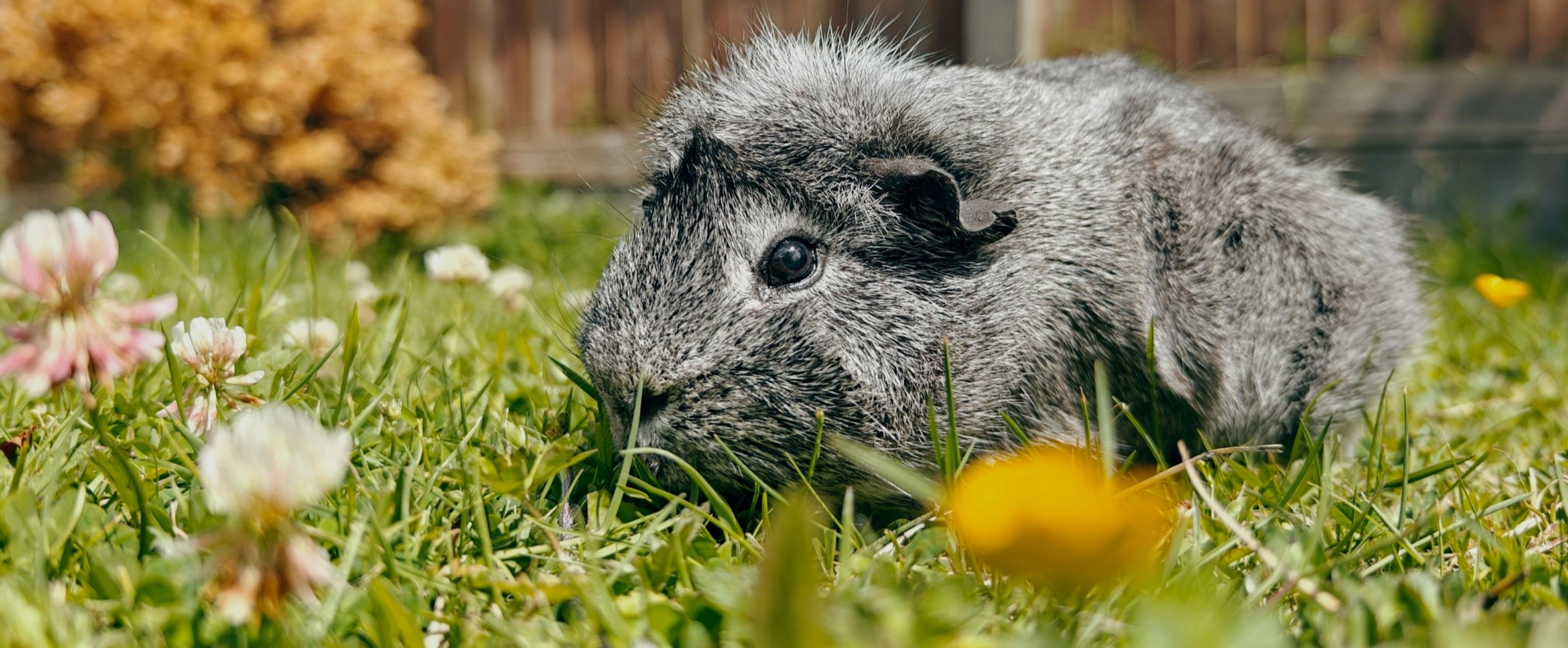
How Do We Have Healthy, Happy Guinea Pigs?


Even when they love their companion animals, guardians may be misinformed as to their best care. This is particularly true when it comes to “exotic pets” such as guinea pigs. For companion animals to have healthy, happy lives, species-specific needs must be met.
The purpose of this study was to investigate how guinea pig guardians care for their animals. Researchers were also interested in how often guinea pigs engage in certain behaviors in order to explore relationships between husbandry and behavior. They developed a German-language survey with 72 questions focused on the following topics:
- Guinea pig demographics (e.g., age, sex, spay/neuter status)
- Housing (e.g., enclosure size and type, social groupings, enrichment)
- Feeding
- Health (e.g., veterinary visits, grooming)
- Behavior (e.g., hiding, chasing, resting)
- Human-animal interactions (e.g., hand-feeding, training, stroking)
- Guardian demographics
A total of 1,181 surveys were analyzed. Just over 70% of respondents lived in Germany, while close to 27% lived in Austria and around 1% lived in Switzerland.
Encouragingly, only 7.5% of guardians reported keeping solo guinea pigs. The most common grouping was five or more (28%). Average floor space given to guinea pig accommodations was about 6.4 square meters, not including any exercise areas the animals may have access to. The most common types of housing were self-built enclosures (28%) and large, fenced indoor floor areas (15%) without additional exercise possibilities. Only 2% of guardians reported housing their guinea pigs in cages without access to an exercise area, compared to 6% using cages with extra exercise space. Guinea pigs housed in cages were allowed to free-roam five times a week on average, while those in self-built enclosures or large, fenced indoor floor areas were let out only a few times a month.
The majority of guardians (90%) provided their guinea pigs with constant access to hay, with less than 1% reporting never giving hay. For furnishings, houses were the most popular (96%), followed by tunnels or tubes (79%), caves (65%), and hammocks (46%). Fresh branches were frequently given as enrichment, with 25% of guardians offering them several times a week. Cardboard boxes (42%), hay balls (33%), food balls (30%), puzzle toys (28%), and wood to nibble on (27%) were given occasionally.
Most guardians reported interacting with their guinea pigs several times a day, including talking to them (88%), hand-feeding them (55%), and stroking them (23%).
The researchers also explored correlations between guinea pig behavior and guardian care. Guinea pig behaviors were sorted into three categories:
- Agonistic (aggressive) behavior such as biting or chasing;
- Affiliative (friendly) behavior such as resting or eating together; and
- Competition for food such as stealing or blocking access to food.
Affiliative behavior was more common in guinea pigs given more food enrichment and more places to hide, and who were frequently stroked and carried. Agonistic behavior was more common when less food enrichment was provided. Competition for food was less likely when guinea pigs were frequently carried and stroked, but more likely when they were frequently talked to and hand-fed. Higher rates of “popcorning” (playfully jumping in the air) and use of enrichment were associated with guardians who offered frequent food enrichment and spent more daily time engaging with their guinea pigs.
Repetitive behavior, such as running up and down and bar chewing, was observed most frequently in cage-housed and solo guinea pigs, which may well be indicative of stress in inadequate conditions. However, this behavior was also seen more often in guinea pigs who were more frequently stroked, carried, and trained by their guardian. This raises the possibility that it could indicate anticipation or attention-seeking. The researchers note that further exploration is needed, as context is crucial.
Overall, the majority of guinea pigs were kept in appropriate social groups and given appropriate housing with places to hide and a range of enrichment items. Guardians housing guinea pigs in cages largely made up for this with increased use of additional exercise areas and higher frequency of free-roam time. The choices made by guardians suggest that those participating in this study were generally well informed about guinea pig needs and acted upon this knowledge.
As with any questionnaire-based study, there are limitations, including the possibility of sample bias. It could be that the type of people most likely to answer a survey about guinea pig care are more likely to have done research into best practices before getting a guinea pig in the first place. So, although the vast majority of guinea pig guardians in this study employed good care practices, this may not be true for the majority of guinea pig guardians overall, particularly in other countries.
It’s heartening that 92.5% of guardians in this study housed their guinea pigs in appropriate social groups. That said, it’s illegal to keep lone guinea pigs in Austria and Switzerland, so people there and in nearby countries may have more awareness of their social needs. It would be interesting to see how the results of this survey would stack up against a similar study in places like the U.S., where there’s a notable lack of laws protecting small mammals (the Animal Welfare Act doesn’t cover rats and mice, for example). Legislating small mammal companion welfare — or, at the very least, promoting knowledge of best practices in pet stores, where guinea pigs are still frequently sold in the U.S. — could be an important step forward for our cavy companions.
https://doi.org/10.3390/ani15081157

Citations:
Elsbacher, T., Sommese, A., Waiblinger, S., Künzel, F., Arhant, C., & Windschnurer, I. (2025). Guinea pig (Cavia porcellus) welfare: Associations between husbandry practices, human-animal interactions, and animal behaviour. Animals, 15(8), 1157. https://doi.org/10.3390/ani15081157
