E.U. Scientific Body Finds Fur Farming Incompatible With Animal Welfare


In response to the European Citizens’ Initiative “Fur Free Europe,” the European Commission tasked the European Food Safety Authority (EFSA) with providing a scientific opinion on the welfare of animals farmed for their fur. The resulting report examines the well-being of the main species used in fur production in the European Union (E.U.), namely American minks, red and Arctic foxes, raccoon dogs, and chinchillas.
The goal of the report was to identify the most significant welfare problems for these animals and to determine whether these issues could be prevented or “substantially mitigated” within the industry’s current farming practices. These practices typically involve keeping animals in small, barren wire cages for their entire lives. To conduct their assessment, EFSA’s panel of experts reviewed scientific literature, consulted with stakeholders, and carried out field visits. Based on this information and their own expertise, the panel identified and ranked the most pressing welfare issues for each species, along with any potential prevention or mitigation measures.
A System With Inherent Problems
The report’s primary conclusion is stark: for the majority of the most relevant welfare consequences, neither prevention nor substantial mitigation is possible in the current cage-based systems.
Across all five species, the expert panel identified three universal welfare consequences that stem directly from the current housing system:
- Restriction of movement: The cages are too small to allow animals to properly perform basic behaviors like running, jumping, climbing, or playing. For example, some standard cages are shorter than the total body length of a red fox and narrower than the total body length of an Arctic fox.
- Inability to perform exploratory or foraging behavior: The barren wire cages lack the complexity and stimuli needed for animals to engage in highly motivated natural behaviors like digging, hunting, chewing, or manipulating objects.
- Sensory understimulation and overstimulation: The monotonous cage environment leads to understimulation, frustration, and boredom. At the same time, factors like noise and human handling can cause overstimulation from which the animals can’t retreat.
Species-Specific Problems
The report also details severe welfare issues specific to each species.
American Minks
Minks suffer from bite injuries from aggression in group housing. They also experience significant handling stress and, as a semi-aquatic species, deprivation from the lack of open water, a resource they’re highly motivated to access.
Red And Arctic Foxes
Foxes suffer from extreme handling stress. Arctic foxes are prone to painful mobility issues, such as bent feet, linked to genetic selection for fast growth and large body size. As mainly solitary animals, red foxes experience intense group stress, which can lead to infanticide by females housed in close proximity to each other.
Raccoon Dogs
As a social species, raccoon dogs experience isolation stress when housed alone. The fact that they’re unable to establish latrines — sites of social significance where they leave their feces — is also thought to cause stress. They’re susceptible to mobility issues like bent feet and poor paw health as well. Overall, there’s extremely limited research on the specific needs of this species.
Chinchillas
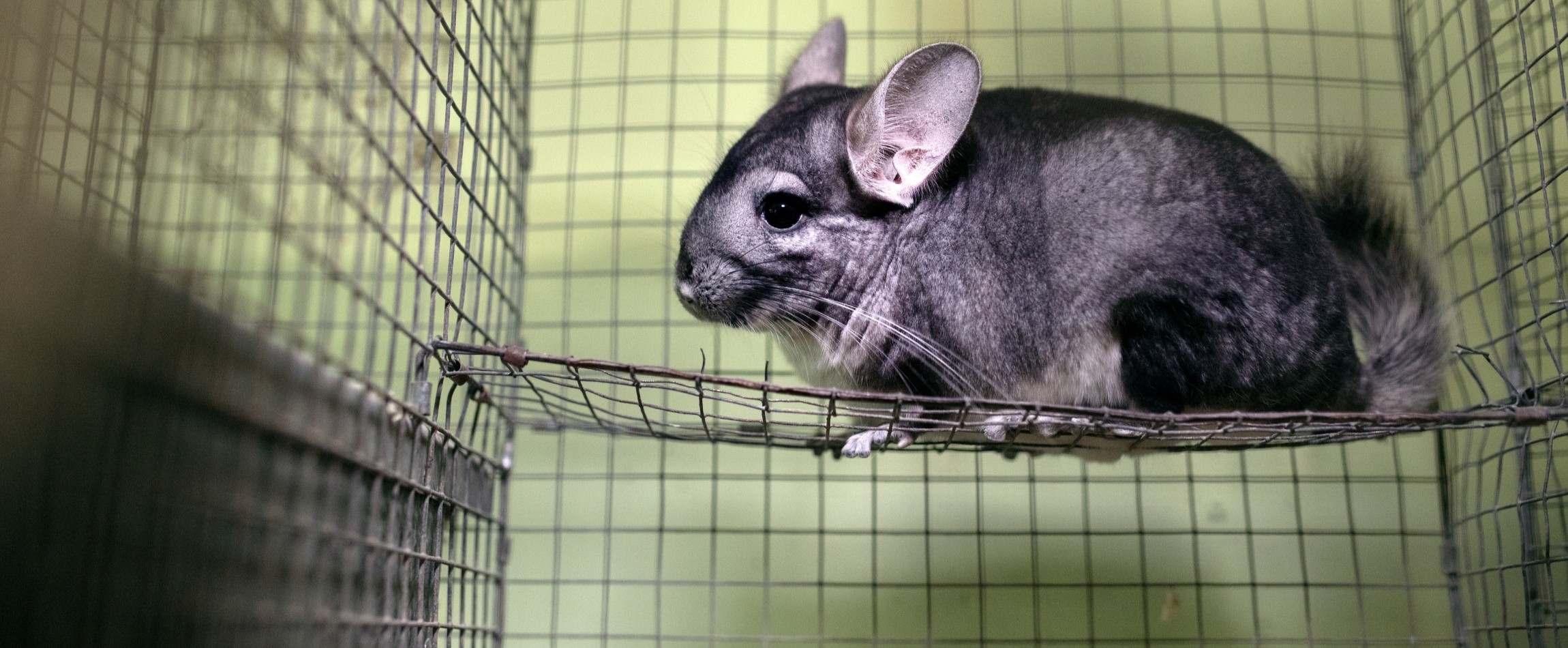
As a prey species, chinchillas suffer from chronic predation stress due to the lack of hiding spaces and frequent human contact. They’re also unable to perform essential comfort behaviors like dust bathing. The absence of suitable resting spots means they’re never really able to rest naturally and comfortably.
Importantly, the report also addresses the common industry argument that these animals have been domesticated. The panel concluded that while some genetic changes have occurred, being bred in captivity hasn’t altered the animals’ fundamental, species-specific behavioral needs. Therefore, they continue to experience poor welfare when they’re unable to perform these behaviors.
The Current System Can’t Continue
The report’s main finding is that substantial welfare improvements would require a complete shift away from the current cage systems to entirely different types of enclosures that provide sufficient three-dimensional space, environmental complexity, and resources that allow for natural behaviors. For most of the identified welfare issues, the panel concluded that meaningful mitigation isn’t possible within the confines of the current system.
This EFSA opinion offers a powerful tool for animal advocates. It provides a credible, authoritative scientific assessment from an E.U. body that directly supports the argument that fur farming is fundamentally incompatible with the welfare needs of the animals involved. Advocates can use these findings to support campaigns for a ban, as the report gives scientific weight to legislative efforts, like the “Fur Free Europe” initiative, that call for an end to fur farming. They can also be used to counter industry claims that animal welfare can be ensured in cage systems through minor adjustments or enrichment. Finally, advocates can continue their efforts to educate the public and policymakers, demonstrating that the problems are inherent to the production system itself.
Ultimately, the report concludes that to substantially mitigate the suffering of animals on fur farms, the system itself must be changed. This provides a strong scientific foundation for the argument that the only effective way to protect these animals is to end the practice of farming them for their fur.
This summary was drafted by a large language model (LLM) and closely edited by our Research Library Manager for clarity and accuracy. As per our AI policy, Faunalytics only uses LLMs to summarize very long reports (50+ pages) that are not appropriate to assign to volunteers, as well as studies that contain graphic descriptions of animal cruelty or animal industries. We remain committed to bringing you reliable data, which is why any AI-generated work will always be thoroughly reviewed by a human.
https://doi.org/10.2903/j.efsa.2025.9519

Citations:
EFSA Panel on Animal Health and Welfare. (2025). Welfare of American mink, red and Arctic foxes, raccoon dog and chinchilla kept for fur production. EFSA Journal, 23(7), e9519. https://doi.org/10.2903/j.efsa.2025.9519