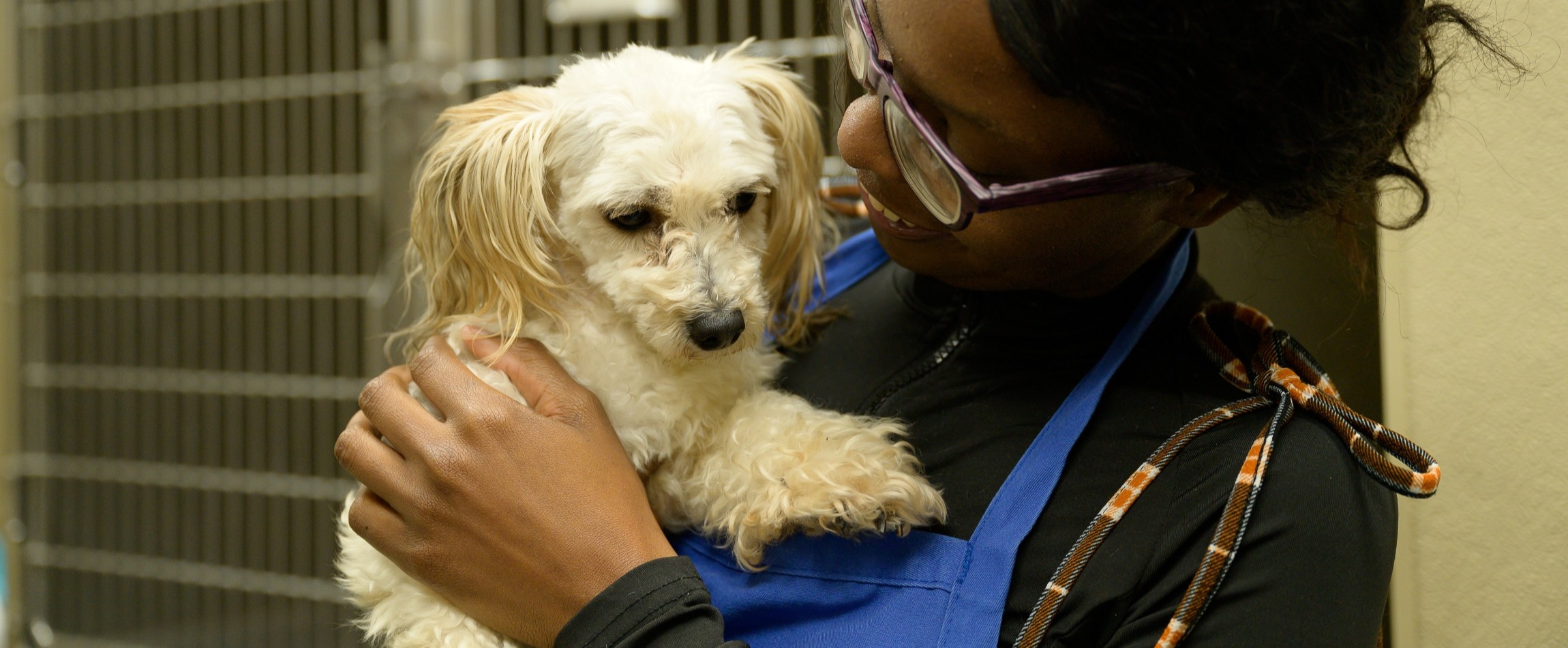
Compassion Under Pressure: A Study Of U.S. Animal Shelter Staff Well-Being


In 2023, Best Friends Animal Society (BFAS) conducted a survey of U.S. animal shelter staff well-being — the largest survey of its kind to date. Shelter work is demanding, of course, and these demands can take a toll on staff’s mental and physical health. The past few years have been especially tough, as shelters struggle to navigate a series of unprecedented challenges, including pandemic-related restrictions, an ongoing shortage of veterinary professionals, and persistent inflation.
All of these factors are likely to affect staff well-being. The question was, to what extent?
In addition, we were interested in how the number of animals admitted to a shelter and the shelter’s live release rate (LRR) might affect staff well-being. We also wanted to compare shelter staff well-being to that of other “helping professionals” (e.g., nurses and firefighters) and the general population. To do this, we used an online survey to administer the Professional Quality of Life (ProQOL) and Patient-Reported Outcomes Measurement Information System (PROMIS) instruments. These are well-established tools commonly used to assess key aspects of well-being in both professional and personal contexts. Finally, we collected basic demographic information and details about participants’ experience in the animal welfare field.
A total of 243 valid responses were collected from the staff of 122 U.S. shelters. Our sample was biased in favor of private shelters, with roughly 34% of respondents coming from private shelters with government contracts (compared to 21% nationally) and 37% from private shelters without government contracts (compared to 24% nationally). Municipal shelters made up about 22% of respondents (compared to 55% nationally) and the remaining 6% of our sample were anonymous. Naturally, we would’ve preferred a larger, more representative sample — but such limitations are not uncommon with surveys of this kind. Although we’re confident that our results are valid, they should be interpreted with some caution.
Shelter Staff Are Struggling
First, the good news: nearly half of our shelter staff respondents (49%) recorded compassion satisfaction (CS) scores in the high range — a strong indication that they derive great pleasure from being able to help animals (and people) through their work. And roughly three quarters of respondents (75%) indicated that they’re likely to continue working at their current shelter for the foreseeable future.
On the other hand, the measures associated with what’s often called “compassion fatigue” are cause for concern. More than half our respondents (53.5%) recorded burnout scores in the high range, and more than 90% recorded secondary traumatic stress (STS) scores in the high range. I don’t think any of us expected to hear that shelter staff were doing great — this work is difficult at the best of times. Even so, I think we were surprised to learn just how much staff are struggling; these scores are among the highest we’ve seen in the published literature. In addition, PROMIS results revealed average anger, anxiety, depression, and fatigue scores in the mild/moderate range, significantly higher than those of the general U.S. population.
Taken together, these findings raise serious questions about the well-being of shelter staff.
Risk Of Staff Turnover
There’s evidence to show that feeling passionate about one’s work — generally considered a positive attribute, especially in the animal welfare field — can itself contribute to burnout. We saw the potential impact of burnout when we asked respondents how likely they were to continue working at their current shelter for the foreseeable future. The average burnout score for those indicating that they were very likely to stay was 25.1, considerably lower than the average (31.6) for those indicating that they were somewhat likely or unlikely to stay. A similar trend was seen for STS scores.
In a previous BFAS survey, conducted between July and August 2021, shelters and rescue groups were asked about staffing issues. The vast majority of the 187 respondents (87%) reported staffing shortages and 75% of organizations reported increased stress levels. Although it’s not clear if there’s a direct relationship between the two, it’s not unreasonable to suggest that staff shortages might lead to increased stress levels, and that increased stress levels lead to turnover (i.e., staffing shortages). While, to our knowledge, updated figures for staffing shortages are unavailable, anecdotal information from shelter leadership suggests that this issue persists today.
Some Surprises In The Data
Another of our results that might seem surprising (at first blush, anyhow): we found no significant correlations between well-being measures and LRR or intake volume. Upon closer inspection, though, this makes sense. High-intake shelters are likely to have more staff, for one thing; the pressures associated with intake are at least somewhat related to staffing levels. And, as other researchers have found, staff working in shelters with higher rates of lifesaving are likely to experience high levels of STS despite high levels of job satisfaction. One possible explanation is that these individuals are less exposed to euthanasia and so feel each loss more acutely.
Easily the most surprising result was the combination of high CS and high STS scores among our respondents. How could somebody experience high levels of compassion satisfaction while also experiencing high levels of secondary traumatic stress? Indeed, others have suggested that fatigue and satisfaction represent opposite ends of the compassion spectrum, challenging the notion that individuals can truly score high on both CS and STS scales. Our findings suggest that they can.
To be clear, it’s not apparent from our data why this might be the case, or why animal shelter work might lead to ProQOL results so different from those associated with other helping professions.
Still, it’s worth considering the possibility that high levels of CS are integral to animal sheltering work, and that this may lead staff to experience — and tolerate — high levels of both burnout and STS. In other words, what if the highs are high enough to put shelter staff at particular risk?
Resources
Our findings would seem to have policy implications. After all, if much of the trauma that comes with animal sheltering work can’t be avoided, it’s important that shelter staff have access to the tools that can mitigate its impact. Work being done with veterinary professionals provides some clues as to what this might look like.
The American Animal Hospital Association’s “Veterinary Practice Team Well-Being” guide provides practical advice for ways to improve staff well-being. Obviously, running a veterinary practice isn’t the same as running a shelter. However, the many similarities offer an opportunity to learn from a field that’s committed considerable resources to better understanding staff well-being in recent years. And the results of Shanti Project’s Veterinary Mental Health Initiative’s pilot program reveal some impressive improvements in well-being among staff who met as a group for 10 weeks. Using the ProQOL scale, the researchers documented a 64% increase in compassion satisfaction, a 64% decrease in burnout, and a 45% decrease in compassion fatigue. Although the pilot program included only a small sample (17), the results are nevertheless encouraging. Given the relatively easy implementation and impressive results, shelters should give serious consideration to similar “group sessions” facilitated by professionals.
Some further resources to consider:
- When rescuers need rescuing: Managing our mental health
A BFAS blog that offers some key strategies and resources for tending to your mental health - Compassion fatigue & burnout
A helpful collection of resources from BFAS for dealing with compassion fatigue and burnout - Center for Veterinary Social Work
Mental health support for individuals and consultations for teams and organizations - Compassion in Balance
Compassion fatigue education specifically designed for animal welfare professionals - Caring for yourself & others: Preventing compassion fatigue & burnout
A free online course about compassion fatigue and burnout for the animal services sector, delivered through a trauma-informed lens