
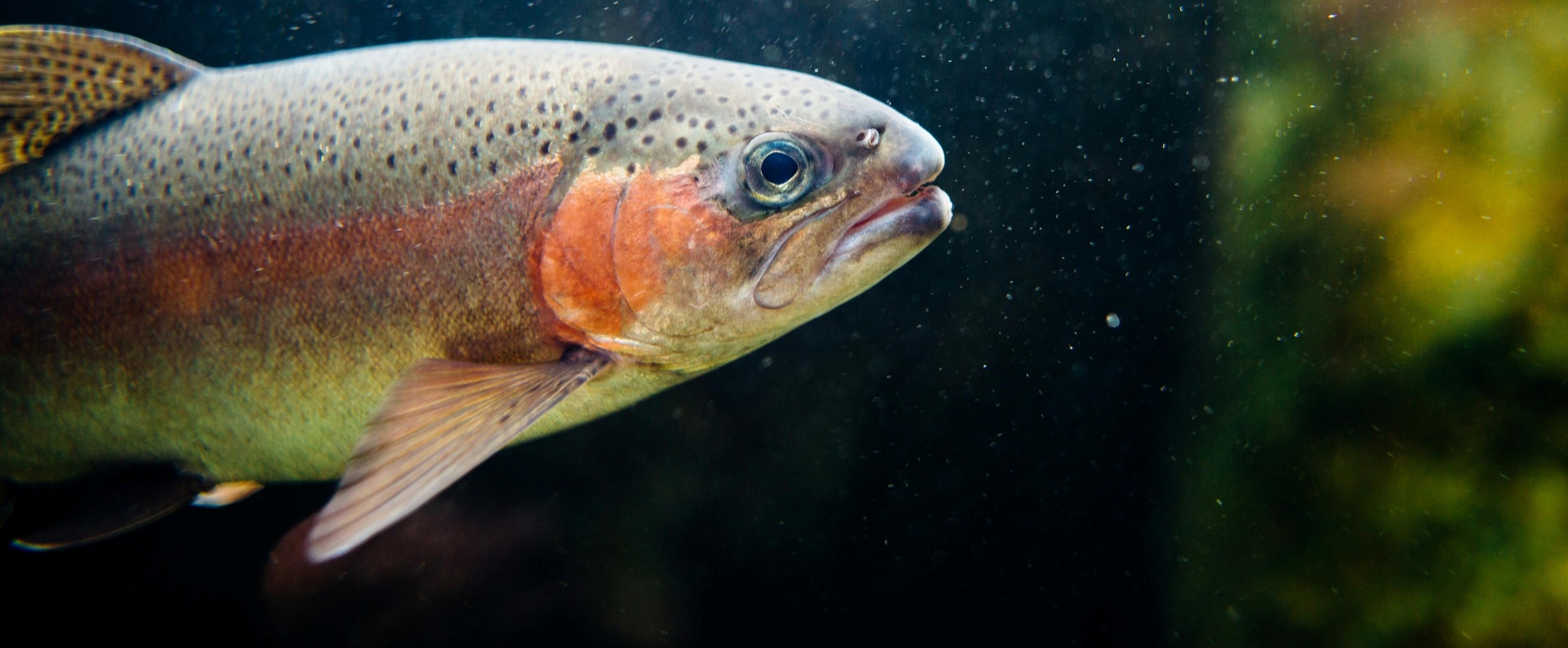
Rainbow Trouts Experience Extreme Pain Out Of The Water


Concern for animal welfare continues to grow, as evidenced by increased consumer interest, certification programs, product labeling, and changes to policy and legislation. However, given limited funding and other resources, it’s important to know whether interventions aimed at improving animal welfare will actually make a difference. One such way is to quantify their welfare impact, while also potentially demonstrating their cost-effectiveness to key decision-makers.
To this end, researchers set out to quantify the intensity and duration of pain experienced by rainbow trouts as they asphyxiate in air, a common practice during slaughter for both wild and farmed fishes. They used the Welfare Footprint Framework (WFF), which builds off existing research that documents behavioral, neurophysiological, and pharmacological indicators of animal welfare, and allows for a determination of welfare impact that can be compared across practices and industries. To limit the subjectivity that’s often present in attempts to quantify animal welfare, the WFF only considers time spent in affective states of varying levels of intensity. For pain, these levels include excruciating, disabling, hurtful, and annoying, as well as no pain.
To begin with, the researchers identified four main time segments during asphyxiation in trouts:
- Initial air exposure when trouts experience acute stress from lack of oxygen that overwhelms their coping mechanisms;
- Hypercapnia and pH imbalance when rising levels of carbon dioxide acidify their blood and cause severe breathlessness, anxiety, and panic;
- Metabolic exhaustion when trouts desperately thrash about in escape attempts, causing lactate to painfully build up in their muscles before they ultimately exhaust themselves; and
- Depressed neuronal activity when carbon dioxide crosses the blood-brain barrier, leading to eventual loss of consciousness.
Due to variability in the times trouts spend in each level of pain intensity, and uncertainty around which level of pain intensity they experience, time ranges and probability percentages were used. By multiplying the time spent in each segment by the probability of each pain intensity, the researchers were able to estimate a range of time spent in each pain level during each segment. These could then be summed to determine the total time spent experiencing each pain intensity.
Based on existing evidence, total time to unconsciousness from asphyxiation can take anywhere from 2 to 25 minutes, as it’s affected by variables like air temperature and fish size.
From this, the researchers determined that the first three segments take up 80 to 95% of the total time to unconsciousness, meaning they last anywhere from 1.9 to 20 minutes. During these first three segments, there’s a 40% chance trouts are experiencing excruciating pain, a 40% chance the pain is disabling, and a 20% chance the pain is hurtful. The fourth segment occupies the final 5 to 20% of the total time to unconsciousness, and thus it lasts between 0.1 and 5 minutes. During this last segment, there’s a 33% chance trouts are experiencing hurtful pain, a 33% chance the pain is annoying, and a 33% chance they’re not experiencing any pain.
Thus, an individual trout can experience anywhere from 1.9 to 21.7 minutes of moderate to extreme pain — excruciating, disabling, and hurtful pain combined — during air asphyxiation. This translates to an estimated 3.5 to 74 minutes of moderate to extreme pain per kilogram of body weight.
However, if trouts were rendered unconscious by a stunning method rather than left to asphyxiate, then much of this pain could be mitigated. To calculate this impact, the researchers assumed that implementing electrical stunning would cause a $0.06 increase in the price of trout per kilogram of body weight and achieve 70 to 100% effectiveness. Based on these assumptions, electrical stunning could avoid 60 to 1,200 minutes of moderate to extreme pain per dollar invested.
While the data presented in this study are promising as an argument for humane and effective stunning, it’s important to note some limitations:
- The study only looked at one aspect of trout production and doesn’t reflect the impacts of other common farming or fishing practices, such as crowding, handling, and transport, or other methods of slaughter, such as exposure to ice or ice slurry. However, these could also be quantified by the WFF.
- The study acknowledges that different stunning methods, like electrical or percussive stunning, require precise, consistent application and, as such, aren’t always effective. This means that the welfare improvement of using electrical stunning quantified by the researchers may not accurately reflect what would occur in industry settings.
Regardless, it’s very useful to have a metric that not only allows decision-makers to determine intervention impact and cost, but can also be communicated to consumers in a way that makes fish pain both a real and urgent issue. Moreover, a framework such as the WFF will continue to prove useful as we attempt to assess which areas of animal production will benefit the most from reform.
https://doi.org/10.1038/s41598-025-04272-1

Citations:
Schuck-Paim, C., Alonso, W. J., Pereira, P. A., Saraiva, J. L., Cerqueira, M., Chiang, C., & Sneddon, L. U. (2025). Quantifying the welfare impact of air asphyxia in rainbow trout slaughter for policy and practice. Scientific Reports, 15, 19850. https://doi.org/10.1038/s41598-025-04272-1
