
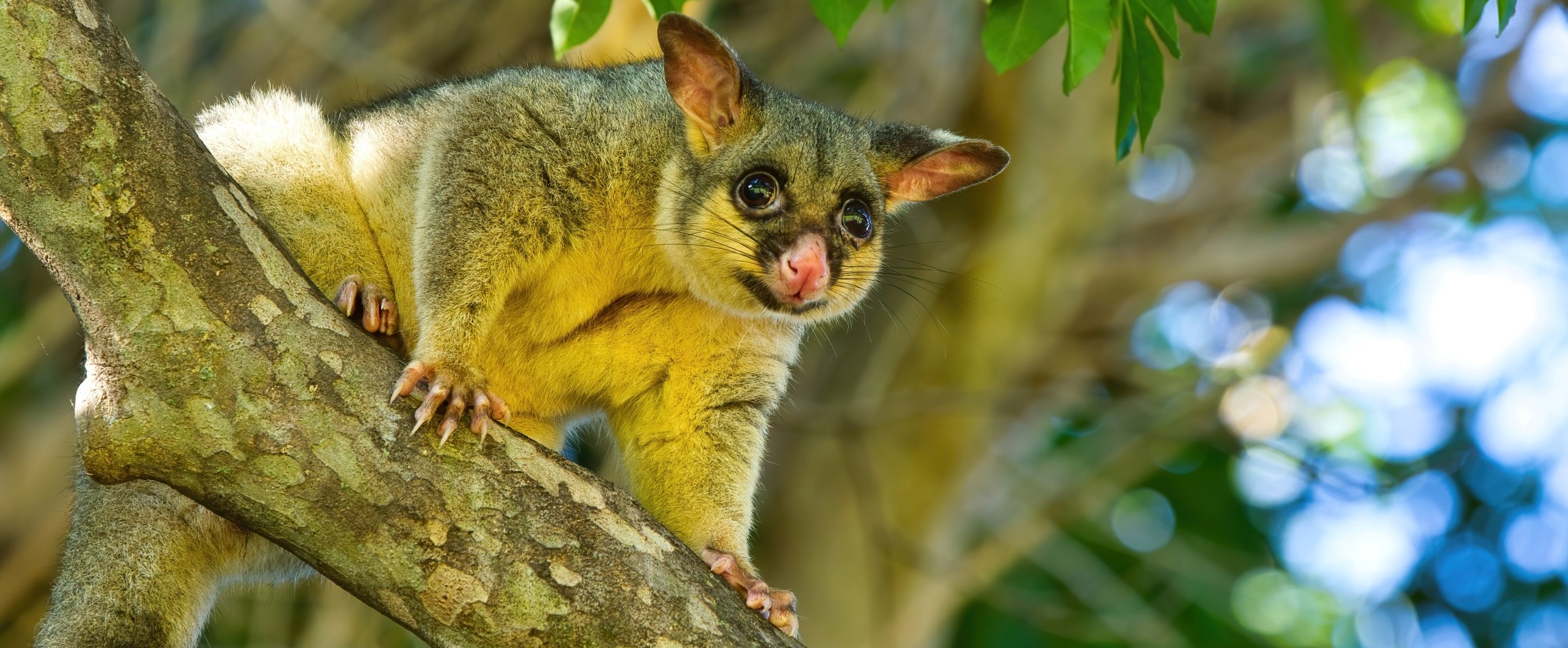
How Dark Humor Normalizes Cruelty To Possums In New Zealand Media


Brushtail possums were introduced to New Zealand by colonial settlers in 1858 to establish a fur trade. When their populations grew, they were recast as threats to native species and, eventually, as the nation’s foremost ecological enemy. Today, the government-backed Predator Free 2050 campaign seeks to eradicate all possums, stoats, and rats from New Zealand by mid-century, relying on widespread public participation in trapping, poisoning, and killing. Against this backdrop, the media has played a powerful role in shaping — and hardening — public attitudes toward possums.
This study examined how New Zealand’s online news media has portrayed possums in the years since Predator Free 2050 launched. The researcher wanted to understand how media language and imagery evolved post-2016 to support, reinforce, and police speciesist narratives about these animals.
The researcher collected online news articles published between May 2016 and August 2023 that included the word “possum” or “possums” in their title. Articles were drawn from eight New Zealand news outlets. Of the 327 initially identified, 148 were deemed relevant after removing duplicates and off-topic pieces. The researcher used a qualitative thematic analysis approach, coding articles for recurring language patterns, tones, and imagery rather than counting occurrences. They openly acknowledge their positionality as a vegan, ecofeminist Critical Animal Studies scholar, noting this likely influenced the themes they identified.
The analysis centers primarily on Pākehā (New Zealander of European descent) perspectives, as these dominate mainstream media; Indigenous Māori perspectives were deliberately excluded, as the researcher believes these would be best addressed through culturally informed, Indigenous-led research.
Three themes identified in earlier research, militant language, economic framing, and objectification, persisted and intensified in post-2016 coverage. A fourth, emergent theme distinguished the newer articles: the pervasive use of dark humor to trivialize possum suffering.
Militaristic language was widespread, with articles describing possum control as a “battle,” “war,” and “blitz” — the latter a term with explicit World War II associations. Technologies used to kill possums were framed as strategic advances. Community killing events, including fundraisers where children participated in trapping and shooting, were described using the language of sport and patriotism, with success measured in body counts.
Economic framing was equally prominent. Many articles positioned possum control as good for dairy and beef industries, since possums can carry bovine tuberculosis. At the same time, possum bodies were treated as commercial resources: their fur was marketed as “ethical” and “cruelty-free,” and possum meat entered the pet food market. The researcher notes a contradiction embedded in this framing — industries depended on a continued supply of possums even as the stated goal was total eradication.
Objectification and desensitization were reflected in multiple ways. Possums were consistently referred to using “it” rather than personal pronouns, reinforcing their status as objects rather than individuals. Graphic images of dead, skinned, and decaying possums were published without content warnings — a treatment, the researcher notes, that wouldn’t be applied to companion animals, native species, or even farmed animals. Several publishers repeatedly used an incorrect species image, apparently without noticing, reflecting a broader disconnection from possums as individual beings.
The emergent theme — dark humor — appeared throughout the post-2016 sample in ways not documented in earlier research. Articles dubbed possums “rippers” and “brutes,” framed home encounters as hostage situations, and celebrated possum-killing events with jokes and puns. School fundraisers featured dead possum bodies dressed in costumes and judged for creativity. The researcher argues that this humor functions to normalize cruelty by making it entertaining, and that children raised within this culture are being taught that desecration of certain animals is acceptable and even funny — with potential downstream consequences for how they understand violence more broadly.
Because this is a descriptive analysis, the findings are interpretive rather than quantitative. The study doesn’t claim to measure exactly how many articles used each theme. The researcher’s positionality and prior familiarity with the topic may have shaped which themes emerged. The analysis also excludes Indigenous Māori perspectives, which the researcher acknowledges as a significant gap. The focus on articles with “possum” in the title means coverage that discussed possums in the body text may have been missed or excluded.
The researcher argues that New Zealand’s media coverage of possums constitutes a form of “creaturely racism,” a speciesist analog to the xenophobic othering of marginalized human groups. This framing, they contend, isn’t ethically neutral: it actively cultivates public acceptance of cruelty and forecloses the possibility of compassion toward a species that was introduced to New Zealand through human decisions, not its own. They call for a new media ethics grounded in intersectional, anti-speciesist principles, in which journalists treat animal suffering as worthy of moral consideration regardless of species status.
For animal advocates, this research offers a useful lens for understanding how cultural cruelty is manufactured and maintained — not through overt propaganda alone, but through the softer, more insidious medium of humor. Advocates working on wild animal issues, anti-speciesism campaigns, or media literacy may find this analysis directly applicable. The paper also raises a question worth sitting with: if a society can be trained to find the killing of one group of animals funny, what does that say about the compassion available to all animals, including those whose exploitation is far more commercially entrenched?
This summary was drafted by a large language model (LLM) and closely edited by our Research Library Manager for clarity and accuracy. As per our AI policy, Faunalytics only uses LLMs to summarize very long reports (~50+ pages) that are not appropriate to assign to volunteers, studies that contain graphic descriptions of animal cruelty or animal industries, and research on niche topics. We remain committed to bringing you reliable data, which is why any AI-generated work will always be reviewed by a human.
https://doi.org/10.3389/fcomm.2024.1377559

Citations:
Major, E. (2024). Slayers, rippers, and blitzes: Dark humor and the justification of cruelty to possums in online media in New Zealand. Frontiers in Communication, 9, 1377559. https://doi.org/10.3389/fcomm.2024.1377559


