Cage-Free Egg Market Prevalence In Japan And Future Strategy


We often hear from advocates around the world that animal welfare in Japan is behind the times. Working in this field day to day, we talk about animal welfare and cage-free eggs constantly. It’s easy to fall into the illusion of living inside a “cage-free bubble,” where everyone already knows what cage-free eggs are. Step outside that bubble and we realize we’ve been like the frog in the well — convinced the small patch of sky overhead is the whole world. Even the phrase “animal welfare” still doesn’t land with the average consumer. It needs explaining. The gap between advocates and ordinary shoppers is wider than we tend to assume.
Even so, a growing number of Japanese companies are starting to reflect animal welfare in their policies, and quite a few have now come together at the starting line. In 2025 and 2026, researchers and companies published enough new data to give us a real picture of where the cage-free egg market stands.
Cage-Free Egg Sales In Greater Tokyo Have Roughly Doubled In Four Years
In December 2025, Professor Shigeru Ooki of the Laboratory of Livestock Economics at Azabu University published a study called “Cage-Free Egg Sales Trends Nationwide and in the Greater Tokyo Area — From Two POS Analyses, 2024.8–2025.7”. It draws on 53 weeks of point-of-sale (POS) scanner data from two sources, Nikkei POS and KSP-SP, covering the week of July 29, 2024 through the week of July 28, 2025. The Animal Welfare Corporate Partners (AWCP) team has summarized the findings (written by Toyofumi Suzuki) on our website.
Sales revenue from cage-free eggs in the Greater Tokyo area has expanded to roughly double its level four years ago — 1.92 times, to be exact. That growth held even as retail egg prices climbed across the board, though the two POS sources disagree about how the cage-free share of total sales has moved.
Price is the obvious sticking point. In Greater Tokyo, cage-free eggs carry a premium of 1.92 times (Nikkei POS) or 2.33 times (KSP-SP) for 10-egg packs, and 1.58 times (Nikkei POS) or 1.55 times (KSP-SP) for six-egg packs. Rising prices across the whole egg category have not produced a clear, consistent narrowing of the gap between caged and cage-free.
The regional picture is stark. The cage-free share of egg sales value runs 4.01% (Nikkei POS) or 2.47% (KSP-SP) annually in Greater Tokyo, and 1.72% in Hokkaido. Most other regions sit below 1%, and the nationwide average is 1.12%. Even in large metropolitan areas like Kinki, assortment is badly insufficient. Outside Greater Tokyo and Hokkaido, food supermarkets nationwide stock less than one cage-free item per store. In Kyushu, enriched-cage (ERC) eggs sell in real volume, but whether that model expands nationally is unclear.
Shelf space is the other constraint, and it’s structural. In the egg category, the top 20% of best-selling items — roughly 50 to 60 products — account for about 80% of sales. That makes it hard for any new item to earn a place on the shelf. Most of the manufacturers behind those best sellers are affiliated with egg-farming companies, so they may hold considerable influence over distribution and sales.
Professor Ooki reads the Greater Tokyo share as a sign that the market is entering the next stage of diffusion of innovation theory — the model of how new products spread from early adopters to the wider public. The POS analysis points to six priorities: expanding product assortment, clarifying labeling, setting detailed definitions and rules, strengthening distribution, building promotional structures, and improving consumer understanding and marketing.
What Retailers Say About Carrying Cage-Free Eggs
Professor Ooki followed up with a “Cage-Free Egg Retail Survey” in May 2026, mailed to 2,365 retailers nationwide. It drew 135 valid responses — a response rate of under 6%, so the results describe the retailers who chose to answer rather than the sector as a whole.
Of those 135, 56% (75 respondents) reported carrying cage-free eggs and 44% (60 respondents) reported not carrying them. The split by channel is wide: 82% of natural food stores carried cage-free eggs and 67% of co-ops did, against only 47% of supermarkets — most of which started stocking them only after 2020.
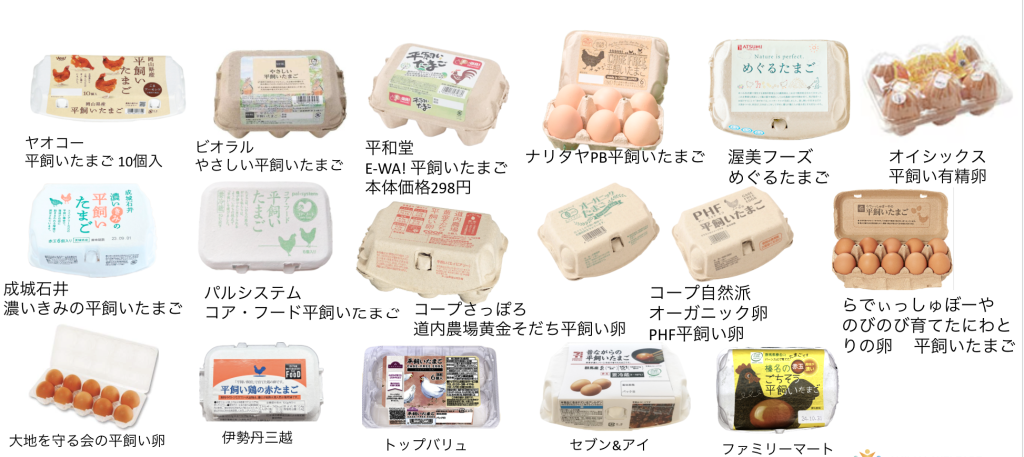
As the photos above show, many retailers are switching their private-brand eggs to cage-free, and the volume on Tokyo shelves is rising. Every cage-free option at eye level is a chance to teach a shopper something, so private-brand conversions do a great deal to move the movement forward.
Why Companies Do And Don’t Carry Cage-Free Eggs
Among retailers that stock cage-free eggs, the main reasons given were “it fits our store concept” (60%), “consumer demand” (59%), and “selling higher value-added eggs” (56%). Among supermarkets and companies with sales of ¥1 billion or more, “selling higher value-added eggs” came first — a strategy of differentiating from competitors.
Among companies that don’t stock them, nearly half (45%) said their suppliers don’t handle cage-free eggs. That figure rises to 62% among supermarkets, which points to supply chain access as the main barrier rather than shopper indifference.
More Than Twice The Price Of Caged Eggs
Comparing assortment and pricing across store types (as of October 2025) shows how differently each format approaches the category.
Natural food stores stock an average of 3.4 egg items, of which 3.2 are 10-egg packs of cage-free eggs, at ¥73 per egg. Supermarkets stock a much richer average of 15 egg items, but only 2.1 are cage-free, mostly in six-egg packs, at ¥77 per egg. Co-ops come in lowest at ¥63 per egg.
According to Professor Ooki, “Comparing these figures to the price found in the Ministry of Agriculture, Forestry and Fisheries’ Food Price Trend Survey (October 2025, national average, 10-egg pack, ¥28.1 per egg), natural food stores are 2.6 times more, supermarkets are 2.7, and co-ops are 2.2. Even accounting for the bias toward higher per-unit prices caused by differing pack sizes, it is clear that cage-free eggs remain in a high price bracket.”
Challenges Going Forward
The POS research points to a distribution problem: medium and large-scale operations need to handle cage-free eggs better, and wholesalers need stronger procurement functions. Labeling is a second problem. Some products labeled “free-range” describe rearing conditions so vaguely that the actual conditions can’t be verified, which is an argument for clear labeling rules and information disclosure that shoppers can read at a glance.
The retail survey found sharp regional differences. On why cage-free eggs aren’t selling, only one reason drew a majority: the price exceeds what consumers are willing to spend on eggs. More than 40% of respondents also cited “consumers are satisfied with cheap eggs” and “consumers don’t know about or want cage-free eggs.”
Open-ended responses, especially from food supermarkets, returned to the same themes — no clear advantage in quality or taste over regular eggs, not enough marketing appeal, high prices, and a strong consumer preference for cheap. Marketing and consumer education still have a long way to go.
Corporate Change
Just before this article went to press, Meiji Holdings — the country’s largest dairy and confectionery company, accounting for 17% of Japan’s milk yield — published its cage-free policy. The company committed to 100% cage-free overseas and 20% in Japan by the end of 2030. The large companies AWCP has been engaging with are gradually changing.
Our colleagues at the Animal Rights Center released FarmWise Impact 2026, the first evaluation of its kind led by a non-governmental organization (NGO) in Japan. It assesses 107 major Japanese companies across trading, retail, food service, and manufacturing on how far their farmed animal welfare efforts actually translate into better conditions on farms.
The evaluation summary shows that nearly 70% of these companies do not recognize animal welfare as a business issue. Only 32 companies (29.9%) recognize and publicly disclose it as a material business issue. Of those, just four treat it as a standalone issue; most fold it into sustainable procurement. Twenty-three companies (21.5%) have animal welfare procurement standards or policies that reference the Five Freedoms, but without specifying concrete actions.
What concerns AWCP most is the treatment of laying hens in Japan, roughly 140 million birds. Our goal is improving the conditions those hens are raised in and increasing the number raised cage-free. Change on that scale needs major companies to shift their egg procurement and publish the commitment as policy. A published commitment signals direction, and it makes it easier for producers to change too.
Several of the foreign-affiliated companies AWCP engages with have made cage-free declarations at the headquarters level that include Japan — among them Nestlé Japan (2017), Hilton (2019), and Four Seasons Hotels (2018).
The FarmWise summary also finds that 24 of the 107 companies (22.4%) have some kind of egg-related initiative. That’s relatively high compared with other species. But willingness and direction are not the same as targets: about 80% have published no specific numerical goal, such as 50% or 100%, and no deadline.
Companies With Specific Targets
Alongside Meiji Holdings, a few companies in Japan have published specific numerical animal welfare targets.
Kewpie Corporation consumes about 10% of Japan’s domestic eggs. It has announced a policy to switch 20% of the domestically produced eggs in its flagship Kewpie Mayonnaise to cage-free by fiscal year 2030 — a leading commitment in the industry.
Toridoll Holdings began its “Initiatives Related to Laying Hens” in fiscal 2022 with 10 Marugame Seimen locations. By fiscal 2023, all raw eggs used at 3% of its stores were 100% cage-free, and the company has raised that figure each year, reaching 4.5% under the same conditions in fiscal 2026.
In its Securities Report for the 149th Fiscal Period, published June 20, 2025, the long-established confectionery maker Bourbon Corporation stated that 5% of the liquid whole egg it uses is cage-free. Bourbon’s 2025 Integrated Report adds that the company is “working to improve animal welfare by expanding our procurement of liquid whole egg made from free-range eggs (eggs laid by hens raised in an environment where they can move freely within the henhouse).”
Meanwhile, in March 2026, AEON (Japan’s Largest Retailer), released an Animal Welfare Policy. AWCP has engaged with the company since 2017, when it was THL Japan, pressing the importance of the Business Benchmark on Farm Animal Welfare (BBFAW). It took many years. But one of Asia’s retail giants publishing an animal welfare policy is a major step for the retail sector across the region.
Moving Beyond The Cage-Free “Bubble” Toward Structural Reform
Cage-free eggs look, on the surface, like an easy theme to promote as animal welfare in action. In practice the field is still immature in Japan, technically and academically. Behavioral risks on farms such as cannibalism and feather pecking remain poorly addressed, and Japanese academia has few leading domestic experts and little animal ethics research.
Closing the gap between advocate awareness and the general consumer market will take more than following overseas trends or appealing to abstract concepts. We think four structural approaches matter most.
- Structural reform of the supply chain. More than 60% of retailers that don’t carry cage-free eggs, especially supermarkets, cite the absence of a supply route. Moving away from dependence on individual farmers, promoting medium and large-scale operations, and strengthening wholesalers’ procurement functions is the first priority for stable supply routes and logistics.
- Labeling rules and standardized guidelines. Unclear or ambiguous labeling breeds distrust. Japan needs clear definitions, third-party certification, and in-store labeling rules that let shoppers identify what they’re paying for.
- Technical research and academic development suited to Japanese conditions. Rather than importing knowledge from overseas wholesale, Japan needs research and development of management techniques suited to its climate, farming environment, and culture. Beyond agricultural economics, academia needs to train young researchers and experts in animal ethics and welfare technology who can guide the country toward international standards.
- Numerical targets disclosed by major companies. The key to overcoming consumers’ strong preference for low prices sits with major food manufacturers, foreign firms, and large retailers, and with their procurement policies. As more companies follow Kewpie, Toridoll, and AEON in making commitments with concrete deadlines and numerical targets, producers will be able to invest in facilities with greater confidence, and that creates a positive cycle.
In Closing
Animal welfare in Japan is shifting from presenting the concept to building the market structure. Production technology, distribution, shopper-friendly labeling, and corporate commitment all have to come together before a cage-free market that ordinary consumers can actually reach becomes real.