
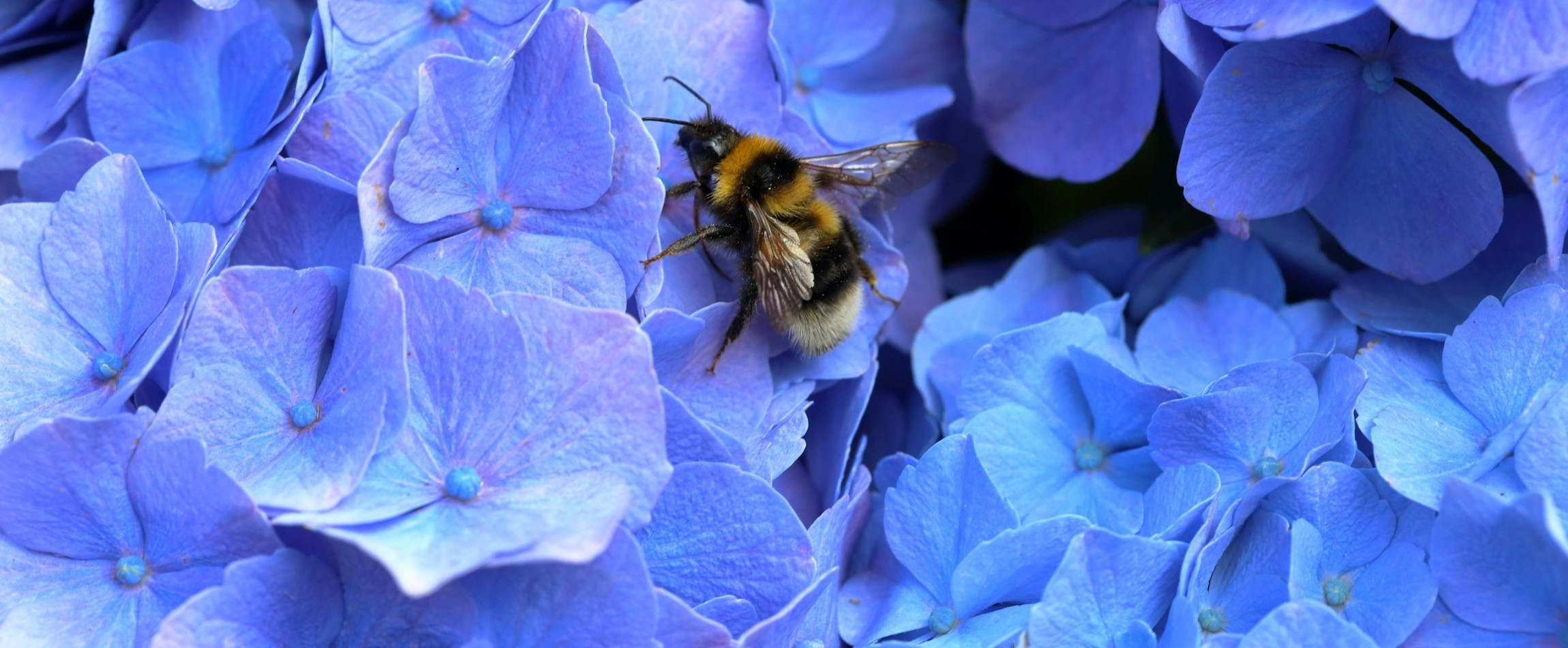
Bumble Bees Spread String Pulling Through Social Learning


When animals learn by observing or interacting with others — a process called social learning — cultural traditions can emerge if the learned behavior persists over time. Importantly, behaviors that spread quickly through social learning and become cultural traits can help populations adapt better to distinct or changing environments.
Most research on culture in non-human animals has focused on vertebrates with large brains, such as primates and whales. While insects are known to engage in social learning, less is understood about how widely and repeatedly they can pass on new behaviors to establish traditions.
A previous study found that bumble bees could learn and spread a non-natural behavior (pulling a string to access a reward) in a tightly controlled setting with limited interaction between bees. This study builds on that research by showing how string-pulling behavior spreads both within and between colonies in a more ecologically realistic environment.
Researchers Test String-Pulling Task
In this two-phase experiment, bumble bees learned to manipulate strings to pull artificial flowers out from under a transparent sheet. Nine commercially raised (non-wild) colonies were involved, and each phase ran for five consecutive days.
- The first phase tested how string-pulling behavior developed within six colonies and how it differed between colonies with and without trained demonstrators. Each colony had three hours per day to forage from eight artificial flowers in an arena, where bees could move freely. While the experimental procedure and arena setup were otherwise the same for all six colonies, only three started with a trained demonstrator — a bee from the same colony who had been trained on string pulling by the researchers. The colonies that had a trained demonstrator were called the primary colonies, and those without trained demonstrators were the control colonies.
- The second phase tested whether string pulling would spread to unrelated colonies through social learning. In this phase, the researchers paired each of the primary colonies (which each contained their original trained demonstrator plus any bees who had learned during phase one, thereby becoming demonstrators themselves) with a new, unrelated colony. The researchers called these unrelated colonies the secondary colonies. Each pair was then given access to a larger arena with 12 flowers, where bees from both the primary and secondary colony were allowed to interact and forage alongside each other for three hours each day.
Because they had tagged each bee, the researchers were able to assign string pulls to specific bees. They analyzed data from both phases of the experiment to provide insights into how social learning helps novel behaviors spread within and between colonies.
As Bees Learned To String Pull, Others Followed
In phase one, trained demonstrators set social learning in motion. During this phase, 25 bees across all three primary colonies, which each started with one trained demonstrator, learned to string pull (i.e., they performed string pulling at least twice). In comparison, two bees from only one of the control colonies learned. These two bees also learned later — on days four and five — while the first primary colony learners learned on day one. By the end of the first phase, learners from primary colonies had performed a total of 2,571 pulls, compared to just 22 by the learners from the control colony.
In phase two, string pulling spread beyond colony boundaries. In total, 17 bees across all three secondary colonies learned to string pull. These 17 bees ended up performing 1,252 total pulls. Seven bees from primary colonies also learned to string pull during this phase, and all learners (primary colony learners from either phase plus secondary colony learners) ended up performing a total of 5,655 string pulls during the second phase.
The researchers attributed the spread of string pulling in both phases to social learning. String-pulling behavior continued through the last day of the experiment, demonstrating its persistence.
Would This Happen In The Wild?
Because this experiment involved commercially raised bumble bees and used trained demonstrators, it doesn’t mirror exactly how cultural traditions in bumble bees might develop in the wild. It does, however, confirm that bumble bees are fundamentally capable of establishing such traditions through social learning. The fact that two bees from a control colony were able to learn string pulling proves that bees are also capable of innovating solutions through trial-and-error. According to the researchers, these findings together suggest that wild bumble bees could also develop new behaviors and spread them to other colonies, helping more bees adapt to their local environments.
Building A Better Future For Bees And Other Insects
This research demonstrates bumble bees’ remarkable ability to learn a new behavior and spread it within and between colonies, with the behavior becoming a tradition as it persisted over time.
Insects play essential roles in the ecosystem, and they deserve to be included more in conversations about wild animal protection. By highlighting research like this, animal advocates can invite more people to understand them better, potentially sparking greater curiosity, connection, and stewardship of bumble bees and beyond.
https://doi.org/10.1016/j.anbehav.2025.123439

Citations:
Procenko, O., Bridges, A. D., Kowalewska, A., Juusola, M., & Chittka, L. (2026). Bumble bee string-pulling skill spreads between colonies under open diffusion conditions. Animal Behaviour, 232, 123439. https://doi.org/10.1016/j.anbehav.2025.123439
