
Audit Reveals Widespread Animal Suffering In U.S. Labs


Each year, hundreds of thousands of animals are used in U.S. research laboratories. The Animal Welfare Act is supposed to ensure they’re provided with at least minimum standards of care. However, a report from the non-profit organization National Anti-Vivisection Society (NAVS) suggests that these standards are frequently violated, and the consequences for labs are minimal.
For its second annual laboratory animal care audit, NAVS analyzed publicly available United States Department of Agriculture (USDA) inspection reports from 2024. The goal of the audit is to increase public awareness about the conditions animals face in labs and to create a tool that advocates can use to demand accountability. It details violations found at 78 animal-use labs across 32 states. To focus just on animal welfare, the report excludes purely administrative violations.
Widespread Violations, Minimal Consequences
The audit uncovered a pattern of serious animal welfare violations and a troubling lack of enforcement. Of the 78 facilities with documented violations in 2024, 29 were repeat offenders also included in the previous year’s audit. Despite numerous instances of animal injury, distress, and death, only four of these 78 facilities (5%) received a fine for violations documented in 2024.
The report notes that the most common enforcement action taken by the USDA is an “Official Warning.” These warnings carry no financial penalty and, according to NAVS, have proven ineffective at creating meaningful change at labs. The report also points out that the USDA hasn’t issued any fines since the summer of 2024, following a U.S. Supreme Court ruling that the Securities and Exchange Commission can’t assess fines for securities fraud on its own. While not directly related to the USDA, this ruling seems to have cast a shadow over the agency’s actions.
The violations documented in the report are extensive and fall into several key categories.
Inadequate Veterinary Care And Neglect
- At a facility in Mississippi, a five-year-old cat named Squid had crusts around his eyes, nose, and mouth and a cloudy spot on one eye. Although his condition was worsening, more than three weeks passed before an inspector’s request prompted a veterinary exam.
- At the University of Minnesota, three monkeys were left without water for four days after their water valve was left off during a repair. Staff had signed off on twice-daily water checks, but the issue was only discovered when the monkeys were reported for not eating.
- Multiple facilities, including Southern Biotechnology Associates, Washington State University, and CorVus Biomedical, had goats, sheep, pigs, or cows with severely overgrown hooves.
- At the University of Georgia, macaques in seven indoor rooms were exposed to continuous light for seven months because of an error in the automated lighting system.
Painful And Improper Procedures
- At Intervet Inc. in New Jersey, a rabbit survived a botched euthanasia procedure and was found alive inside a freezer meant for dead animals.
- At the University of Washington, five macaques didn’t receive required pain relief after undergoing procedures like lymph node biopsies and a spinal tap.
Unsafe And Unsanitary Housing
- At the University of Utah, a rhesus macaque died of asphyxiation after his collar became entangled with part of the hammock in his cage.
- At the University of Missouri-Columbia, a flooded room led to the death of four piglets.
- Auburn University had a long list of sanitation issues, including rodent droppings found where sterile medical supplies were stored, feces on the walls, signage, towel and soap dispensers, and sinks of the milking parlor, and a dead rodent covered in ants in a storage room.
What The Report Doesn’t Show
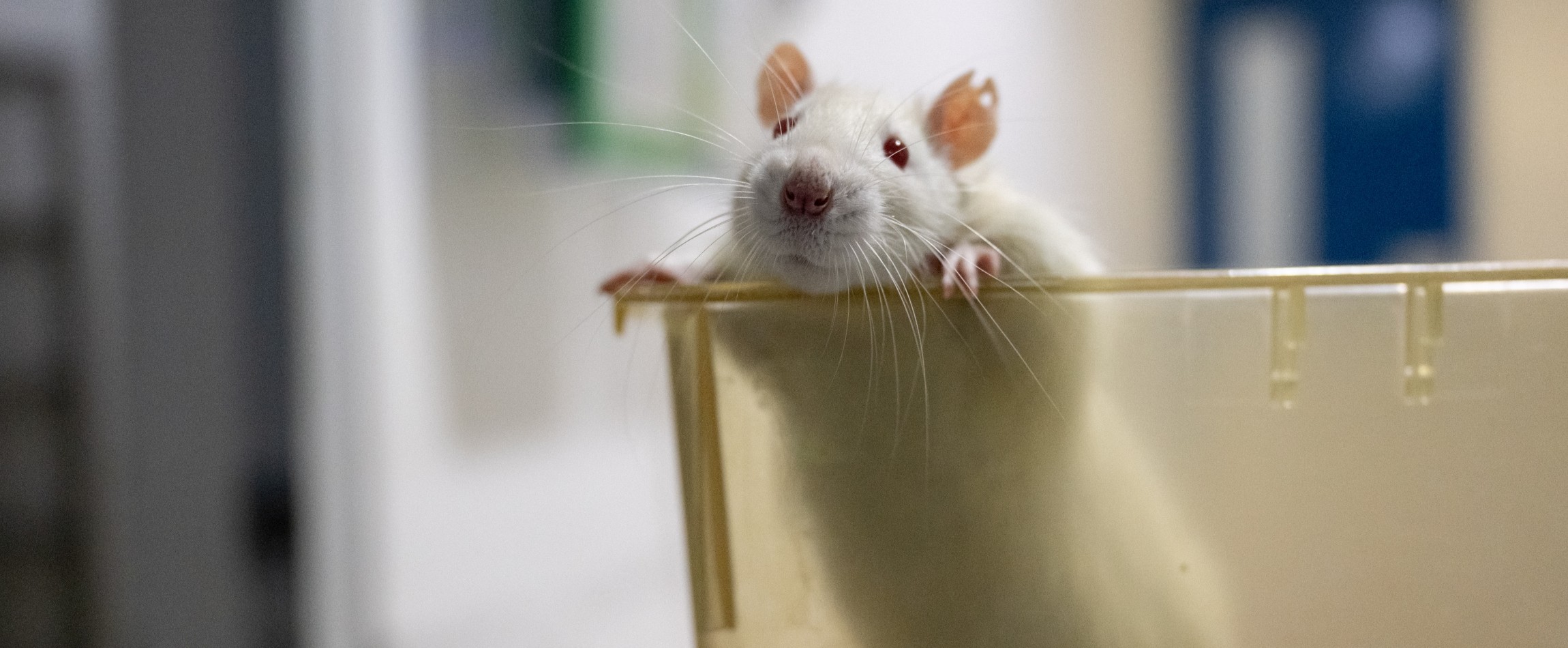
The audit highlights several critical limitations in the Animal Welfare Act and its enforcement. First, its legal definition of “animal” excludes the species most commonly used in research, including mice, rats, purpose-bred birds, fishes, and invertebrates. This means that labs using only these species aren’t required to register with the USDA or undergo inspections, and the immense suffering of these animals goes completely undocumented. Estimates suggest between 10 million and 111 million mice and rats are used in U.S. labs annually.
Furthermore, USDA inspections are often brief — sometimes only a few hours per year — and inspectors rely heavily on self-reporting from the labs. This means that the violations detailed in this report likely represent only a fraction of the problems that exist. Finally, the scope of USDA inspections is limited to animal care and housing. They don’t assess the scientific validity or ethical justification of the experiments being performed.
Demanding Change For Animals Used In Research
NAVS presents this audit as a call to action and a tool for accountability. The findings provide clear, documented evidence that the current system is failing to protect animals in labs. Advocates can use this report to:
- Raise public awareness by sharing specific, documented examples of animal suffering.
- Demand accountability from research institutions and government agencies by highlighting repeat offenses and weak enforcement.
- Advocate for stronger laws, including expanding the Animal Welfare Act to cover all animals used in research and implementing more effective enforcement mechanisms than warnings.
- Promote alternatives by arguing that these persistent welfare issues underscore the need to replace animal models with more humane and effective non-animal methods.
This summary was drafted by a large language model (LLM) and closely edited by our Research Library Manager for clarity and accuracy. As per our AI policy, Faunalytics only uses LLMs to summarize very long reports (50+ pages) that are not appropriate to assign to volunteers, as well as studies that contain graphic descriptions of animal cruelty or animal industries. We remain committed to bringing you reliable data, which is why any AI-generated work will always be thoroughly reviewed by a human.
https://navs.org/insight/laboratory-animal-care-audit/

Citations:
National Anti-Vivisection Society. (2025). Laboratory animal care audit: Findings from 2024 USDA inspections of animal-use laboratories. https://navs.org/insight/laboratory-animal-care-audit/
