
Minding Other Minds: Evidence For Cephalopod Sentience And Intelligence


This report, commissioned by the Brooks Institute for Animal Rights Law & Policy, synthesizes the current scientific evidence on the minds of cephalopods — the class of animals that includes octopuses, cuttlefishes, and squids. Though their last common ancestor with humans lived over 560 million years ago, these animals have evolved remarkable intelligence through a completely different path. The goal of this project is to create a “Citable Authority,” a policy-relevant scientific foundation that can be used to shift legal precedent away from a property paradigm toward one of protection and rights.
The report is a comprehensive synthesis of peer-reviewed scientific studies on cephalopod sentience and cognition. By collating and integrating this research, the authors provide an accessible summary for policymakers, advocates, and lawyers to articulate a given species’ attributes without needing to conduct significant further research.
Problem-Solving And Intelligence
Octopuses in particular show an impressive range of problem-solving abilities. They’re skilled at feeding on shelled prey, flexibly choosing the most effective strategy — such as prying shells open or drilling holes to inject paralyzing toxins — based on the prey’s size and species. They’ve also been documented using tools for defense, such as barricading den entrances with stones or carrying coconut shells to use as portable shelters. In captive settings, they can learn to open jars to get food rewards, and their performance improves with experience, showing that learning is involved. Their ability to quickly adapt to new variations of a puzzle suggests they can understand the physical requirements of a task.
Learning, Memory, And Self-Control
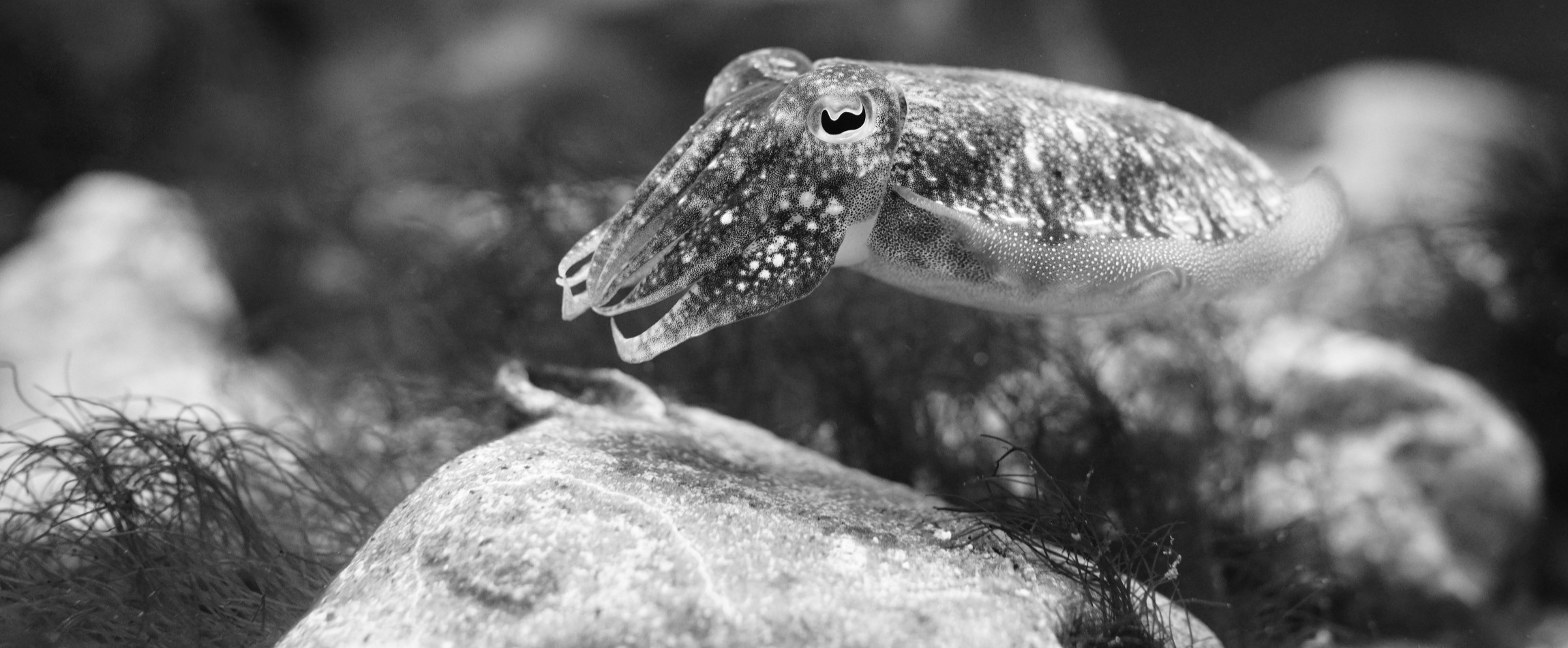
Cephalopods possess brain areas dedicated to learning and memory and can rapidly learn to associate a stimulus with a positive or negative outcome. Cuttlefishes show some of the most advanced abilities, including:
- Episodic-like memory: Cuttlefishes can recollect information about the “what, where, and when” of past events to guide their foraging behavior. For example, they remember what they ate, where they got it, and how long ago it was. Unlike in mammals, this ability doesn’t appear to decline with age.
- Future planning: Cuttlefishes can use predictions about the future to guide their decisions. They will eat less of their non-preferred food like crabs if they expect shrimps, their favorite food, to be available later.
- Delayed gratification: In experiments, cuttlefishes have shown remarkable self-control, waiting up to 130 seconds for a preferred food item while ignoring an immediately available but less desirable one. These wait times are comparable to those seen in apes, parrots, crows, and ravens.
Pain And Negative Emotions
The report notes very strong evidence of pain in octopuses and substantial evidence in squids and cuttlefishes. In one key study, octopuses were given a choice between two chambers and allowed to pick their favorite one. Researchers then gave them a noxious injection while they were in their favorite chamber before moving them to their less-preferred chamber and administering a pain-relieving anesthetic. The octopuses ended up switching their chamber preferences, developing a lasting aversion to the first and a lasting preference for the second. This is a standard test used to demonstrate pain in mammals. Furthermore, both octopuses and cuttlefishes exhibit wound-tending behaviors, like grooming an injured site, which stops when a local anesthetic is applied.
Cephalopods also show clear signs of other negative emotions. They exhibit stress responses after being caught in trawl nets. Factors like unsuitable water temperatures or lack of shelter can cause skin blanching, excessive inking, erratic swimming, and loss of appetite — all indications of stress, discomfort, fear, or even depression-like states.
Knowledge Gaps
While the evidence is strong, the report highlights many areas where more research is needed. Key knowledge gaps include understanding the full extent of these animals’ cognitive abilities, the nature of their positive emotions, and the development of effective, species-specific anesthetic procedures and pain relief. Current protocols for humane killing also lack detail and need refinement.
Cephalopods Deserve Greater Protection
This comprehensive report is a powerful tool for advocates. It provides a single, authoritative source that synthesizes decades of scientific research, confirming that cephalopods are intelligent, sentient beings capable of experiencing pain, fear, and stress. This evidence has already led the U.K. government to legally recognize cephalopods as sentient and the E.U. to extend legal protections to cephalopods in research settings.
Advocates can use this report to:
- Argue for stronger legal protections and welfare regulations for cephalopods in all contexts, including public aquariums and commercial fishing.
- Educate the public and policymakers about the complex inner lives of these animals.
- Bolster arguments against the development of commercial octopus farming, which raises significant welfare concerns.
The science is clear: cephalopods aren’t simple animals. They possess minds that demand our ethical consideration and protection.
This summary was drafted by a large language model (LLM) and closely edited by our Research Library Manager for clarity and accuracy. As per our AI policy, Faunalytics only uses LLMs to summarize very long reports (50+ pages) that are not appropriate to assign to volunteers, as well as studies that contain graphic descriptions of animal cruelty or animal industries. We remain committed to bringing you reliable data, which is why any AI-generated work will always be reviewed by a human.

Citations:
Birch, J., Morse, P., Schnell, A. K., & Amodio, P. (2025). Cephalopod cognition and sentience (Living Bibliography Project, Vol. 1). Brooks Institute for Animal Rights Law & Policy. https://thebrooksinstitute.org/sites/default/files/2025-02/Cephalopod%20Cognition%20and%20Sentience.pdf
