
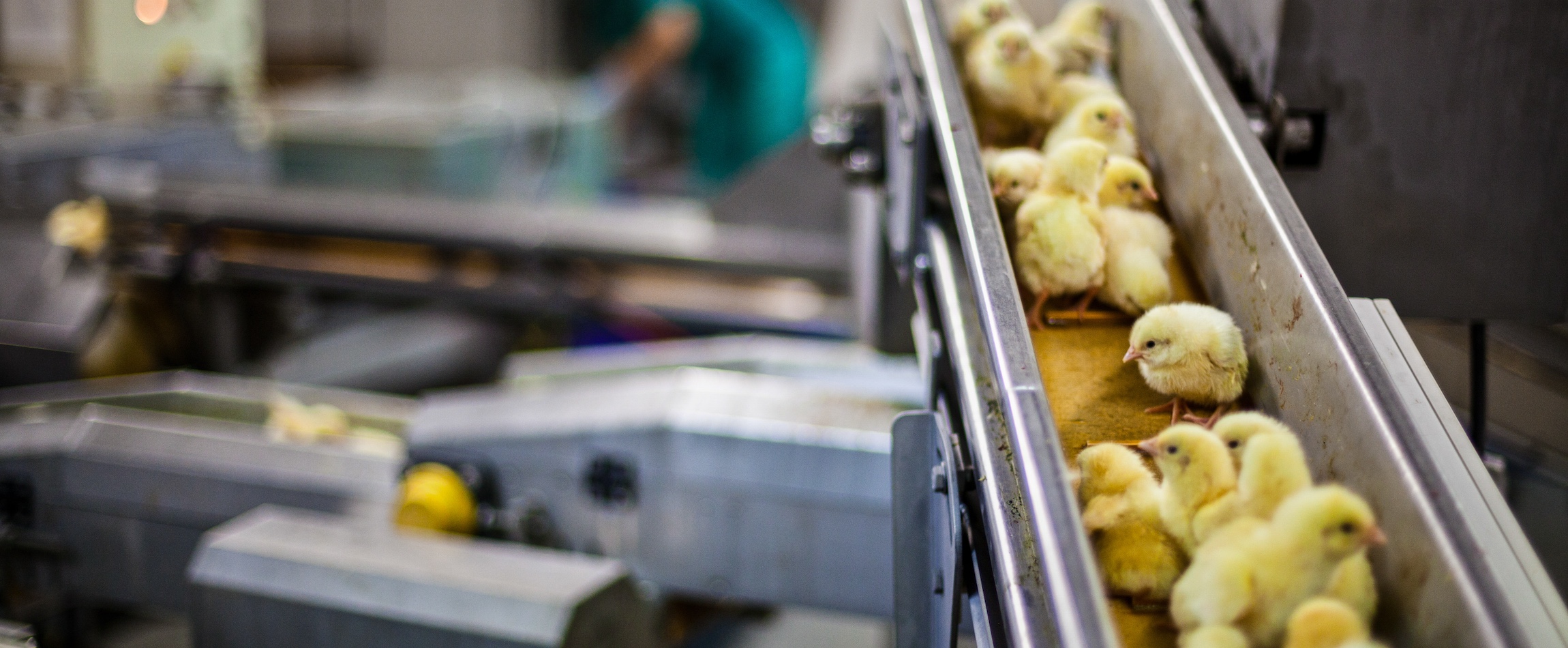
Nearly Eight Billion Per Year And Counting: Global Chick Culling, 2019–2024


Within hours of hatching, roughly half the chicks born into the global egg industry are killed. These are the males — and because modern poultry genetics have diverged into two highly specialized lineages over the past century, they serve no commercial purpose. Layer breeds are optimized for egg output; broiler breeds for rapid meat growth. Males from layer breeds can’t lay eggs, and their feed conversion ratio of 3.7–4.2 kg feed per kg body weight makes them roughly twice as costly to raise for meat as broiler breeds. The economic logic is stark: it’s cheaper to kill them on day one than to feed them for weeks.
This divergence between layer and broiler genetics didn’t always exist. Chickens were dual-purpose animals for most of agricultural history. The split emerged through a specific sequence of 20th-century innovations: vent sexing developed in Japan in the 1920s–30s, the USDA’s “Chicken of Tomorrow” competitions in the late 1940s that accelerated broiler genetics, and the full divergence into separate breeding programs by the 1950s. Today, two primary breeding companies control roughly 90% of global broiler genetics, and a similarly concentrated set controls layer genetics. Chick culling is structurally embedded in this consolidated supply chain — but that concentration also means change at relatively few chokepoints could have outsized impact.
The primary methods of culling are maceration (using high-speed industrial grinders, the dominant method in the U.S., Australia, and France), CO₂ or inert gas asphyxiation (common in Belgium, the Netherlands, and Switzerland), and suffocation (reported in parts of the developing world and deemed unacceptable by the AVMA). In the E.U., only maceration and gassing are authorized under harmonized slaughter regulations.
The welfare case against these practices is supported by robust science. A landmark 2023 three-part study from the Technical University of Munich established that cardiovascular pain responses emerge from embryonic day 16, meaningful EEG activity begins reliably from day 13, and behavioral nocifensive responses appear from day 15. A systematic review from 2025 confirmed that day-old chicks are sentient and capable of suffering. By hatching, they possess a fully functional nociceptive (pain feeling) system. At nearly 8 billion males culled per year, chick culling is one of the largest-scale animal welfare issues in the world, and it produces no direct food product for human consumption. For perspective: if male chicks were counted as their own category in global slaughter statistics, they’d rank second only to adult chickens among all land animals killed.
Methodology And Data
The Model
This analysis estimates male chick culling directly from each country’s laying flock — the hens that produce the eggs the UNFAO counts. We take flock size (F) straight from FAOSTAT’s reported number of laying birds, then estimate the replacement pullets that flock needs each year. Because one male chick is hatched and culled for every female pullet reared, annual replacements equal annual male culling. The formula is:
C = (52 × F) / (P × (1 − M₀) × (1 − M₁/2))
where C is chicks culled, F is flock size, P is the laying period in weeks, M₀ is pre-lay mortality, and M₁ is in-lay mortality. With our values (P = 62 weeks, M₀ = 3.5%, M₁ = 8%), the formula reduces to a simple relationship: annual culling is about 91% of flock size. (The ÷2 on in-lay mortality is a mid-interval correction — it assumes deaths are spread evenly across the laying period, not anything to do with the male-to-female ratio.)
As a check, we also estimated flock size the indirect way — dividing each country’s egg output by its average eggs-per-hen. Run on past years, the two routes agree closely — confirming that FAOSTAT’s egg and flock figures line up.
How The Assumptions Hold Up
Because we read flock size directly from FAOSTAT rather than inferring it from egg output, the estimate rests on just three modeling parameters — the laying period and two mortality rates — plus the 1:1 sex ratio. Together they reduce the flock-to-culling relationship to a single factor: annual male culling is about 91% of the laying flock.
The laying period (62 weeks) is the most influential of the three. It reflects a traditional single cycle, with hens laying from roughly 18 to 80 weeks of age. The U.S. industry increasingly extends this — about 80% of laying flocks are molted at least once, pushing productive life toward 100 to 106 weeks — and European producers are trending toward 85 to 100 weeks. A longer effective laying period means hens are replaced less often, so if the true global average is 70 rather than 62 weeks, the culling estimate falls by roughly 10%. This will be the parameter most worth refining as laying periods lengthen.
The mortality rates are well supported. Pre-lay mortality at 3.5% aligns with commercial breed guides (Hy-Line targets 97% rearing livability) and accounts for higher losses in developing regions, according to a large meta-analysis of nearly 4,000 flocks. In-lay mortality at 8% sits between cage systems (around 5%) and free-range (around 9.5%), supported by the same meta-analysis. Again, the ÷2 applied to in-lay mortality is a mid-interval correction. The 1:1 sex ratio itself reflects Mendelian genetics, with negligible commercial deviation (±2–3%).
One assumption from an earlier version of this model no longer applies: a fixed lay rate of 275 eggs per hen per year. Initially, we used that figure to infer flock size from egg tonnage, and it was the main reason an earlier draft of this estimate came in closer to 5 billion chicks culled annually. FAOSTAT’s own data show the global average is closer to 205 eggs per hen — pulled down by China, the world’s largest producer, at just 184. Holding the rate at 275 systematically undercounted the flock in the high-volume countries that dominate the global total. Reading flock size straight from FAOSTAT removes that error.
Where “7 Billion” Comes From, And Why Our Model Is Close
The figure of “7 billion male chicks culled annually” has become ubiquitous across literature. The most widely cited source is a 2018 paper in Poultry Science, which itself draws from an earlier estimate from around 2015. Despite extensive searching, no publication provides a transparent bottom-up methodology for the 7 billion figure at present day. Other estimates span a wide range: FFAR used 6 billion; the European Investment Bank cites 6.5 billion; The Guardian reported 4–6 billion in 2018.
Our estimate — 7.83 billion for 2024 — lands very close to that long-cited figure, and for the first time grounds the number in a transparent, country-by-country calculation. Where earlier work asserted a round number, this report shows the arithmetic: about 8.65 billion laying hens worldwide, each requiring annual replacement, with nearly one male hatched and culled for every female reared.
Country-level cross-validation supports the approach. According to USDA NASS data, 638 million egg-type chicks hatched in the U.S. in 2023, implying around 320 million males culled — close to the model’s U.S. figure of roughly 340 million.
That convergence is, in a certain sense, reassuring. The 7 billion figure has circulated essentially unchanged since around 2015 despite shifting production and a wave of legislative bans; its agreement with our number is partly coincidental. Our estimate carries uncertainty in the other direction: FAOSTAT’s flock counts appear inflated in some countries, and in places like China and India, a meaningful share of male chicks from backyard and dual-purpose flocks are raised rather than culled. This is most pronounced in parts of Asia: In Thailand, most male layer chicks end up raised for meat, and the data providers report a similar pattern in Indonesia, where they estimate that fewer than 10% of male layer chicks are culled and the rest are sold on and reared. Because Indonesia ranks third in our model — about 375 million in 2024 — that practice, if widespread, would move a large share of its total out of the “culled” column and pull the global figure down accordingly.
Both factors suggest the number actually culled may sit marginally below the headline flock-derived figure.
2019–2024 Trends
The Global Total Grew ~11% From 2019 To 2024
Applying the model to FAOSTAT data, estimated global male chick culling rose steadily from 7.08 billion in 2019 to 7.83 billion in 2024 — a compound annual growth rate of 2.0%.
The slowdown in 2021 (+0.7%) likely reflects pandemic disruptions to supply chains and foodservice demand. The renewed growth in 2022–2023 (+1.6%, +2.8%) tracks post-COVID recovery and surging production in Asia, before easing again in 2024 (+1.4%).
Asia Drives ~70% Of All Culling — And Nearly All The Growth
The geographic distribution is overwhelmingly concentrated. Asia accounted for 69.4% of estimated culling in 2024 (5.43 billion chicks), up from 67.4% in 2019. The Americas held at around 14.1% (about 1.10 billion), Europe at 9.2% (about 719 million), Africa at 7.1% (about 555 million), and Oceania was negligible at 0.3%.
The top 10 countries account for approximately 70% of the global total:
Several trends stand out. China alone added about 240 million estimated culled chicks from 2019 to 2024, driven by continued intensification of its egg sector — already the world’s largest by far. Bangladesh grew fastest among major producers (+69%), while the Philippines (+36%), India (+29%), and Indonesia (+23%) all expanded rapidly. The U.S. edged down about 6%, partly due to the 2022–2025 H5N1 avian influenza outbreak — the largest in U.S. history, which depopulated over 73 million egg layers. Bangladesh, Nigeria, and the Philippines now displace Japan, Türkiye, and Pakistan from the top 10.
What Drove Production Growth (And Disruptions Along The Way)
Global egg production expanded approximately 3% annually from 2019–2024, driven by population growth combined with rising protein demand, urbanization across the Global South, and post-COVID recovery in foodservice channels.
Two major disruptions shaped the period. The H5N1 avian influenza outbreak affected over 73 million egg-laying hens in the U.S. between 2022 and mid-2024, driving wholesale egg prices to a record $4.82/dozen in January 2023. Ironically, HPAI worsens the culling problem: as flocks are rebuilt, more chicks must be hatched, and more males culled. Separately, Russia’s invasion of Ukraine spiked grain and vegetable oil prices, with feed costs rising nearly 80% above 2019–2020 levels by mid-2022.
The implication for chick culling is stark: the countries driving virtually all production growth — China, India, Indonesia — have zero in-ovo sexing adoption and no regulatory pressure to adopt it. As global production continues to climb, the number of male chicks culled will likely rise well beyond 8 billion per year this decade, absent intervention.
Technological Solutions: In-Ovo Sexing
As of early 2025, a handful of companies have commercially deployed in-ovo sexing systems, and as of mid-2026, approximately 40% of the E.U.’s laying hens were hatched using these technologies — an 8-point increase from the prior year. Companies have identified and removed around 175 million male embryos since commercial adoption began.
Agri Advanced Technologies (AAT/Cheggy) is a market leader with 15+ machines across 7+ countries, using non-invasive hyperspectral imaging at day 13 with throughput up to 25,000 eggs per hour — but it works only with brown layer breeds. AAT installed the first U.S. machines in December 2024 at Hy-Line hatcheries in Iowa and Texas. Respeggt/SELEGGT offers >99.5% accuracy via PCR DNA analysis at day 8–9 and crucially works with both white and brown genetics — essential for the white-layer-dominant U.S. market — and is entering U.S. production. Orbem uses AI-powered MRI, is completely non-invasive and breed-agnostic, and was deployed in Switzerland as part of a sector-wide initiative. On the R&D frontier, HyperEye claims day-4 detection, and EggXYt uses CRISPR for day-0 detection but faces GMO regulatory barriers.
The economics increasingly favor adoption. In-ovo sexing adds an estimated €0.016–0.02 per egg (~1.6–2.0 euro cents). Consumer willingness to pay vastly exceeds this: a 2023 Cultivate Insights survey of 1,012 U.S. adults found 71% willing to pay a premium averaging 65 cents per dozen (5.4 cents/egg). Only 11% of consumers were aware chick culling occurs; once informed, 73% agreed the industry should find alternatives and 82% expressed interest in purchasing in-ovo sexed eggs. On labeling, 81% preferred the term “no-kill.”
The Policy And Advocacy Landscape
Legislative Bans Are Spreading
Germany became the first country to ban chick culling on January 1, 2022, and tightened requirements on January 1, 2024 to mandate sexing before day 13 — aligned with the pain perception research. Pre-ban, Germany culled around 45 million males annually; by early 2024, in-ovo sexing covered around 70% of the market. France followed with its ban effective January 1, 2023, backed by €10 million in public subsidies, with in-ovo sexing mandatory for all hatcheries. (In October 2025, the French egg body CNPO ended its retail-levy financing arrangement early after supermarket pushback, shifting in-ovo costs into producers’ cost index — reflecting a financing dispute rather than a rollback of the mandate.) Austria banned culling in July 2022 with a distinctive requirement for organic farms to raise males to 1 kg. Italy enacted legislation taking effect January 1, 2027, estimated to spare 34 million chicks annually. Switzerland achieved nationwide voluntary adoption in 2025. Our World in Data tracks these bans on an interactive country-level map.
The most consequential policy development is at the E.U. level. The European Commission’s February 2025 “Vision for Agriculture and Food” explicitly committed to phasing out systematic killing of day-old chicks. A December 2024 white paper from Animal Law Europe provided legal framework for E.U.-wide prohibition. In the U.K., a September 2025 Parliamentary debate saw 30+ MPs sign a joint letter calling for action, with 76% of respondents supporting a ban.
The U.S. has no federal or state bans, but market-driven adoption is accelerating. NestFresh launched the first U.S. “Humanely Hatched” eggs at retail, Kipster followed, United Egg Producers launched “Hatch Check” certification in January 2025, and Walmart’s supplier guidelines included in-ovo sexing as a focus area.
Who Is Driving Change
Many organizations across the animal advocacy movement are pushing for progress. The Albert Schweitzer Foundation provided legal architecture for Germany’s ban. Animal Equality drove Italy’s ban through 110,000+ petition signatures. Eurogroup for Animals leads E.U.-level advocacy. The Humane League coordinates the Open Wing Alliance and has pressured major retailers. CIWF advocates for in-ovo sexing at the earliest possible embryonic day when dual-purpose breeds are not practicable and tracks corporate in-ovo sexing commitments. OIPA coordinates E.U.-level petition campaigns. The ASPCA has highlighted the issue through its Farm Animal Protection program.
Corporate commitments have reached critical mass in Europe and are emerging in the United States. Unilever committed to supporting in-ovo sexing in 2014. United Egg Producers, representing 95% of U.S. egg operations, pledged to replace culling when commercially feasible and formalized that commitment with Hatch Check certification. Certified Humane released the first U.S. hatchery standard for in-ovo sexing in 2024. The Business Benchmark on Farm Animal Welfare (BBFAW), backed by 31 institutional investors including Aviva and BNP Paribas, creates additional accountability pressure through ESG channels.
What The Bans Have Achieved: Estimating Chicks Spared
Legislative bans are recent enough that their real-world impact is still accumulating — but the model lets us estimate how many males the bans have kept out of the grinder. We report two measures. The narrower and more meaningful one is males spared entirely: chicks identified by in-ovo sexing and never hatched at all. The broader one is chick-culling deaths avoided: every male no longer culled at hatch, whether spared in the egg or reared for meat instead. We lead with the first because a male raised for slaughter hasn’t truly been spared — he’s been moved to a different point in the supply chain, and will simply be slaughtered later.
Each estimate starts from a country’s model-derived counterfactual — how many males would have been culled absent any ban — and applies current in-ovo coverage. These should be read as estimates with a fair amount of uncertainty rather than precise counts.
Germany (ban effective January 1, 2022) has the longest track record. Our model puts its 2024 counterfactual at 46.5 million males. In-ovo sexing now covers about 70% of German egg production, so roughly 33 million males were spared entirely. Counting the rest — reared for meat rather than culled — the total culling deaths avoided reach the full 46.5 million since the ban ended day-old culling outright. One caveat: Germany’s reported laying flock fell sharply between 2023 and 2024, which may reflect avian influenza, and the counterfactual moves with it.
France (ban effective January 1, 2023) has a 2024 counterfactual of 57.8 million males. In-ovo sexing has been mandatory for every French hatchery since 2023. White layers (who make up about 10% of the flock) and missexed brown chicks are exempted from the ban. Because the national flock is mostly brown layers — well served by lower-cost sexing systems — coverage is broad. On that basis, the vast majority of those 57.8 million males were spared entirely, with culling deaths avoided reaching nearly the same figure.
Austria (ban effective July 2022) has a smaller industry, and FAOSTAT hasn’t yet reported its 2024 flock; using the 2023 stats would derive a counterfactual of about 6.5 million males. However, this number carries several important caveats: Austria’s rules allow organic farms to raise males to 1 kg for meat; there is also an exemption in the ban that allows for male chicks to be sold to zoos as snake / reptile food; finally — and perhaps most importantly — there are currently no in-ovo sexing machines present in Austrian hatcheries.
Switzerland reached full voluntary adoption by 2025, with the transition still underway in 2024. The model puts its counterfactual at about 3.5 million males; the 2024 reduction was substantial but partial, and we don’t quantify it precisely here.
Across Germany, France, and Austria — the three countries with bans in force — roughly 90 to 95 million male chicks were spared entirely in 2024, about 1.1% of the estimated 7.83 billion culled globally. Counted the broader way, as culling deaths avoided, the figure rises to around 110 million, or about 1.4%. Either reading points to the same conclusion: real progress at the country level, against a global total that is still significantly higher.
Recommendations For Advocacy
1. Make The E.U.-Wide Ban The Flagship Legislative Target
An E.U.-wide ban would cover approximately 7.3% of global egg production and, more importantly, create the regulatory precedent and manufacturing scale needed to drive technology costs down further. The Commission’s commitment to propose legislation in 2026 creates a clear near-term window. Advocacy should focus on ensuring the proposal mandates a hard deadline (not an indefinite phase-in), includes a pre-day-13 embryo development threshold aligned with the pain perception science, and provides transitional subsidies for member states with less-developed hatchery infrastructure. The coalition of 7+ member states already calling for an E.U. ban should be expanded. Germany’s experience — where 70% of the market had transitioned to in-ovo sexing by late 2023 — demonstrates that industry adapts quickly once a mandate is certain.
2. Apply The Cage-Free Campaign Playbook To Corporate Commitments
The chick culling issue has structural advantages over cage-free that advocacy hasn’t yet fully exploited. A 2025 Coefficient Giving/Open Philanthropy case study of the cage-free movement identified key success factors: pragmatic corporate engagement, leveraging industry concentration (top four U.S. retailers control 33% of egg purchases), multi-tactic coordination combining protests and collaborative standard-setting, and institutional infrastructure like the Open Wing Alliance for accountability tracking. The chick culling version of this playbook benefits from even more favorable economics: in-ovo sexing adds under 1 cent per egg compared to 8–9 cents per egg in additional production costs for cage-free conversion. Walmart’s existing supplier engagement and United Egg Producers’ Hatch Check certification provide footholds. An “EggTrack”-style accountability tool for chick culling commitments would be a logical next investment.
3. Close The Awareness Gap
The gap between current consumer awareness (11%) and opposition once informed (73% believe the industry should find alternatives; 61% report feeling uncomfortable with the practice) represents one of the largest awareness-to-action gaps in animal welfare. The 2023 Cultivate Insights survey explicitly recommended that advocates prioritize chick culling and found that 48% of consumers incorrectly believed male chicks were raised for meat. Consumer education campaigns modeled on the cage-free movement — combining investigative media, social media content, and retail-level labeling — could shift the issue rapidly. The consumer data strongly favors “no-kill” labeling (81% preference) over technical terms like “in-ovo sexed.”
4. Invest In The Asia Bridge
This is the most difficult but most important strategic priority. China (around 38.8% of culling), India (7.8%), and Indonesia (4.8%) together account for more than 51% of the global total, and their share is growing. These markets have no in-ovo sexing adoption, no regulatory frameworks for hatchery welfare, and highly cost-sensitive commodity production. However, the in-ovo sexing market in Asia-Pacific is small. As poultry economist Peter van Horne has noted, this remains largely a rich-country concern. Bridging this gap will require technology transfer partnerships with Asian breeding companies, cost reduction through manufacturing scale (enabled by E.U.-wide mandates), and engagement with multinational food companies whose supply chains span both regulated and unregulated markets. Without progress in Asia, the absolute number of chicks culled globally will continue to rise even as European countries celebrate bans.
5. Fund Research On The Remaining Technology And Data Gaps
Two practical gaps limit the case for action. First, in-ovo sexing for white-shell layer breeds — dominant in the U.S. market — relies on only two providers (Orbem and Respeggt), both less mature than the market-leading AAT system for brown breeds. Accelerating white-breed technology readiness is essential for U.S.-scale adoption. Second, the methodology underlying this report now reads flock size directly from FAOSTAT rather than inferring it from a fixed lay rate, so the largest remaining uncertainty is the quality of the flock data itself — above all China’s reported flock, which may be inflated. Refining the China figure against independent sources is the single highest-value data improvement.
6. Treat Dual-Purpose Breeds As A Niche Complement
Dual-purpose breeds like Lohmann Dual — where males are raised for meat rather than culled — serve organic and premium market segments. But at scale, the economics are unfavorable: males reach a standard slaughter weight of around 2 kg more slowly than conventional broilers (which reach 2.4 kg in around 42 days), with lower breast meat yield and a cost premium of 2.6–3.9 cents per egg — roughly 3–4 times the cost of in-ovo sexing. Advocacy messaging should position in-ovo sexing as the primary commercial-scale solution even if acknowledging dual-purpose systems as a valid choice for producers who prefer them.
Conclusion
This report finds that 7.83 billion male chicks were culled globally in 2024, up about 11% from 7.08 billion in 2019, driven overwhelmingly by production growth in Asia. The estimate rests on transparent, replicable methodology using FAOSTAT laying-bird data, validated against country-level figures from the USDA and other national governments.
The scale of this issue is tremendous and worth paying attention to. As mentioned in our introduction, if male chicks were counted as their own category in global slaughter statistics, they’d rank second only to adult chickens among all land animals killed. Put another way, if we included male chicks in annual slaughter numbers, they would make up 8.2% of the annual total. Beginning next year, we will begin supplementing our global slaughter stats with ongoing estimates of annual chick culling based on this methodology.
This moment is one of unusual convergence. In-ovo sexing technology is commercially proven at scale, with 40% E.U. market penetration and costs well below consumer willingness to pay. Legislative momentum is building, with E.U.-wide rules expected in 2026. Consumer opposition to the practice of culling is overwhelming once awareness exists. The cage-free movement provides a proven playbook for translating technology availability and public sentiment into industry-wide change.
But the numbers in this report make clear that without engagement in Asia, where about 70% of culling occurs and nearly all growth is concentrated, progress in Europe and North America will be outpaced by the global scale of the problem. The most impactful advocacy strategy treats the E.U. ban as a catalyst, corporate commitments as a multiplier, consumer awareness as fuel, and Asia-Pacific technology transfer as the decisive long-term challenge.
Pablo Rosado of Our World in Data provided invaluable feedback throughout drafting of this report, and Andie Thompkins reviewed data and calculations.