
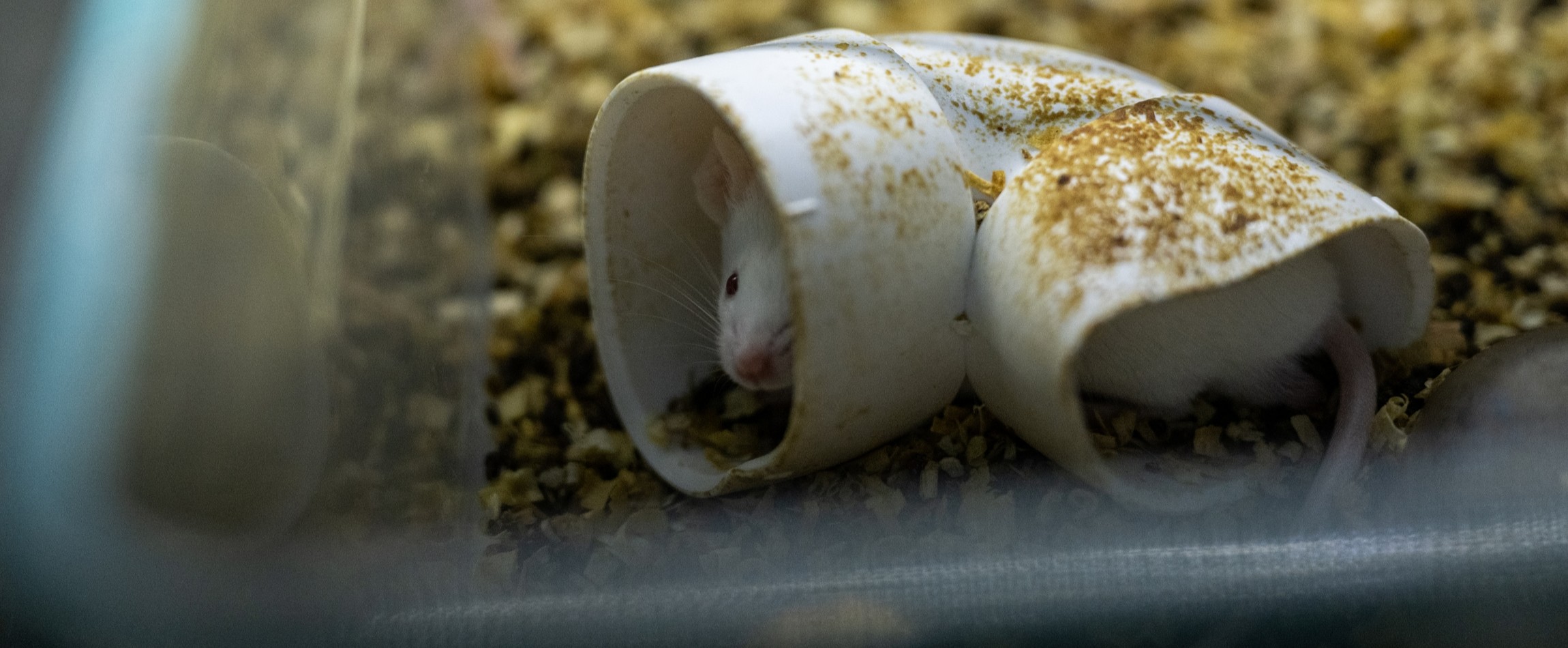
Do Laboratory Mice Get What They Need From Their Cages?


The common house mouse is the most widely used laboratory animal in the world, yet standard housing conditions are vastly different from anything mice would encounter in nature. Conventional lab cages are typically small and bare, kept that way for economic, ergonomic, and sanitary reasons, as well as a desire for consistency across studies.
In Switzerland, a sharp contrast between the legal housing standards for lab mice and the recommended standards for companion mice sparked a debate: should companion mouse housing conditions also apply to lab mice? Inspired by this debate, researchers set out to compare how mice actually behave under each type of housing.
The researchers housed 64 mice — from two common laboratory strains, of both sexes, and in groups of three or five — in either standard laboratory cages or larger, resource-rich companion-style cages. The companion cages were designed based on recommendations from Schweizer Tierschutz STS, Switzerland’s largest animal protection organization. The lab cages followed Switzerland’s minimum legal standards for laboratory mouse housing.
Behavior and resource use were tracked over four weeks through live observations. These were made over a four-hour period following “lights out,” when mice were most active. Video recordings were also used to assess where mice spent their time within the companion cages across a 24-hour period. Statistical models were then used to estimate differences in behavior and resource use between the two housing conditions.
Different Housing, Different Behaviors
The results showed clear differences in what mice did — and how much time they spent doing it — depending on their housing.
- Mice in companion cages showed more running, digging, and gnawing. Mice in lab cages climbed the cage grid more, reared up on their hind legs more, and exhibited more abnormal repetitive behaviors such as circling, bar-mouthing, twirling, back-flipping, and route-tracing.
- Mice in companion cages spent much of their time on the wheels and elevated shelves, as well as in the deep bedding. Mice in lab cages spent considerable time on the cage grid, and used their tunnel and house very little — though still more than the companion-cage mice did.
What These Differences Mean
Although climbing is a natural behavior for mice, the pattern seen in lab cages appears to be driven by something else. Previous research has shown that climbing in laboratory cages likely represents attempts to escape the cage rather than an urge to explore. In barren lab cages, this kind of climbing often escalates into stereotypies — such as repeatedly gnawing on the cage bars or spinning from the cage lid — as mice try and fail to cope with an inadequate environment. In companion cages, where mice had genuine choices about where to go, they spent far less time interacting with the cage grid, even though their cages had more bars available.
Running wheels were among the most well-used resources in the companion cages. Exercise is known to positively affect physical health and brain function in mice, and the researchers observed that mice used the wheels consistently and voluntarily. This aligns with earlier research showing that wheel running is intrinsically rewarding for mice — something they’re strongly motivated to do when given the chance.
Deep bedding also turned out to be an important feature of the companion cages, with mice actively burrowing into it and creating underground shelters. Burrowing is a natural mouse behavior, and in a lab setting, deeper bedding could provide opportunities to dig and hide. Research facilities tend to keep temperatures below what mice find comfortable, so it could help keep them warm too.
There are a few limitations to note. Because some mice were individually marked by shaving patches of fur, the shaving process itself may have introduced some stress and potentially altered their behavior. However, the researchers took steps to minimize this by giving unshaved mice a simulated shaving procedure to control for the handling experience.
The researchers also acknowledge that because much of the mice’s behavior in the deep bedding wasn’t directly observable, the study may have underestimated how often certain behaviors, such as social interaction and grooming, occurred in companion-cage mice.
Despite these limitations, the findings suggest that current standard laboratory housing conditions suppress natural mouse behavior, limiting movement, restricting burrowing, and creating conditions in which stereotypic behaviors develop. For animal advocates working on laboratory animal welfare, this research supports calls for enriched housing standards, particularly deeper bedding and equipment that encourages physical activity, such as running wheels. Whether kept in people’s homes or in research settings, mice deserve the cage upgrades needed to improve their well-being.
https://doi.org/10.1016/j.applanim.2024.106381

Citations:
Gygax, M., Sanches Fortes, M., Voelkl, B., Würbel, H., & Novak, J. (2024). Rattling the cage: Behaviour and resource use of mice in laboratory and pet cages. Applied Animal Behaviour Science, 278, 106381. https://doi.org/10.1016/j.applanim.2024.106381