Scotland’s Hill Sheep Face Unexplained “Blackloss”


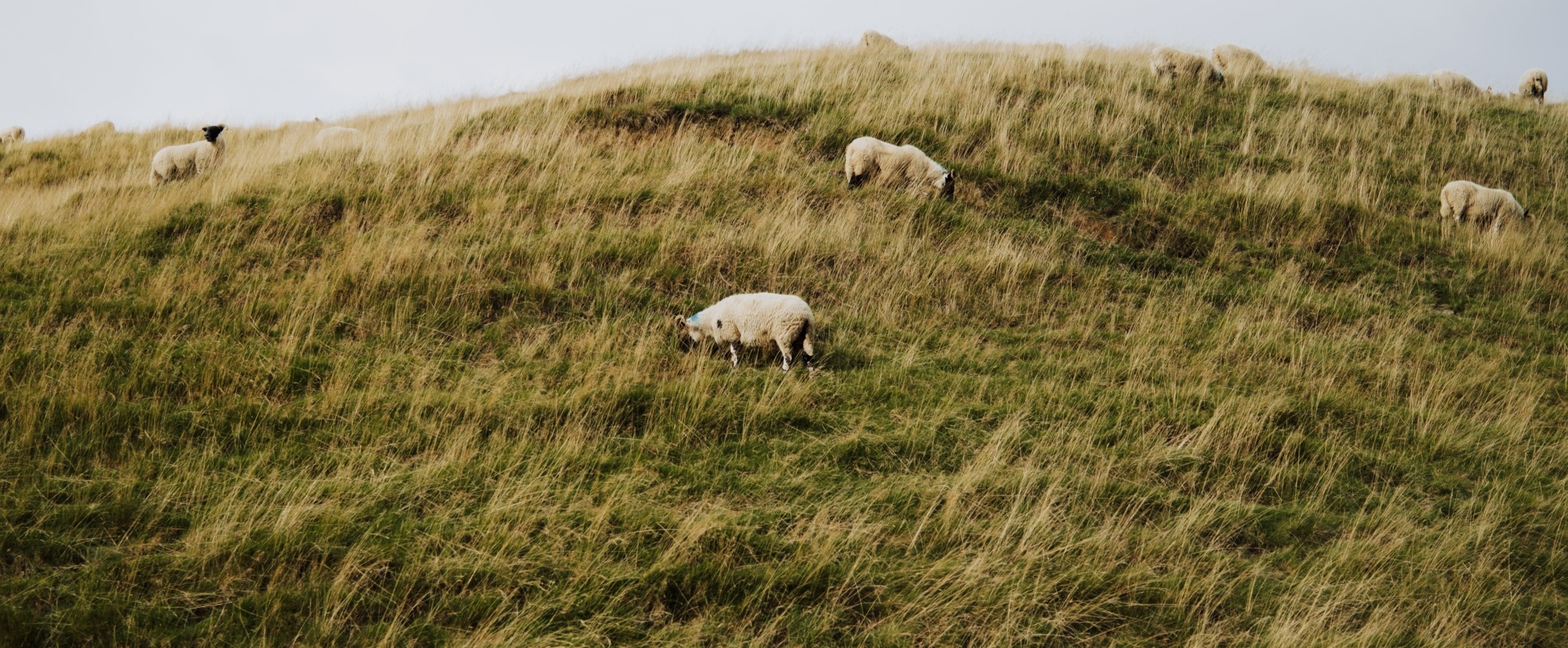
In the Scottish Highlands and Islands, sheep are raised on vast, remote grazing land. Flocks are gathered only a few times a year for husbandry tasks and health treatments. Between these gatherings, some lambs simply disappear and are never found. Farmers call these unexplained disappearances “blackloss.”
Unlike deaths with a confirmed cause, blackloss has no clear explanation. Farmers and researchers suspect that parasites, predation, a sunlight-sensitivity disease known as plochteach or yellowses, and poor nutrition all play a role. An earlier survey of Scottish hill sheep farmers found an average lamb loss of close to 7% between marking at six to eight weeks of age and weaning at four to six months of age. That survey pointed to some anecdotal causes, but didn’t explore them in depth.
For this study, researchers developed a 32-question survey covering farm characteristics, husbandry practices, lamb health, predator presence, and farmer attitudes toward blackloss. They distributed it through agricultural and government organizations across the Highlands and Islands between April and December 2020. Of the 57 people who requested a copy, 31 completed it, a response rate of about 54%.
Many respondents were crofters. Crofters are tenants or owners of small agricultural landholdings. Some have rights in so-called sheep stock clubs — flocks that are owned and farmed collectively.
Using a statistical clustering technique, the researchers sorted respondents into three types of operations. They grouped farms by size, type, access to shared grazing land, and number of breeding female sheep.
- Group 1 (the “traditional extensive” cluster): This group included two farms and three sheep stock clubs, with a median size of 2,820 hectares and 1,000 breeding ewes. Only one farm had no access to shared grazing.
- Group 2 (the “smallholders” cluster): This group included 10 crofts and one sheep stock club, with a median size of 45 hectares and 120 breeding ewes. Everyone had access to shared grazing.
- Group 3 (the “medium enterprises” cluster): This group included 13 farms and two crofts, with a median size of 530 hectares and 500 breeding ewes. No one had access to shared grazing.
Overall, the study found that close to 8% of lambs were lost to blackloss between marking and weaning in 2019. At the flock level, average lamb losses reached 6%, ranging from 0% up to 17.5%. All respondents in Group 1 (those with the largest properties and flocks) reported experiencing blackloss. Nearly two-thirds (64%) of Group 2 and three-quarters (73%) of Group 3 respondents did too. However, the differences between groups weren’t statistically significant.
Group 1 respondents reported a significantly higher rate of plochteach among their lambs than Group 2 respondents did. They also rated several consequences of blackloss as significantly more severe than the other groups did. These included productivity loss, financial loss, and their own stress.
All three groups agreed that predation was an important cause of blackloss, and this didn’t differ significantly between groups. However, Group 1 respondents rated predators as a significantly greater threat to their lambs than respondents in the other two groups did. In particular, they perceived white-tailed eagles as a greater threat than Group 3 respondents did, even though all groups farmed within this species’ natural range.
Despite these differences, respondents broadly shared similar attitudes about blackloss overall. Many believed it was an inevitable part of hill sheep farming. Still, most agreed that reducing these losses mattered to them, and that understanding the causes better would help them do so.
The study relied on a small sample of 31 respondents, and only 13 provided detailed lamb counts. The specific blackloss percentages should therefore be read with some caution. Respondents’ own loss estimates didn’t always match their lamb counts. For example, one Group 1 respondent estimated losses above 30%, but recorded just 1.3% based on an actual count. Group 3 respondents showed the opposite pattern: their calculated blackloss (13.5%) was higher than their own estimated range of 1% to 10%. This suggests that hill sheep farmers can both overestimate and underestimate their true losses.
This research offers a rare, farmer-reported window into a scale of lamb suffering and death. Blackloss, by definition, involves lambs disappearing between infrequent gathering events. This means that animals who fall sick, starve, or are injured or killed by predators may go unnoticed for extended periods. Even the lower reported loss rates in this study represent many lambs. These individuals may have experienced prolonged suffering with no veterinary care or intervention at all. And blackloss occurs in addition to the industry average loss of 15% around lambing time.
Hill sheep farming carries a pastoral, low-input image. Yet these findings challenge the assumption that this traditional, extensive system is inherently welfare-friendly. Instead, the study suggests that the difficulty of monitoring animals across vast, remote grazing areas can create serious welfare gaps that go undetected. Many farmers view blackloss as an unavoidable feature of the system rather than a solvable welfare problem. This framing may point to a normalization of animal suffering that advocates could work to challenge. Advocates working on farmed animal welfare policy might use this evidence to push for stronger monitoring and reporting requirements in extensive farming systems. It could also help highlight blackloss as an underexplored source of suffering in current food production practices.
This summary was drafted by a large language model (LLM) and closely edited by our Research Library Manager for clarity and accuracy. As per our AI policy, Faunalytics only uses LLMs to summarize very long reports (~50+ pages) that are not appropriate to assign to volunteers, studies that contain graphic descriptions of animal cruelty or animal industries, and research on niche topics. We remain committed to bringing you reliable data, which is why any AI-generated work will always be reviewed by a human.
https://doi.org/10.1371/journal.pone.0298255

Citations:
McAuliffe, F., McLaren, A., Sargison, N., Brülisauer, F., Kent, A., & McCracken, D. (2024). Investigating hill sheep farmers and crofters’ experiences of blackloss in the Highlands and Islands of Scotland. PLOS One, 19(3), e0298255. https://doi.org/10.1371/journal.pone.0298255