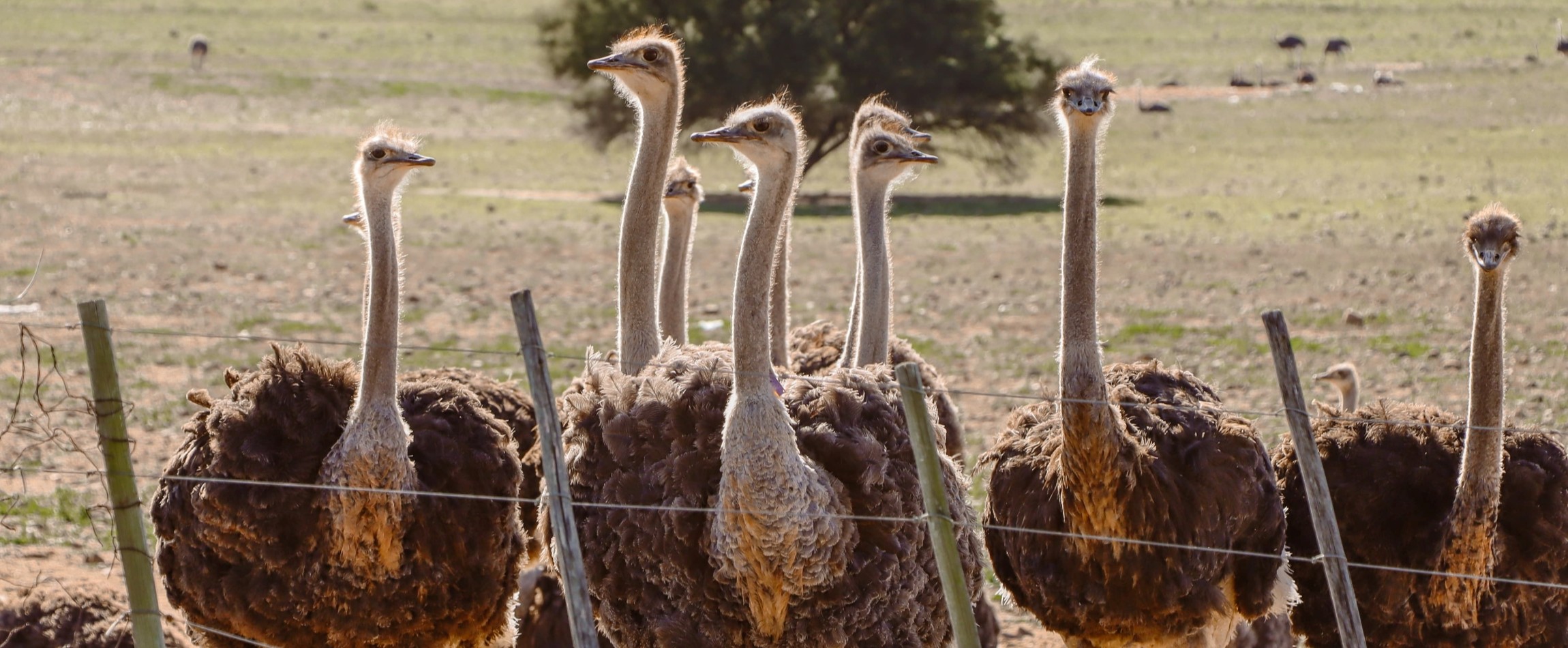
The Hidden Cruelty Behind Ostrich Feathers


Fur has steadily lost its luxury status, with a growing number of brands, retailers, and fashion weeks banning it. Yet feathers haven’t faced the same scrutiny. Ostrich feathers appear everywhere from couture runways to fast fashion, and are often marketed as naturally shed or as a byproduct of meat and leather farming. South Africa dominates this trade, centered around the Klein Karoo region and the town of Oudtshoorn in particular.
This report from World Animal Protection and Collective Fashion Justice set out to test these claims and document conditions on South African ostrich farms. Between 2023 and 2025, the authors conducted desktop research, reviewing published supplier lists, trade data, and trade media to map the feather supply chain. In 2026, World Animal Protection commissioned an independent investigation agency to visit ostrich sites in the Klein Karoo region. These included commercial farms, a feather processing facility, and public-facing “show farms.” Some sites were linked to the country’s two major feather producers, Cape Karoo International and Ostrich Products South Africa. World Animal Protection also obtained export data from the South African government and polled the public in the U.K., the U.S., Australia, and New Zealand.
A Growing, Self-Regulated Industry
South Africa exported more than 150 metric tons of ostrich feathers in the 2024/2025 season, worth more than US$60 million. That value has nearly tripled since 2018, while export volume has grown by around 20%. During the 2024/2025 season, 150,000 ostriches were slaughtered in South Africa — 7% more than the season before.
Beyond general animal cruelty laws, South Africa doesn’t appear to have legally binding welfare rules specific to farmed ostriches. Instead, the industry sets its own voluntary standards through the South African Ostrich Business Chamber.
The Myth Of The Natural Molt
Wild ostriches don’t have a mass molting season; they maintain their feathers year-round. Yet in World Animal Protection’s polling, 47% of respondents believed that feathers used in fashion are mostly collected through natural shedding. Only 16% thought that feathers are plucked from live birds, and just 10% identified cutting feathers from live ostriches as a collection method.
No industry regulations or guidelines mention molting as a viable harvesting method. One processing facility manager said it takes three birds’ worth of feathers to make a single 2.2-pound auction bundle. The authors argue that natural shedding alone couldn’t plausibly supply 150 metric tons a year.
According to the authors, the industry’s public “show farms” also misrepresent how it operates. These sites market themselves as working farms, offering tours where visitors can meet ostriches, eat ostrich meat, and buy feather and skin products. But investigators found they present a far more polished picture than commercial farms, and one commercial farmer said show farms don’t reflect the industry’s real challenges.
Plucked, Cut, And Pulled
On one show farm tour, guides explained that plucking only happens on commercial farms. A later visit to one of these farms bore this out: staff said ostriches’ wing feathers are live plucked every six months. Live plucking forcibly removes feathers still connected to living tissue, causing pain and bleeding. Other farms preferred cutting, where feathers are cut above the bloodline and the remaining shafts are removed later on.
But cutting isn’t the gentle alternative it appears to be. Left alone, the remaining shafts would eventually fall out on their own. On one farm, though, workers pulled them out with pliers after just two weeks to speed up regrowth. Investigative footage from a farm in the luxury fashion supply chain shows an ostrich being chased, restrained, and hooded with a sack. Four workers then cut and pulled the bird’s feathers with pliers, without providing any pain relief.
Investigators also saw multiple blood feathers — immature feathers with an active blood supply — at farms supplying the fashion industry. This suggests feathers are being harvested before they’re mature, despite industry guidance recommending otherwise.
Captivity And Slaughter
Investigators observed ostriches with pecking injuries to their eyes, repetitive fence pecking, and aggression between birds. Sick or injured birds were sent to slaughter because treatment was considered financially unviable.
Every feather production system supplying the fashion industry ends in slaughter. Ostriches kept for high quality feathers endure repeated harvesting for years until their feather quality, egg production, or breeding quality declines. Those raised mainly for meat, skin, or lower quality feathers are killed at around nine to 14 months. In the wild, ostriches can live 30 to 40 years.
The authors also reject the byproduct claim. South Africa’s commercial ostrich farming began with feathers in the 1860s, and the meat and leather industries developed nearly a century later. Farms supplying Ostrich Products South Africa told investigators that feathers are their main source of income.
Fashion’s Uneven Response
Melbourne Fashion Week banned all wild animal products, including ostrich feathers, in 2024, and Copenhagen Fashion Week followed in 2025. Retailers like Selfridges, Wolf & Badger, and Debenhams Group have also banned ostrich feathers. But none of the “Big 4” fashion weeks — London, Milan, New York, and Paris — have feather-free policies. Of 24 major luxury brands reviewed in the report, only Stella McCartney has one. Chanel bans ostrich skins but not feathers from the very same supply chain.
This gap may carry risk for brands. In World Animal Protection’s polling, 83% agreed that farming and killing ostriches for fashion should be banned. And 70% said they’d stop buying from a brand that uses ostrich feathers. Meanwhile, plant-based feather alternatives are starting to appear on major runways.
Limitations
This is an advocacy report, not a peer-reviewed study. The authors don’t say how many farms were visited. Several key findings also come from a single farm or farmers’ own descriptions, so it’s unclear how widespread these practices are. Slaughter evidence relies partly on a 2015 People for the Ethical Treatment of Animals investigation. Also, the polling lacks details on sample size, methods, and question wording.
Advocating For Ostriches
The “natural molt” and “byproduct” narratives are doing heavy lifting for the feather industry, and many consumers believe them. Advocates can counter these claims directly with evidence that feathers are harvested on a schedule and drive farm income. The findings also suggest that debates over “humane” harvesting may be a dead end. Cutting shares many of plucking’s welfare problems, industry standards are voluntary, and every system ends in slaughter. Rather than pushing for better harvesting practices, advocates may make more progress calling for an end to feather use, as the report recommends.
Brands, retailers, and fashion weeks are promising pressure points. Advocates can highlight inconsistencies like skin bans that exclude feathers. They can also urge brands not to treat South African Ostrich Business Chamber certification as proof of good welfare. As the report notes, ostrich feathers may be on the same path fur has already traveled, offering hope for a future where wild animals are no longer exploited for fashion.
This summary was drafted by a large language model (LLM) and closely edited by our Research Library Manager for clarity and accuracy. As per our AI policy, Faunalytics only uses LLMs to summarize very long reports (~50+ pages) that are not appropriate to assign to volunteers, studies that contain graphic descriptions of animal cruelty or animal industries, and research on niche topics. We remain committed to bringing you reliable data, which is why any AI-generated work will always be reviewed by a human.

Citations:
World Animal Protection, & Collective Fashion Justice. (2026). Blood feathers: An investigation into the ostrich feather industry. World Animal Protection. https://www.worldanimalprotection.us/siteassets/reports-programmatic/2026-blood-feathers-ostrich-report.pdf