Entertainment, Education, And Captive Animals


For many families, summer is a time for entertainment and family field trips. Many of the most popular theme parks and special events of the summer involve the use of animals for entertainment: county fairs have petting zoos; water parks have dolphin-shows; circuses entertain audiences by having large animals perform tricks; and zoos and aquariums leave animals in enclosures so that they can be observed by human visitors.
To animal advocates, it is clear that individual animals are suffering in places like Sea World, zoos, and circuses. However, this is not the dominant perspective, as is evidenced by the continued success of these enterprises. One tourism company from the United Kingdom reported that one quarter of the 1.2 million excursions it books each year are animal related.
———————-
Although the plight of animals used for entertainment is rarely at the forefront of people’s minds when making vacation plans, a recent tragedy brought the issue to the mainstream press. This past winter, a captive orca named Tilikum killed his trainer at Sea World and the news media picked up on the cruel conditions in which these animals live. There were even reports focusing on the analogy that the size of the enclosure in which Tilikum lived for 27 years is equivalent to a human living in a space the size of a bathtub.
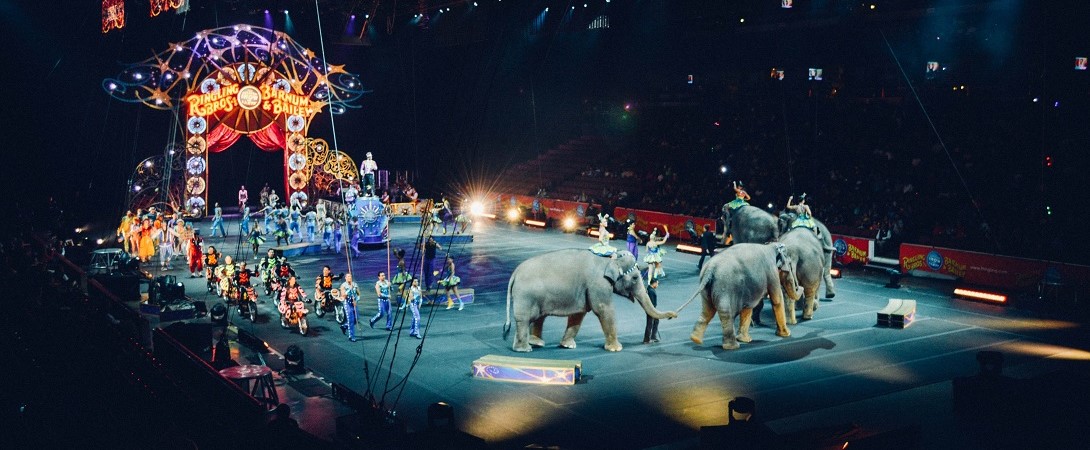
Similar situations exist for animals in other locations where animals are used for entertainment. In 2008 the RSPCA compared the health of elephants living in natural environments in Africa to elephants living in European zoos. This research concluded that elephants in zoos die younger and suffer higher rates of physical, emotional and psychological health problems than do animals living in their natural environments. Life in the circus may be even worse. Research conducted by the Universities Federation for Animal Welfare revealed that 91-99% of the time circus animals live in extreme confinement. The enclosures in which they live are typically one quarter the size of the enclosures of animals in zoos and they are let out only to train and perform.
Many people are not aware of the unnecessary suffering of animals used for entertainment. Some argue that zoos and aquariums educate the public about the plight of animals and the need to conserve the environment for their sake. Some research has examined if the assertion that visits to zoos and aquariums increase knowledge of animals is accurate. Notably, one recent study by Falk et al. found that visiting zoos and aquariums has a measurable positive impact on visitors’ knowledge and attitudes. This study is important as it was considered “the first direct evidence that visits to zoos and aquariums produce long-term positive effects on people’s attitudes toward other animals.” However, an independent group of researchers examined this study and found it to be fraught with methodological problems.
Marino et al. analyzed the methodology employed by Falk et al. and concluded that, due to six methodological flaws, this study does not provide “compelling evidence for the claim that zoos and aquariums promote attitude change, education, or interest in conservation in visitors” and that further research in this area is needed. One problem was that respondents were fully informed as to the purpose of the study before responding. This is problematic because research participants have a tendency to alter their responses according to what they believe the researcher is hypothesizing.
Another flaw was that in attempting to gauge how attitudes change because of visiting the zoo, Falk et al. only questioned visitors as they exited, asking how they “would have” responded before entering. A more appropriate design would have been to interview people before they entered and as they exited. Further, interviewing visitors immediately upon exited likely gives all answers a positive skew due to novelty effects, which are the uplifting effects of a new experience. Hopefully future research will use better research designs when examining the impact of zoos and aquariums on attitudes toward animals.
However, even if it is found that zoos and aquariums increase knowledge about certain animals this is not the full story; they may also reinforce the idea that it is acceptable for humans to capture and cage animals. It is possible that seeing captive animals reinforces the idea that it is acceptable to use animals for entertainment; hopefully someone will look into this soon.