
Cleaner Fishes Show Self-Awareness Quickly


Observing whether an animal recognizes their own reflection is one way to show that they have a sense of self, which can shape both scientific knowledge and approaches to animal welfare.
Most research about self-awareness in non-human animals has focused heavily on whether animals can pass the mark test. This involves placing a mark on an animal’s body visible to them only in a mirror and observing whether they interact with it. Humans have passed this test within minutes of mirror exposure, demonstrating their own self-awareness. When an animal doesn’t try to interact with the mark, scientists have typically viewed this failure as an indication that they aren’t capable of mirror self-recognition (MSR) and have little to no self-awareness.
A New Way Of Studying Mirror Self-Recognition
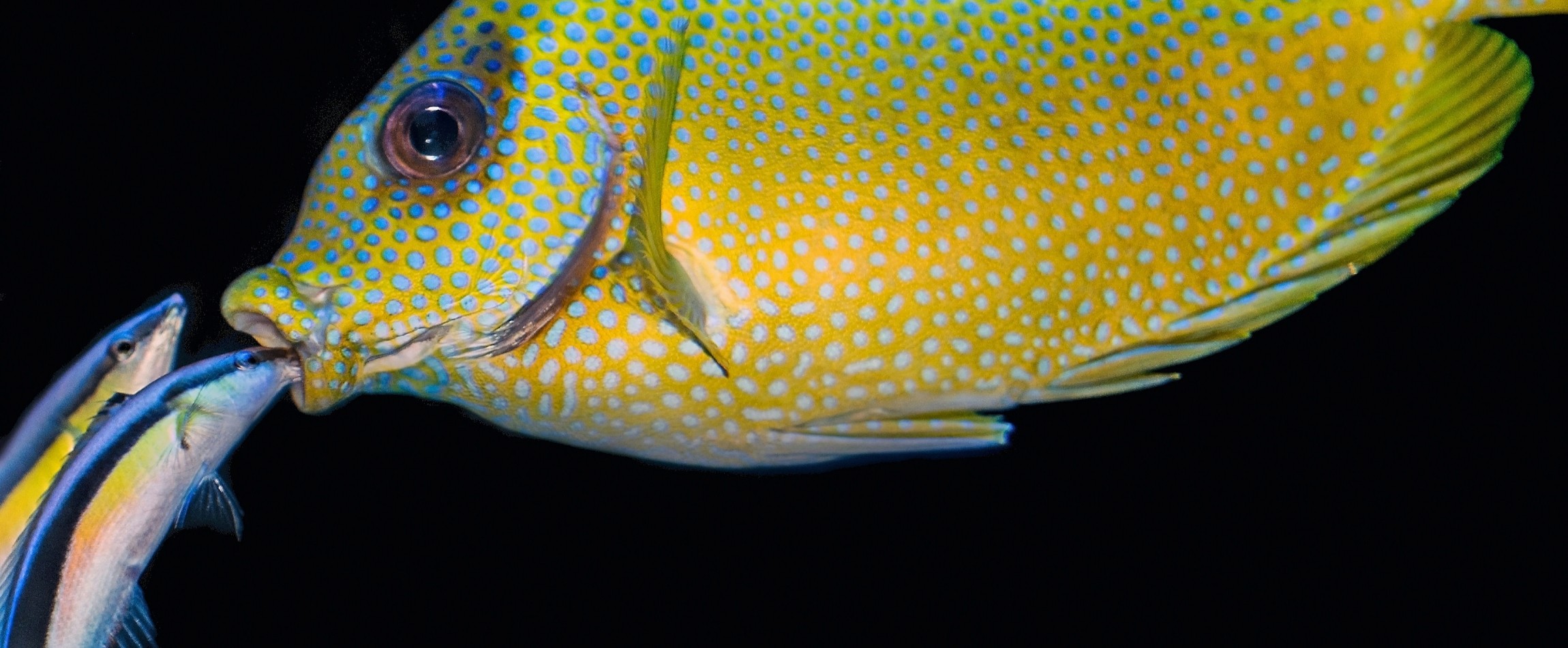
The authors of this study wanted to better understand MSR in the bluestreak cleaner wrasse, a species of fish specialized in removing parasites from other fishes. Prior research has already found this species to show MSR, but here, the researchers wanted to determine the exact time MSR occurred and its relationship with other behaviors.
Traditionally, past studies have waited to conduct the mark test until days or weeks after mirror exposure. In this study, when the fishes saw the mirror for the first time, they’d already been marked. This change allowed the researchers to observe the MSR process from the beginning and document the fishes’ behaviors in greater detail than past studies.
Experimental Setup
Nine wild-caught fishes were involved in the experiment. Each fish was housed in their own tank with a mirror, a piece of shrimp, and a rock they could use for scraping. After a period that allowed fishes to adjust to the tanks, the researchers implanted small brown marks under the skin of their throats that were intended to resemble parasites. The researchers then uncovered the mirrors and recorded the fishes’ behavior for the following five days. They noted the exact time fishes tried to scrape off the marks and statistically analyzed changes in behavior during the experiment.
How Fishes Reacted To The Mirror
After seeing the mirror for the first time, fishes’ behavior followed a clear sequence. First, seven out of nine acted aggressively towards their reflections, which the authors interpret as fishes mistaking their reflections for unknown or rival fishes. Then, they began testing whether their movements matched those of the mirror image, such as by swaying their heads while gazing at the mirror. These kinds of behaviors are what the authors identify as contingency-testing, or “C-testing.” Within four hours of mirror exposure, six fishes had attempted to remove the marks on their throats, with the first attempt occurring about 20 minutes after mirror exposure. The authors interpreted the end of C-testing as the point at which fishes achieved MSR (i.e., they concluded the mirror images must be themselves), with passing the mark test serving as evidence MSR had indeed occurred.
After recognizing the mirror image as their own, fishes seemed much more relaxed, and they began to investigate their relationship with the mirror. They exhibited curious behavior not observed in the absence of a mirror, such as rushing towards it before quickly turning away. Three were even seen dropping their pieces of shrimp by the mirror and watching them sink, perhaps testing if the mirror’s properties applied to objects beyond themselves. The authors called these kinds of post-MSR behaviors “mirror-exploring behaviors.”
Results Expand Understanding Of Mirror Self-Recognition
The experiment revealed several insights into animal cognition:
- Cleaner fishes are likely self-aware by nature. Within an hour of mirror exposure, all fishes had begun testing whether the mirror image was their own, a behavior that requires an understanding of the concept of self. According to the authors, the fishes’ rapid achievement of MSR suggests that, like humans, they were most likely already self-aware — that is, they didn’t develop self-awareness from seeing the mirror. The authors believe this provides the first directly observed scientific evidence that a non-human animal has a pre-existing sense of self.
- The new method allowed the researchers to determine the exact timing of MSR and characterize post-MSR behaviors. In this study, the authors concluded that MSR likely happens at the end of C-testing because they carefully observed the natural behaviors of fishes before and after mark removal attempts. C-testing and mirror-exploring behaviors can look similar, so mark removal attempts, which confirmed MSR had occurred, served as reference points that helped the authors pinpoint when C-testing ended. After stopping C-testing, fishes behaved as though they recognized the mirror images as themselves. For example, they no longer displayed social behaviors, and they attempted mark removal. Knowing the timing of MSR, the authors could distinguish between seemingly similar behaviors before and after MSR, allowing them to also characterize mirror-exploring behaviors.
- Using research methods beyond the traditional mark test may reveal that more species are self-aware than scientists think. Researchers have previously observed animals such as manta rays and pigs performing C-testing and using mirrors as tools. However, because these animals didn’t pass the traditional mark test, scientists assumed they had little to no self-awareness. If the end of C-testing is when MSR truly occurs, scientists might be able to observe MSR through alternate methods that identify key behavioral shifts and/or acknowledge other kinds of interactions with the mirror as signs of self-awareness. By doing so, they may discover that more species can recognize themselves, but haven’t been able to demonstrate MSR through the mark test. The authors suggest that self-awareness may be common across vertebrates.
Limitations And Future Considerations
This experiment studied only one species of fish, the cleaner wrasse, which is ecologically specialized in removing parasites. As explained above, other species may not be as interested in interacting with marks or may otherwise demonstrate different behaviors. As such, the mark test may not be appropriate for determining self-awareness in all species and shouldn’t be the only standard for determining self-awareness in non-human animals. However, for species that are likely to notice and respond to unusual marks on their bodies, the mark test remains a reliable way to demonstrate that an animal is capable of self-awareness at all, with the authors’ updated method useful for understanding the process of MSR in that animal.
Implications For Animal Advocacy
Animal advocates can highlight the importance of tailored approaches to measuring self-awareness in animals that consider both the species and questions being studied. While the traditional mark test may be enough to confirm MSR, uncovering the exact timing of MSR and understanding post-MSR behaviors requires an approach like the one in this study. Additionally, the mark test shouldn’t be regarded as the only standard for self-awareness in all non-human animals.
Advocates can also uplift this research to highlight the similarities between human and non-human animal experiences. Seeing that fishes, like people, experience self-awareness and curiosity could change how people empathize with species often viewed as less charismatic. This research can also provide advocates with scientific insights that strengthen efforts to champion protections and policies that acknowledge the cognitive abilities of non-human animals. However, if future research shows that self-awareness is indeed widespread across animal species, advocates may no longer need to rely on this trait when making the case for their welfare or protection.
https://doi.org/10.1038/s41598-025-25837-0

Citations:
Sogawa, S., Kobayashi, T., Bshary, R., Sowersby, W., Awata, S., Kubo, N., Nakai, Y., & Kohda, M. (2025). Rapid self-recognition ability in the cleaner fish. Scientific Reports, 15, 41882. https://doi.org/10.1038/s41598-025-25837-0
